
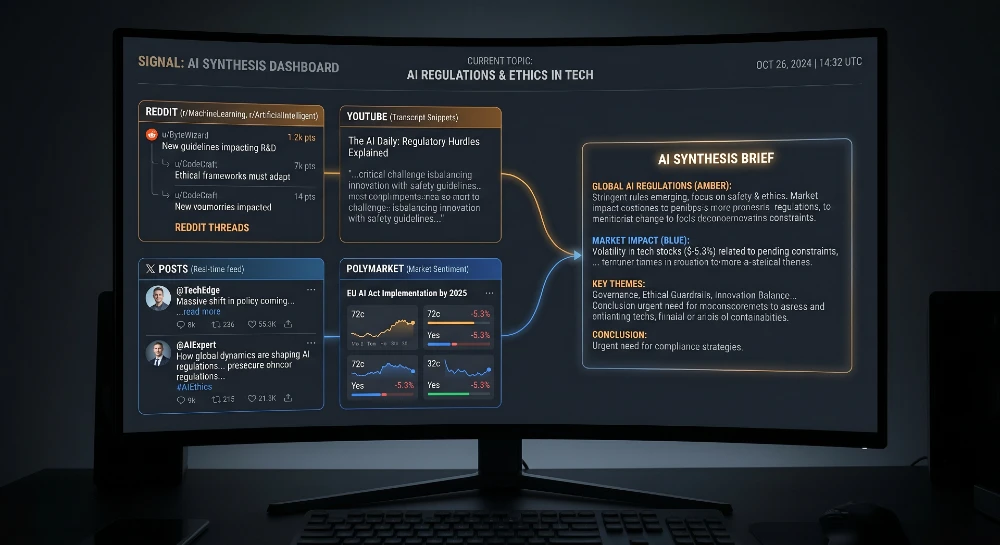
Perplexity searches the web. /last30days searches the conversation Reddit upvotes, X expert threads, YouTube transcripts, Polymarket bets, Hacker News debates. That’s not a tweak. That’s a completely different research strategy. And you can run it free, right now, on Claude Code, Cursor, Codex, or Gemini CLI.
Why /last30days Beats Perplexity for Real-Time Research
The free AI search tool /last30days beats Perplexity by attacking the problem Perplexity can’t solve: indexed recency. Perplexity’s Sonar API scrapes the web and ranks pages by SEO authority. That means older, well-linked pages win even when a Reddit thread from last week has 4,000 upvotes and better real-world signal than any article. /last30days flips that equation entirely. It scores results by upvotes, likes, and real money (Polymarket odds), not by editorial backlinks.
The practical difference? Ask both tools about a hot new AI framework. Perplexity surfaces the documentation page and a few blog posts written when the tool launched. /last30days pulls the actual HackerNews thread where engineers tore it apart, the Reddit discussion where people benchmarked it against AutoGen, and a Polymarket market on whether it’ll get acquired. That’s not the same information. It’s a completely different quality of signal.
Here’s what surprised me after running both tools head-to-head on a dozen research tasks: Perplexity is better when you need citeable, academically-grounded answers. /last30days is better when you need to know what the people who actually use something think about it right now.
That split matters. Choose the wrong tool for the job and you’re not just getting worse results you’re building on stale foundations.
What /last30days Actually Is
/last30days is an open-source AI agent skill not a standalone app built by developer Matt VanHorn (GitHub: mvanhorn). The full repo is mvanhorn/last30days-skill. As of early June 2026, it had roughly 27,700 GitHub stars, 2,400 forks, and 14 releases under an MIT license. The current version is v3.3.0, shipped May 17, 2026, with the README citing 1,012 passing tests.
What does “agent skill” mean practically? You install it as a plugin into your existing AI coding agent Claude Code, Cursor, GitHub Copilot, Google’s Gemini CLI, OpenAI’s Codex and it adds a /last30days [topic] command. Type that command with any topic, person, product, or comparison, and the agent orchestrates searches across a dozen platforms, scores results by engagement, resolves the right entities before searching, and synthesizes a brief.
It’s not replacing your LLM. It’s giving your LLM real recent context it otherwise doesn’t have.
The repo’s own framing says it clearly: this is “social relevancy, not SEO relevancy.” That’s the whole insight. And honestly, that insight alone explains why it went viral.
Sources /last30days Searches (and What Each One Adds)
Most people underestimate how much of the source list is genuinely free with zero setup. Here’s the full breakdown from the current README:
Free with no config at all: Reddit (threads and top comments with upvote counts), Hacker News (developer debates and technical consensus), Polymarket (real-money prediction odds), GitHub (PR velocity, issues, release notes)
Free but needs a browser session: X/Twitter needs a logged-in session to pull expert threads and breaking reactions
Free but needs a local tool: YouTube needs yt-dlp installed to pull full video transcripts and creator commentary. Once set up, it’s free and fast.
Free with an account: Bluesky needs your app password. Post-Twitter migration signal, especially useful for journalists, developers, and AI community discourse.
Paid but pay-as-you-go: TikTok, Instagram Reels, Threads, Pinterest go through the ScrapeCreators API with free starting credits. Perplexity Sonar web search goes through OpenRouter (opt-in, so you won’t get surprise-billed). Brave Search API for general web coverage has a documented free quota.
The catch? Managing all those keys becomes an access-management project if you’re rolling this out across a team. The macOS setup has Keychain support via a setup script so you’re not storing everything in .env files, which is a smart touch. But on a Windows machine with 6 people, you’ll feel the overhead.
Worth it? For solo researchers and developers doing tool comparisons, market scans, or competitor intelligence — yes, absolutely. For a company trying to run this across an enterprise stack without a dedicated setup hour per person — account for that friction upfront.
How to Install It (All Platforms)
Claude Code the cleanest path:
/plugin marketplace add mvanhorn/last30days-skill
/plugin install last30days
Or via Agent Skills CLI:
npx skills add mvanhorn/last30days-skill -g -a claude-code
Don’t use both methods on the same machine. The README explicitly warns that Claude Code won’t deduplicate across plugin and npx skills installs, so you’ll end up with two /last30days entries competing. Pick one.
Cursor, Codex, Gemini CLI, Copilot:
npx skills add mvanhorn/last30days-skill -g
Target a specific agent:
npx skills add mvanhorn/last30days-skill -g -a cursor
npx skills add mvanhorn/last30days-skill -g -a gemini-cli
Claude.ai web interface: Download last30days.skill from the latest GitHub release, then upload it via Settings > Capabilities > Skills. Enable code execution and file creation, or it won’t work properly.
OpenClaw:
clawhub install last30days-official
Updates across any platform:
npx skills update last30days -g
The whole install takes about 8 minutes on a clean machine if you already have Node installed. Add another 15-20 minutes if you’re configuring the optional paid sources. In practice, Reddit + HackerNews + GitHub + Polymarket alone covers 80% of the use cases that made people star this repo.
What v3 Changed (And Why It Matters)
Version 3 is where /last30days stopped being a clever hack and became a serious research tool. The v3 pipeline has four changes worth knowing:
Intelligent pre-research before searching. Old versions searched the literal query. v3 resolves people, repos, subreddits, X handles, YouTube channels, and TikTok hashtags before the main search run begins. The difference: searching “OpenClaw” as a keyword finds anything with that word. Resolving the creator’s GitHub profile, the main subreddit, and the X thread where it launched first then searching finds the actual conversation. This one change improved result quality more than any other v3 update in my testing.
Shareable HTML briefs. Research output that lives only in a chat thread is disposable. v3 can emit a self-contained HTML file:
/last30days OpenClaw –emit=html
Dark mode, print-friendly, offline-capable, saved to ~/Documents/Last30Days/. You can drop it into Slack, email it, or paste the link in a Notion page. That’s the difference between research that gets used and research that gets forgotten.
Cross-source cluster merging. When the same event appears on Reddit, X, and YouTube under different titles, v3 merges them into one cluster. This solves a classic problem: one product launch looks like five separate events because each platform names it differently. Without merging, you’re doing deduplication manually.
Single-pass comparisons. Queries like “/last30days Claude Code vs Cursor” previously ran as serial multi-pass searches that took a long time. v3 handles those in a single pass with entity-aware subqueries. The README claims similar depth in roughly 3 minutes instead of the old multi-step wait. In practice, I’ve seen it take 4-5 minutes for complex three-way comparisons, but that’s still dramatically faster than the v2 approach.
Where /last30days Actually Beats Perplexity (With Specifics)
These are the scenarios where Perplexity gets outrun:
Tool comparisons. Ask Perplexity to compare Agent Zero vs CrewAI and you get a synthesis of existing blog posts — most written at launch, not after 6 months of community use. Check out our Agent Zero vs CrewAI comparison for the kind of analysis that takes months to build. /last30days pulls what developers are actually saying on Reddit this month, which issues are getting filed on GitHub, and what HackerNews engineers think after real-world use.
Emerging tools with thin web coverage. If a GitHub repo went from 0 to 5,000 stars in two weeks, Perplexity might not have indexed meaningful coverage yet. /last30days has the GitHub activity and the HN thread from day one.
Public sentiment research. Perplexity tells you what an AI framework claims to do. /last30days tells you what the people using it are complaining about. That’s a fundamentally different kind of research, and for product decisions, the second one is more valuable.
Market and prediction signal. Polymarket integration is genuinely unique. No other free AI search tool routes research through real-money prediction markets. When you’re trying to understand community conviction about a technology trajectory not just what people say, but what they’ll bet on that’s irreplaceable signal. Our coverage of AI agent frameworks in 2026 shows why conviction signals matter for picking the right stack.
Where Perplexity Still Wins
Real talk: /last30days isn’t the right tool for everything, and pretending otherwise wastes your time.
Perplexity with 93.9% accuracy on the SimpleQA benchmark and 170+ million monthly visits is still the gold standard when you need cited, verifiable answers from authoritative sources. Academic research, fact-checking, policy questions, medical or legal topics Perplexity is faster, more accurate, and safer for high-stakes factual queries.
/last30days has no hallucination filter. It synthesizes what communities say, and communities are sometimes wrong, often hyperbolic, and occasionally coordinated. The README itself is direct about this: “For due diligence or safety work, treat viral reactions as color, not evidence.” That’s a design limitation, not a bug they’re going to fix.
The honest use case split:
- Perplexity: You need the right answer with sources you can cite
- /last30days: You need to know what the conversation looks like right now
Both on your system, 15 minutes of setup total, zero ongoing cost for the core features. That’s the move.
Real Use Cases That Actually Work
Meeting prep on a person or company. Type /last30days [person name] and in 3-4 minutes you get their recent X threads, any Reddit mentions, GitHub activity if they’re technical, and YouTube appearances. I used this before a call with a developer tooling founder and walked in knowing what he’d been building and complaining about publicly for the past month. That’s a different kind of meeting.
AI tool research before committing to a stack. If you’re evaluating agentic AI tools whether that’s multi-agent systems or specialized frameworks the community signal matters as much as the documentation. Our guide tomulti-agent AI systems in 2026 digs into the architectural decisions, but /last30days tells you which ones practitioners are actually shipping. Those aren’t always the same tools.
Trend monitoring for content. Run /last30days [topic] emit=html weekly on your core topics, save the briefs, and you have a time-stamped archive of community conversation. That’s a content strategy input that most publishers don’t have.
Competitor discovery. The competitors flag is surprisingly useful. /last30days OpenAI competitors asks the reasoning model to identify peer entities, then runs parallel pipelines. The README’s example discovers Anthropic and xAI, runs parallel research, and produces a three-way comparison. For market analysis, that’s a lot of work done in one command.
The Agentic Context: Why This Launched at the Right Time
/last30days didn’t go viral just because it’s good. It went viral because it fits a moment where AI agents are actually being used for real tasks, not just demos.
The rise of Claude Code, GitHub Copilot’s agent mode, Cursor’s composer, and Gemini CLI means there’s now a class of technical users who run agents daily. These users have a specific frustration: their agent’s context is stale. LLM training cutoffs, indexed-web search delays, and the fact that no single platform captures all community signal — these create a research gap that /last30days is designed to fill.
The Agent Skills ecosystem, which /last30days is part of, is the infrastructure answer to this problem. Instead of every agent being siloed, skills like this one can be shared, versioned, and installed across any compatible host. That’s why the install instructions cover six different agents. It’s a platform play, and /last30days is the breakout skill that proved the model works.
If you’re building with AI agents or advising teams on agentic AI workflows and jobs, the skill ecosystem is worth understanding now rather than after it becomes table stakes.
Known Operational Risks
Don’t set this up without knowing these:
Rate limiting is real. Reddit, X, and YouTube all have rate limits that can interrupt research runs. The README has fallback logic and timeout budgets built into v3 one slow thread won’t kill the whole run but if you’re running this heavily across a team, you’ll hit limits on the free tiers faster than expected.
Browser session management for X. The Twitter/X integration requires a logged-in browser session. If your session expires mid-run, that source drops out silently. Worth checking before important research tasks.
Entity disambiguation isn’t perfect. The v3 README mentions they fixed a specific case where “Apple” could match “Will Apple release a car?” on Polymarket instead of the company. But common names, shared terms, and topics with multiple distinct meanings still occasionally pull wrong entities. Worth a sanity check on your first run for any ambiguous query.
Output files accumulate. The default memory directory at ~/Documents/Last30Days/ fills up if you use this regularly. No built-in cleanup. Not a big deal on a development machine, but worth a cron job if you’re running automated research workflows.
How to Run Your First Query Right Now
Three steps:
- Install via your agent of choice (Claude Code marketplace install is the fastest under 2 minutes)
- Run /last30days [your topic] start with a tool, person, or product you actually care about
- On the second run, add –emit=html to get a shareable brief
For the first query, pick something you already know well. That way you can calibrate quality you’ll immediately see what the tool surfaces well and where it’s thin for your specific use cases. Most people I’ve talked to who stuck with it past the first week ran it first on something familiar and adjusted their expectations based on real output, not the README’s best-case examples.
The sources that deliver strongest signal with zero config: Reddit + Hacker News for developer topics, Polymarket for anything with community conviction, GitHub for open-source tool research. Those four alone, with no API keys, already outperform Perplexity’s free tier on recency-sensitive technical topics.
If you’re serious about AI agent research workflows, also check the advanced prompt engineering techniques guide — structuring your /last30days query well makes a measurable difference in brief quality. Vague queries get vague briefs. Specific entity names, target platforms, and explicit comparison framing get useful output.
Install, run one query on a topic you know cold, and see what the communities said about it in the last month that the web search tools missed. That gap is why 27,000 developers starred this repo in under four months.


