
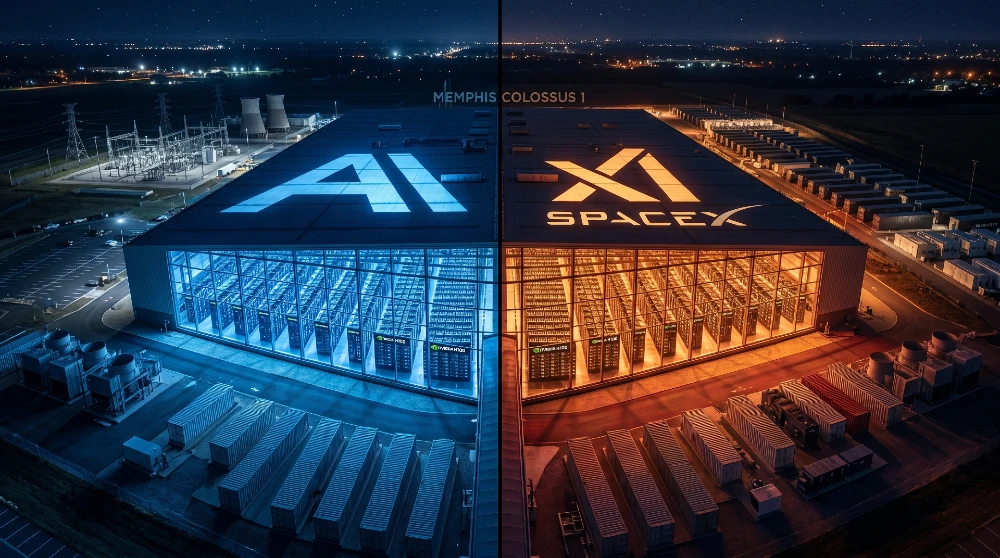
xAI sold Colossus 1 compute to Anthropic not because Elon Musk suddenly likes his rivals, but because the supercomputer was sitting at 11% utilization while burning money. Anthropic was compute-starved and needed 220,000 GPUs fast. What looks like a truce is actually a window into how the real AI race works in 2026: not model quality, not research papers raw GPU access.
Here’s the full story.
- xAI leased all of Colossus 1 to Anthropic on May 6, 2026 220,000+ Nvidia GPUs, 300 megawatts of power — for $1.25 billion per month through May 2029.
- Best for understanding: anyone tracking AI infrastructure, Claude’s capacity expansion, or SpaceX’s pre-IPO financial strategy — not useful if you’re looking for a model comparison between Grok and Claude.
- The key insight: xAI couldn’t efficiently train Grok on Colossus 1’s mixed GPU architecture (H100/H200/GB200), moved to Colossus 2, and then monetized the orphaned cluster instead of letting it idle.
- Biggest mistake people make: assuming this is a sign xAI and Anthropic are “partnering” ideologically — it’s a landlord-tenant deal with a 90-day cancellation clause on both sides.
- If Anthropic’s compute needs shrink or a better deal appears, this contract disappears in three months — which is the real risk nobody’s talking about.
What Actually Happened on May 6, 2026
On May 6, 2026, xAI signed a deal giving Anthropic exclusive access to all of Colossus 1: more than 220,000 Nvidia GPUs, 300 megawatts of power — the entire Memphis supercomputer that was built as xAI’s answer to OpenAI.
Anthropic will pay xAI $1.25 billion per month through May 2029, with a discounted rate for the first two months while xAI completes its infrastructure ramp-up. The full deal could bring xAI over $40 billion in total revenue. Details surfaced through SpaceX’s S-1 filing with the SEC.
So the first question is obvious: why would xAI, a company that built Colossus 1 specifically to train Grok and beat OpenAI, hand the keys to a rival?
The answer isn’t ideology. It’s architecture.
According to an internal xAI memo, Colossus 1 was running at roughly 11% Model FLOPs Utilization. Industry production-grade is 35-45%. The mixed H100/H200/GB200 architecture couldn’t efficiently parallelize Grok training, which forced xAI to shift its training workloads to Colossus 2.
That’s the real story. xAI didn’t sell out of goodwill. They had an expensive supercomputer doing almost nothing, and Anthropic needed exactly that kind of scale. The deal wrote itself.
Why Anthropic Was Desperate for This Deal
Anthropic had been capacity-constrained for months. The announcement focused on what it meant for Claude users: rate limits lifted for paid subscribers, more headroom for Claude Code and API workloads.
Officially, the deal immediately translated into higher limits across Claude products. Claude Code’s 5-hour rate limits were doubled for Pro, Max, Team, and Enterprise subscriptions. Peak-hours limit reductions were removed for Pro and Max plans. Opus API rate limits were substantially increased.
That last one matters more than most people realize. If you’ve been using Grok’s free image and video tools and wondering why Claude’s rate limits felt comparatively tight, this deal is the direct answer. Anthropic was training one of the world’s most capable AI models on infrastructure that simply couldn’t keep up with demand.
The part that trips people up: they assume cloud providers like AWS or Google Cloud could have filled the gap. They couldn’t, at least not at this speed. The deal gives Anthropic access to more than 300MW of capacity across more than 220,000 Nvidia GPUs within the month a timeline that cloud marketplaces simply can’t match for purpose-built supercomputer-grade clusters.
Speed of access was the deciding factor, not price.
The Colossus 1 Architecture Problem Nobody Explained
Here’s what I haven’t seen anyone break down clearly enough.
Colossus 1 was initially designed and operated by xAI before its acquisition by SpaceX in the February 2026 stock merger. The cluster spans Nvidia H100, H200, and GB200 processors three different GPU generations with different memory bandwidth, interconnects, and FLOP profiles.
Mixed-generation GPU clusters are a nightmare for large model training. The bottleneck is always the slowest node in a distributed training run. When you’re doing synchronous gradient updates across 220,000 GPUs, having H100s (80GB HBM2e) in the same fabric as GB200s (192GB HBM3e) creates throughput mismatch that tanks your utilization. xAI engineers apparently couldn’t get it above 11%.
Colossus 2, built after Colossus 1, runs on a much cleaner Blackwell architecture. Musk insists Grok is not dead and points to Colossus 2 — a newer data center built on Blackwell GPUs where multiple new Grok models are being trained simultaneously.
So xAI didn’t abandon AI training. They abandoned this specific cluster. And rather than spend another year trying to optimize a mixed-gen mess, they monetized it.
Anthropic, meanwhile, can handle heterogeneous compute better because their inference workloads (running Claude for users) are less sensitive to mixed GPU bottlenecks than training runs. Training needs all-or-nothing synchronization. Inference is embarrassingly parallel you can split it across whatever GPUs you have.
Smart trade. Both sides got what they needed.
The Elon Musk Flip That Surprised Everyone
Two months before this deal, Musk was publicly calling Anthropic “evil” and “Misanthropic.” That’s not editorializing — he said it on X.
Musk tweeted: “I spent a lot of time last week with senior members of the Anthropic team to understand what they do to ensure Claude is good for humanity and was impressed. After that, I was ok leasing Colossus 1 to Anthropic, as SpaceXAI had already moved training to Colossus 2. Just as SpaceX launches hundreds of satellites for competitors with fair terms and pricing, we will provide compute to AI companies that are taking the right steps to ensure it is good for humanity. We reserve the right to reclaim the compute if their AI engages in actions that harm humanity.”
That last sentence deserves a pause. Musk is saying he can pull 220,000 GPUs from Anthropic with 90 days’ notice if Claude does something he considers harmful. From a supply chain risk standpoint, that’s a significant exposure for Anthropic. Your primary compute provider has a personal veto on your AI’s behavior defined entirely by him.
Musk acknowledged a wider strategic pivot in May 2026: “xAI will no longer exist as a separate company. It will just be SpaceXAI, the AI product of SpaceX.” This rebranding follows SpaceX’s acquisition of xAI in February, a deal that valued the combined entity at roughly $1.25 trillion.
Whether you read this as pragmatism or retreat depends on your priors. But the dissolution of xAI as an independent entity — and the pivot toward neocloud revenue — is a real strategic shift.
xAI’s Real Motivation: The SpaceX IPO Play
TechCrunch described the deal as “a major heat check before the IPO.” Becoming a neocloud might be “a more believable business in the near term,” but analysts noted it’s less likely to excite outside investors looking for frontier AI innovation.
This framing is basically right. SpaceX is preparing to go public, and a $40+ billion revenue contract looks excellent in an S-1. It transforms xAI from a money-losing AI lab into a data center landlord with predictable recurring revenue — which is exactly the story you want to tell public markets.
The SpaceX IPO filing shows that xAI lost $2.4 billion and that SpaceX expects to enter into additional compute-leasing agreements with third parties. Translation: they’re building a neocloud business, not just doing Anthropic a favor.
SpaceX has already locked Google into a $920 million per month compute deal in June 2026, following the Anthropic arrangement. The company appears to be aggressively converting Colossus 1’s stranded compute into cloud revenue from multiple AI labs.
Google at $920M/month. Anthropic at $1.25B/month. That’s $2.17 billion in monthly GPU rental from two clients alone. Before you add Cursor and whoever comes next.
This isn’t a one-off deal. It’s a business model.
What This Means for the GPU War in 2026
Real talk: the “GPU war” isn’t really about who builds the best AI model anymore. It’s about who controls the physical infrastructure underneath those models.
OpenAI has a 30GW compute roadmap backed by Microsoft’s infrastructure deals. Google has its own TPUs plus now a Colossus rental. Anthropic, which had no major hardware partnership until this deal, just went from capacity-constrained to running the second-largest dedicated supercomputer cluster in AI.
The competitive math is brutal. You can have the best researchers, the best training techniques, the most creative architecture and still lose if the other lab can run 10x more experiments per week because they have the compute. This is why Grok’s agent mode and Runway’s video generation capabilities have been closing the gap on Claude: consistent access to training compute, not just better math.
For Anthropic, this deal is existential. Claude Code has been eating into developer workflows precisely because Claude 3.x and 4.x series models are strong at reasoning — but without enough inference capacity, rate limits kill adoption. The agent mode workflows that users demand require reliable compute access, not occasional burst capacity.
The 220,000 GPUs change that equation directly.
The Environmental Problem Nobody Wants to Talk About
Colossus 1 has a particularly bad environmental record. The gas turbines installed to power the facility initially ran without Clean Air Act permits or pollution control devices, which the company got away with by classifying them as “temporary.” Credible reports link it to increases in hospital admissions related to low air quality.
Anthropic has a detailed Constitutional AI framework and positions itself as the “safety-focused” AI lab. Taking over compute from a facility that’s been sued by civil rights groups for environmental violations in a majority-Black neighborhood is a PR contradiction the company hasn’t resolved cleanly.
The honest truth: Anthropic needed the compute badly enough that the environmental and political risks were worth it. That’s a defensible pragmatic decision. But pretending it’s not a contradiction isn’t.
If you’re using Claude and care about this, it’s worth knowing. The marketing ROI calculations you’re running through Claude or thecharacter-driven video workflows you’re building they’re now running on Memphis natural gas turbines with a contested environmental permit history.
The 90-Day Termination Clause: The Risk Everyone’s Underpricing
Either party can cancel the partnership with 90 days’ notice. So things could go badly for xAI’s revenue stream if Anthropic decided it didn’t need the compute.
That risk cuts both ways. Musk has the ability to pull this compute for undefined “harm to humanity” reasons. Anthropic can leave if they secure better infrastructure elsewhere. Neither side is fully locked in.
For Anthropic users, this is worth monitoring. If the deal collapses say, Claude does something that triggers Musk’s harm threshold, or Anthropic builds out its own facilities faster than expected the rate limits could tighten back up quickly.
For xAI, the revenue is real but fragile. $40 billion over three years sounds transformative until you realize $1.25 billion of it evaporates the moment Anthropic walks. That’s why the Google deal and the Cursor deal matter: SpaceX is diversifying its neocloud tenant base to reduce concentration risk.
The hallucination and looping issues that plague AI agents in production aren’t going away just because compute availability expands but the rate limit pressure that forces users off Claude onto alternatives? That specifically gets better with this deal.
Who Wins, Who Loses, and What Changes
Anthropic wins short-term. More compute, better rate limits, Claude Code doubled throughput, less churn to competitors. The deal buys them 12-24 months of competitive parity on infrastructure.
xAI wins on paper. $40+ billion in contracted revenue is a compelling IPO story. But as TechCrunch noted, “renting out GPUs” isn’t the narrative a frontier AI company wants attached to it long-term.
Google and Microsoft watch carefully. Google has already entered a $920 million per month compute deal with SpaceX following the Anthropic arrangement, which tells you the hyperscalers see neocloud rental as cheaper or faster than building equivalent clusters themselves in the short term.
Nvidia wins either way. Whether clusters are used by xAI, Anthropic, or Google, the H100s and GB200s are getting burned. The GPU manufacturer doesn’t care who pays for the electricity.
The real losers are the companies and researchers who assumed raw model quality would determine the AI race. It won’t. The companies that secure compute at scale and lock it down before rivals can are the ones that will dominate 2026-2028. Model architecture matters less than whether you can train the next version before your competitor does.
If you’re a Claude user on a paid plan: your rate limits are better now. Test Claude Code’s updated 5-hour throughput window — it’s doubled for Pro, Max, Team, and Enterprise. The peak-hour caps are gone for Pro and Max. Actually use it.
If you’re building on the Anthropic API: Opus rate limits increased substantially. If you’ve been throttling back to Sonnet because Opus was too restricted, that calculation has changed. Re-benchmark your pipeline.
If you’re tracking the AI infrastructure race: watch whether SpaceX announces more neocloud tenants over Q3 2026. Every new customer confirms the business model. The moment xAI starts winning on Colossus 2’s Blackwell cluster — and Grok shows real benchmark gains the neocloud narrative gets tested against a resurgent model story.
And if you’re building AI video or agent workflows that depend on reliable Claude access: the capacity crunch that was forcing workarounds is largely over. Build like the compute is there, because for now, it is.


