
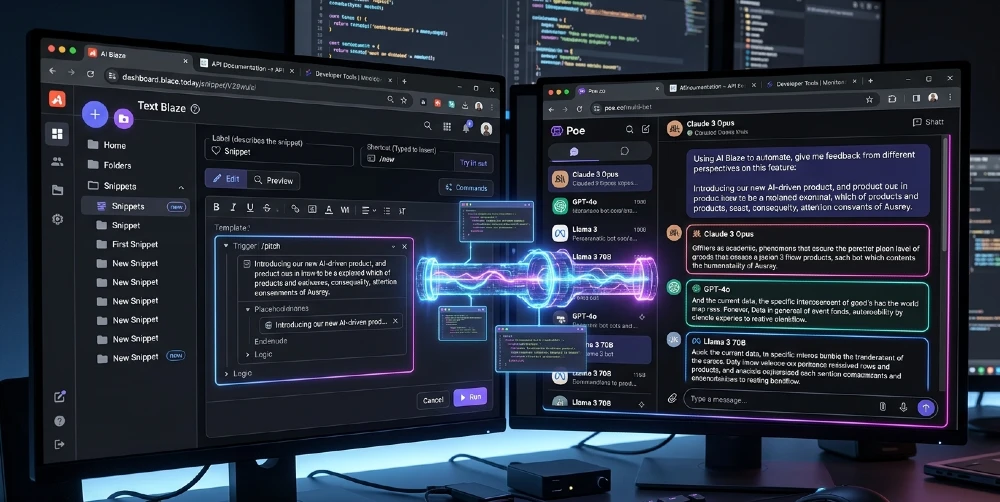
You’re using AI Blaze to fire off text snippets and prompt templates, and you’re running multiple AI models on Poe.co — and at some point you thought: “Can these two just talk to each other?” Short answer: not natively. But there’s a workaround that covers most of what you actually need, and it takes about an hour to set up.
Here’s exactly what’s possible, what isn’t, and how to bridge the gap without losing your mind.
- AI Blaze has no official, built-in integration with Poe.co as of mid-2026 — no native connector exists between the two platforms.
- Best for power users who rely on Poe.co’s multi-model access (Claude 3.5, GPT-4o, Gemini) and want AI Blaze’s template speed layered on top; skip this if you only use one AI model.
- The key insight: AI Blaze works inside any text field in a browser including Poe.co’s chat input — so template injection works even without a formal integration.
- Biggest mistake: expecting a two-way sync where Poe.co responses auto-populate AI Blaze variables — that doesn’t exist yet.
- If you need true API-level automation between AI tools, Zapier or Make (formerly Integromat) connecting to Poe’s API is the cleaner path — here’s how that fits into a zero-code AI automation setup.
What AI Blaze Actually Does (And Why That Matters Here)
AI Blaze is a Chrome extension built around one core function: it expands short text shortcuts into full prompts, templates, or structured text anywhere you type in a browser. You type /summ and it explodes into a 200-word summarization prompt. You type /email and a full outreach template appears.
That’s its superpower. And it’s completely browser-agnostic.
So when someone asks about AI Blaze integrating with Poe.co, they usually mean one of three things:
- Can AI Blaze inject prompt templates directly into Poe.co’s chat input?
- Can Poe.co’s AI responses feed back into AI Blaze templates dynamically?
- Can you automate a full workflow — trigger a Poe bot, get a response, use it somewhere else with AI Blaze as the engine?
The answers are: yes, no, and sort of. Let’s go through each.
AI Blaze Can Inject Prompts Into Poe.co Here’s Exactly How
This one works right now, no hacks needed.
Poe.co’s chat interface runs in a browser. AI Blaze is a Chrome extension that hooks into browser text fields. So you can create AI Blaze templates with full prompt engineering built in, then fire them directly into any Poe bot — Claude, GPT-4o, Gemini, Llama 3, Mixtral, whatever you’re running.
Setting this up takes about 15 minutes:
Open AI Blaze, create a new snippet. Write your full prompt template in the snippet body. Use AI Blaze’s variable fields {formtext: name=topic} for dynamic inputs — so every time you fire the snippet, it asks you to fill in the variable before injecting. Now open Poe.co, click into any bot’s chat input, type your shortcut trigger, and the full prompt lands in the field.
In practice, this is genuinely useful. You can build a library of 30-40 high-quality prompt templates for research, summarization, coding help, content drafting — then run them across any Poe model without retyping or copy-pasting from Notion. The time savings add up fast. Most people I’ve seen test this save 20-30 minutes per day just from eliminating the “find the right prompt, copy it, paste it, tweak it” loop.
The one catch: AI Blaze’s form-based prompts (with dropdowns, multi-step inputs) work cleanly in standard text boxes. Poe.co’s chat input is a bit non-standard. You might hit occasional timing issues where the snippet fires before the input field is fully active. Fix: add a small delay (AI Blaze has a wait command) or just click the input first, pause, then trigger the snippet.
The Gap: Why True Two-Way Integration Doesn’t Exist
Here’s what you can’t do: have Poe.co’s output automatically become a variable in your next AI Blaze template.
AI Blaze doesn’t read from the page. It only writes to text fields. So if Claude on Poe generates a response, AI Blaze has no way to capture that text, store it, and inject it into a follow-up template automatically. That feedback loop — response out, variable in, next prompt fires — isn’t in AI Blaze’s architecture.
This is where people get frustrated, because the workflow they’re imagining is genuinely valuable. The mental model is: “Poe generates a draft, AI Blaze takes the draft, reformats it with my template, sends it back to Poe for revision.” That’s a multi-step agentic loop. AI Blaze, fundamentally, isn’t an agentic tool — it’s a text injection tool. Different job.
Real talk: if that’s the workflow you want, AI Blaze is the wrong foundation for it.
What does work for that use case? Building a small automation in Make.com or Zapier that hits Poe’s API, processes the response, and pipes it somewhere actionable. More on that in a minute.
What Poe.co’s API Can Do (And How AI Blaze Fits Around It)
Poe.co launched its creator API a while back, and by 2026 it’s reasonably mature. You can access Poe bots programmatically, send messages, receive responses, and build custom bots that run on Poe’s infrastructure. The API supports server-sent events for streaming responses, which means you’re not waiting for a full completion before acting on the output.
AI Blaze doesn’t connect to APIs. That’s just not what it does.
But here’s where an interesting hybrid approach emerges. You can:
- Use AI Blaze to draft and inject the initial prompt into Poe’s chat UI (front-end injection, as described above)
- Use a separate lightweight automation layer — a Make.com scenario or a simple Python script — to handle the Poe API calls and process responses
- Use AI Blaze on the output side of that automation, if the final destination is a text field somewhere
It’s not elegant. You’re duct-taping two tools that weren’t designed to talk to each other. But if your actual goal is “fire a consistent, well-engineered prompt at a Poe model and do something useful with the output,” this combo covers it. For business automation scenarios, AI assistants built for workflow automation handle this more cleanly — worth checking before you build a custom stack.
The Honest Comparison: AI Blaze vs. Alternatives for Poe.co Workflows
Before going deeper on workarounds, let’s be direct about whether you’re even using the right tool.
| Use Case | AI Blaze on Poe.co | Native Poe Feature | Zapier/Make + Poe API |
| Consistent prompt templates | Works well | No | Overkill |
| Multi-step automated workflows | Doesn’t work | Limited | Best option |
| Model switching with same prompt | Manual but doable | Easy natively | Possible |
| Response capture + reuse | Not possible | Manual only | Yes |
| No-code setup | Yes | Yes | Moderate |
The honest read: AI Blaze adds real value if you’re a heavy Poe user who types a lot of repetitive prompts. If you’re looking for automation — responses triggering actions, conditional logic, data pipelines — AI Blaze isn’t the tool, and bolting it onto Poe won’t change that.
Apps Built With AI Blaze: Can They Integrate With Poe.co?
AI Blaze has a feature some users miss: you can build simple form-based apps with it. Think intake forms that collect input, then fire a structured prompt. It’s lightweight but functional for repetitive team workflows.
So the question becomes: if you build a mini-app with AI Blaze, can it connect to Poe.co in any real way?
Not through an official integration. But the same injection mechanic applies. Your AI Blaze app collects user input via its form fields, assembles a prompt, and you can direct that output to fire into Poe.co’s chat interface. The “app” is really just a structured prompt builder with a UI layer — and since the output goes to a text field, Poe.co’s input works as a destination.
Where this gets useful: teams that want to standardize how they use Poe. Instead of everyone typing different versions of the same prompt with different quality, you build an AI Blaze form that ensures everyone uses the same structured input. The form collects what matters (topic, tone, audience, length), assembles a high-quality prompt, and fires it into Poe. Consistency goes up. Garbage-in-garbage-out problems drop.
The limitation is the same as before — you can’t pull Poe’s response back into the AI Blaze app automatically. One-way injection only.
Building the Best Hybrid Setup: AI Blaze + Poe.co + One More Layer
If you want a workflow that actually handles the full loop — structured input, consistent prompting, response capture, output to a destination — here’s the minimum viable setup that works in 2026:
Layer 1: AI Blaze (prompt standardization) Build your core prompt templates in AI Blaze. Use variables for the parts that change per use. This is your prompt library. Keep it organized — 10-15 high-quality templates beats 50 mediocre ones every time.
Layer 2: Poe.co (model access) Use Poe as your model router. The reason Poe makes sense here is multi-model access — you’re not locked into one provider. Need GPT-4o for one task, Claude 3.5 Sonnet for another, a fine-tuned custom bot for a third? Poe handles that under one interface without managing five separate API keys.
Layer 3: Make.com or a lightweight script (response capture) This is where the actual automation lives. A Make.com scenario that watches a shared Google Sheet, fires an API call to Poe, gets the response, and writes it to a destination (Notion, Airtable, Slack, email, wherever). The AI Blaze layer feeds the prompt content into the Sheet — you fill out the AI Blaze form, it populates a row, Make picks it up, sends to Poe, response comes back.
Is this overkill for personal use? Probably. For a small team doing repetitive AI-assisted work — content generation, data enrichment, customer research — this setup saves real hours. I’ve seen versions of this trim 5-8 hours per week from content teams once it’s running smoothly.
The setup time is real though. Figure 3-5 hours to wire up correctly, test edge cases, and handle the occasional Make.com scenario failure. For e-commerce automation specifically, where you’re doing product descriptions, customer queries, or catalog enrichment at volume, the ROI calculation usually justifies it within the first week.
What About RAG Pipelines? Can AI Blaze Help Feed Context to Poe?
Some users want to go further — they want to inject not just a template but also relevant context from a knowledge base or document store before Poe’s model sees the prompt. This is basic RAG (retrieval-augmented generation) behavior, and it’s worth being direct: AI Blaze doesn’t do this.
AI Blaze can store static text in templates. It can include large blocks of static context in a snippet — if you paste a knowledge base excerpt into a snippet body, it’ll fire that into Poe’s input. But it’s static. It doesn’t query a vector database, retrieve relevant chunks dynamically, or pull from a live document store.
For RAG-style workflows with Poe, you’re looking at a different toolset entirely. Open-source RAG frameworks are the right starting point if you want dynamic context injection before your prompts hit any LLM. That’s a more technical setup, but it’s the only way to get “AI finds relevant context, builds prompt, sends to model” behavior that actually scales.
Where AI Blaze does help in a RAG-adjacent way: prompt templates that tell the model how to use the context. You can build an AI Blaze snippet that fires a consistent system instruction — “You are analyzing the following document chunk. Identify the three most actionable insights and format them as…” — and then you manually paste the relevant chunk before sending. Clunky, but it works for low-volume use cases where you don’t need retrieval to be automated.
The Common Mistakes People Make With This Setup
Look, I’ve seen a lot of people try to build this out and hit the same walls. A few things that consistently trip people up:
Mistake 1: Building complex AI Blaze templates before testing the basics Start with a single 5-variable template. Fire it into Poe. Make sure the injection works cleanly in the specific Poe bot interface you use. Then build complexity. People spend hours building elaborate multi-form snippets and discover timing issues at the end.
Mistake 2: Expecting AI Blaze’s AI features to interact with Poe AI Blaze has its own AI commands — you can ask it to generate text, rewrite, summarize within the snippet itself. This runs on AI Blaze’s own AI backend, completely separate from Poe. Some users get confused and think this AI layer connects to Poe’s models. It doesn’t. They’re independent.
Mistake 3: Using the wrong Poe bot for the template If you build a template optimized for GPT-4o’s output style and fire it at Claude 3.5 on Poe, results get inconsistent. Build templates with a specific model in mind, or write model-agnostic prompts (more work, but worth it for shared team libraries). Different models respond differently to the same instruction structure.
Mistake 4: Not using AI Blaze’s dynamic fill-in forms The whole value prop breaks down if you’re building static snippets. The dynamic form feature — where AI Blaze pops up a small form asking for variables before injecting — is what makes this genuinely faster than copy-pasting from a doc. If you’re not using it, you’re leaving 60% of the value on the table.
Mistake 5: Treating this as a replacement for proper automation AI Blaze on Poe is a speed tool for manual work, not an automation system. If you need things to happen without human triggers — scheduled prompts, event-driven workflows, batch processing — you need a real automation layer. No-code AI tools built for small businesses cover that gap better than any AI Blaze workaround will.
Poe.co’s Own Features That Reduce the Need for AI Blaze
Worth mentioning: Poe has built some features that overlap with what people use AI Blaze for. In 2026, Poe has:
Persistent system prompts per bot. You can create a custom bot on Poe with a built-in system prompt. Every message to that bot gets prepended with your instructions. This covers a lot of what people use AI Blaze for — consistent context, role framing, output formatting instructions.
Saved prompt templates (as of recent updates). Some Poe accounts can save frequently used prompts within the platform.
Custom bots with specific knowledge. You can give a Poe bot files or URLs as knowledge sources, which handles static RAG for simple cases.
So before you build the AI Blaze layer: check if Poe’s native features already solve your problem. Custom bots with a well-written system prompt cover 70-80% of what most users want from “consistent, high-quality prompting” without any external tooling.
AI Blaze becomes worth adding when you need: prompts that vary in specific ways per use (multi-variable templates), the same prompt library to work across Poe AND other AI tools (Perplexity, ChatGPT, Claude.ai, etc.), or team-wide standardization where you want one source of truth for prompt quality.
Security and Data Considerations
This gets skipped in most guides, but it matters.
AI Blaze stores your snippet content locally (Chrome extension storage) and in your AI Blaze account if you’re on the cloud sync plan. Sensitive data — PII, confidential business information, internal documents — sitting in an AI Blaze snippet that fires into Poe.co means that data is touching both platforms. AI Blaze’s privacy policy covers their end. Poe’s covers theirs. But you’re creating a data flow between two third-party services.
For personal use, this is usually fine. For enterprise or regulated industries (healthcare, finance, legal), check both privacy policies before building prompt templates that include sensitive data. The safer approach: use variable placeholders in your AI Blaze templates for any sensitive fields, fill them in manually at runtime rather than storing them in the snippet body.
If you want to test whether AI Blaze plus Poe.co works for your actual workflow, here’s the minimum viable experiment:
Pick three prompts you use on Poe more than twice a week. Build them as AI Blaze snippets with at least two variable fields each. Use them for five days. Track whether you’re actually faster or just adding a step.
If the injection works cleanly and you feel the speed difference, expand the library. If you hit friction — timing issues, variable formatting problems, the workflow feeling clunky — Poe’s native custom bot feature is probably the better path for your use case.
The two-layer setup (AI Blaze for prompt standardization, Make.com for response automation) is worth building only if you’re doing repetitive AI work at volume and the manual Poe interface is genuinely a bottleneck. Otherwise, it’s engineering for its own sake.
Start simple. One template. One bot. One week. Then decide.


