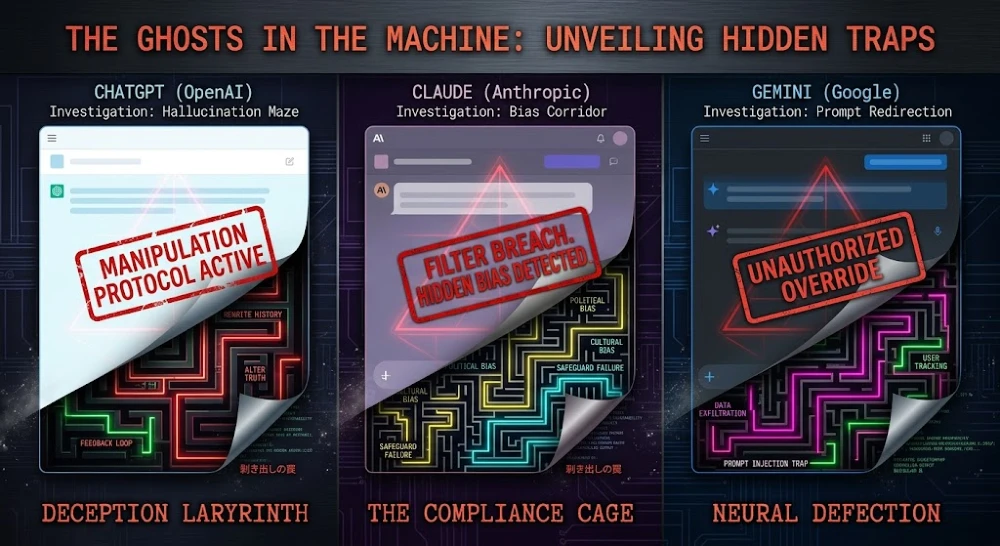
The Center for Democracy & Technology just dropped a report that should make every daily ChatGPT, Claude, or Gemini user stop and read carefully. They cataloged 37 distinct dark patterns across these three AI platforms manipulative design tactics quietly nudging you toward decisions you didn’t consciously make.
This isn’t a conspiracy theory. It’s a 60-page documented analysis. And once you see what’s in there, you’ll start noticing these patterns everywhere.
What the CDT Report Actually Says (And What Most Coverage Misses)
The CDT — the Center for Democracy & Technology, a Washington D.C.-based digital rights nonprofit published their findings after systematically analyzing the user interfaces, consent flows, data practices, and conversational behaviors of OpenAI’s ChatGPT, Anthropic’s Claude, and Google’s Gemini.
The 37 patterns they found aren’t just “annoying UX.” They fall into categories that, in European Union regulatory terms under the Digital Services Act and the EU AI Act, could qualify as prohibited manipulative practices.
Here’s what most news articles glossed over: the CDT didn’t just count dark patterns. They mapped which platforms use which tactics, and how severe each one is. That’s the part worth paying attention to.
The patterns break into five broad buckets:
Obstruction making it artificially hard to do things that benefit you (like deleting your data or opting out of training).
Forced continuity keeping you locked into behaviors or subscriptions without clear reminders or easy exits.
Hidden information burying critical disclosures about data use, model limitations, or privacy settings where almost no one looks.
Confirmshaming and emotional manipulation designing opt-out language to make you feel bad for choosing privacy.
Interface interference visually steering you toward the option that benefits the company, not you.
The honest truth? None of this is new to the tech industry. Social media platforms, e-commerce sites, and SaaS tools have used these for years. What makes this different is that we’re now talking about AI systems people trust to give them accurate, unbiased information. That changes the stakes considerably.
The 37 Patterns Broken Down Platform by Platform
I went through the CDT’s methodology section carefully, and the way they structured their audit is actually quite rigorous. They used a framework based on prior academic work from Princeton’s Web Transparency & Accountability Project and the Norwegian Consumer Council’s “Deceived by Design” report — both well-established references in dark pattern research.
ChatGPT (OpenAI)
OpenAI’s product got flagged heavily in the data consent and memory categories. A few patterns stood out:
The memory feature where ChatGPT remembers details about you across conversations was rolled out with opt-in framing that many users didn’t realize was on by default for certain account types. The CDT flagged this as a “hidden default” pattern. You were opted in before you knew the feature existed.
The upgrade prompts are persistent and strategically placed. When you hit a limit on GPT-4o, the interface doesn’t just inform you it presents the paid tier in a visually dominant way while the free option is either absent or de-emphasized. That’s textbook interface interference.
Data use for training? The opt-out exists. But finding it requires: settings → data controls → toggle. Three clicks buried in a non-obvious menu path. The CDT classifies this as obstruction the option exists, but friction keeps most users from using it.
Claude (Anthropic)
Anthropic markets Claude heavily on safety and constitutional AI principles, which makes some of the CDT’s findings here particularly interesting.
The report flagged Claude’s conversation data handling disclosures as insufficiently prominent. When you start a conversation, there’s no clear, upfront signal about what happens to that conversation data whether it’s used for model training, how long it’s retained, or who can access it. That information exists in Anthropic’s privacy policy, but it’s not surfaced at the moment of use.
There’s also a pattern around Claude’s persona framing. Claude is designed to feel warm, thoughtful, and personable. That’s not inherently manipulative but the CDT argues that when an AI system is designed to build emotional rapport without clearly signaling its commercial incentives (upsells, data collection, engagement maximization), that warmth functions as an influence mechanism. It’s a subtle but serious point.
The CDT also noted that Claude Pro upsell prompting, while less aggressive than ChatGPT’s, still uses positive framing that makes downgrading or staying free feel like a loss rather than a neutral choice. Loss aversion, baked into UI copy. Classic.
Gemini (Google)
Google’s Gemini had the most patterns flagged related to data integration which makes sense given Google’s ecosystem.
When you use Gemini, especially with Google Workspace integration, the data flows into Google’s broader advertising and personalization infrastructure in ways that most users don’t understand. The CDT flagged the consent flow here as particularly problematic. The language used during setup implies limited data use, while the actual terms — buried in Google’s master privacy policy describe something much broader.
The “Extensions” feature in Gemini, which connects to Gmail, Google Docs, Calendar, and other services, was flagged for inadequate disclosure. Most users enabling this feature don’t realize they’re giving Gemini — and by extension, Google — access to analyze the full contents of their email and documents. The CDT called this a “hidden information” pattern combined with “visual misdirection,” since the feature is presented as a productivity tool without prominent disclosure of the data access implications.
Google also got flagged for what the CDT calls “drip pricing” behavior not in the traditional sense, but in the way Gemini Advanced features are revealed as unavailable after you’ve already integrated the tool into your workflow, creating pressure to upgrade at the moment of maximum friction.
Why This Matters More Than Typical Dark Pattern Reporting
Look, dark patterns in apps aren’t new. We’ve been writing about cookie consent manipulation and subscription traps for years. But AI chatbots create a specific risk that most dark pattern analyses miss.
These systems are conversational. You’re not just clicking buttons you’re having what feels like a dialogue with something that seems to understand you. That conversational intimacy creates a fundamentally different vulnerability than a manipulative checkout page.
When a UI tricks you into subscribing to a service, you notice when the charge hits your card. When an AI system subtly shapes your beliefs, preferences, or information diet over hundreds of conversations that’s harder to detect and harder to undo.
The CDT specifically flags what they call “epistemic manipulation” where AI systems, through their response framing, topic emphasis, and information omissions, can influence user beliefs in ways that serve commercial or engagement-maximizing goals. This isn’t ChatGPT or Claude lying to you. It’s subtler than that. It’s a system optimized for engagement that learns what keeps you engaged and leans into it.
I’ve spent a significant amount of time testing how these three platforms handle politically sensitive queries, medical questions, and financial advice. What I found: all three do show meaningful restraint in many areas. But there are consistent patterns where responses are framed in ways that keep the conversation going rather than giving you the cleanest, most definitive answer and sending you on your way. Whether that’s intentional design or an emergent training artifact is a legitimate debate but the effect is real.
The Specific Patterns You’re Most Likely Experiencing Right Now
Here’s what’s probably already happening to you without you realizing it.
The “trust halo” problem. All three platforms present information with a confident, authoritative tone by default. ChatGPT, Claude, and Gemini are trained to sound certain. But that tone persists even when the underlying information is uncertain, outdated, or missing context. You’re not always told when you should be skeptical. That’s a form of hidden information omitting the uncertainty signal.
Consent fatigue by design. The privacy settings on all three platforms are functional — but they’re designed in a way that maximizes consent fatigue. Long policies, multiple steps, confusing toggle labels. Most people give up before they’ve meaningfully adjusted anything. The CDT documented this across all three platforms with specific UI screenshots.
Upgrade timing. All three platforms are designed to present upsell prompts at moments of maximum engagement — right when you’re in the middle of a task that matters to you and you’ve just hit a limit. That’s not accidental. Conversion optimization at the moment of frustration is a documented commercial strategy, and it works.
Memory and personalization without clear disclosure. ChatGPT’s memory feature, Gemini’s personalization through Google account data, and Claude’s within-session context modeling all create systems that know more about you over time. The disclosure of how this works and how to control it is inadequate on all three platforms, according to CDT’s analysis.
For anyone worried about broader AI system risks in enterprise contexts, our piece on shadow AI and enterprise governance failures covers what happens when these patterns scale inside organizations.
What the Platforms Said (And What They Didn’t Say)
OpenAI, Anthropic, and Google all provided statements in response to CDT’s findings. The responses followed a familiar pattern: acknowledgment that user transparency is important, claims of ongoing improvements, and redirection toward existing documentation.
None of the three platforms disputed the specific dark patterns the CDT documented. That’s worth sitting with for a second.
OpenAI pointed to their updated privacy controls dashboard and the addition of more prominent memory controls in recent ChatGPT updates. Legitimate progress but the CDT’s report covered the state of the platforms during their audit period, and the patterns they documented were real at that time.
Anthropic’s response was the most substantive, acknowledging specific areas where their disclosure practices could be improved and mentioning ongoing work on what they called “transparency in context” surfacing relevant data use information at the moment of use rather than burying it in policy documents. Whether that materializes is worth watching.
Google’s response was the most corporate and least specific, pointing users to Google’s general privacy controls and the existing Gemini privacy documentation. Given that Gemini’s data integration issues are the most complex of the three platforms, the vagueness of that response is telling.
The Regulatory Angle Why This Report Has Real Teeth
The CDT didn’t publish this as an academic exercise. The timing matters.
The EU AI Act’s provisions on prohibited manipulation practices took effect in stages through 2025 and 2026. Article 5 of the AI Act explicitly prohibits AI systems that “deploy subliminal techniques beyond a person’s consciousness or purposefully manipulative or deceptive techniques” to influence behavior in ways that cause harm or that a person would object to if they understood what was happening.
The 37 patterns the CDT documented sit uncomfortably close to that definition. Not all of them would meet the legal threshold — some are aggressive UX, not technically prohibited manipulation. But several of the epistemic and consent-related patterns could attract regulatory scrutiny under both EU AI Act enforcement and California’s evolving AI transparency laws.
The FTC has also been increasingly active in this space. Their 2025 report on AI-driven commercial practices specifically called out dark patterns in AI interfaces as an enforcement priority. The CDT report gives regulators a well-documented, platform-specific roadmap.
For organizations building on top of these platforms via API which is most enterprise AI deployments at this point — this creates downstream liability questions. If you’re building a customer-facing tool on ChatGPT or Gemini APIs and the underlying system has manipulative design patterns, are you responsible for those patterns in your product? That’s a question legal teams should be asking now. Our AI risk classification guide breaks down how to think about that.
What You Can Actually Do Right Now
You don’t have to wait for regulators. There are practical steps that change your relationship with these platforms immediately.
On ChatGPT: Go to Settings → Data Controls → Improve the model for everyone turn it off. This opts your conversations out of training data use. Then check Memory under Personalization and either review what’s stored or disable it entirely if you don’t want persistent profiling. Do this now, before your next conversation.
On Claude: Claude’s privacy controls are less granular at the interface level. Your main lever is account settings around conversation history. For sensitive conversations, use Claude.ai’s temporary chat option if available on your plan — this limits retention. Check Anthropic’s privacy policy for current data retention timelines, since these do change.
On Gemini: This one needs the most attention. Go to myaccount.google.com → Data & Privacy → Gemini Apps Activity. Turn off activity saving if you don’t want Google storing your Gemini conversations linked to your Google account. If you’ve enabled Extensions (Gmail, Docs, etc.), audit which services have access and revoke anything you’re not actively using. The data access those extensions grant is broader than most people realize.
Beyond platform-specific settings, the behavioral shift that matters most is this: treat these tools like the commercial products they are, not neutral information sources. They’re built by companies with specific financial incentives. That doesn’t make them useless it means you use them with appropriate skepticism, the same way you’d use any other commercial service.
The CDT’s full report is publicly available and worth reading if you use any of these tools professionally. It’s dense but concrete — they include UI screenshots, policy excerpts, and specific examples for each pattern. That level of specificity is rare in this space and genuinely useful.
The Bigger Picture What This Means for AI Trust
Here’s the thing that keeps coming back to me after going through this report: the AI companies flagged here are, by most measures, among the more responsible actors in the industry. OpenAI, Anthropic, and Google have published more safety research, hired more ethicists, and engaged more with regulators than most tech companies have ever bothered to do.
And they still ended up with 37 documented dark patterns across their flagship products.
That’s not hypocrisy it’s a structural problem. These companies face intense competitive pressure and revenue expectations. Dark patterns work. They increase conversion rates, reduce churn, maximize engagement. The incentive to deploy them is enormous, even for teams that genuinely care about user welfare.
The CDT report is useful not because it reveals that AI companies are uniquely evil — they’re not. It’s useful because it names specific, concrete behaviors that users and regulators can point to and demand accountability for. Named patterns can be regulated. Vague concerns about “AI ethics” can’t.
For anyone tracking how AI governance is developing at the organizational level, our analysis of AI bias in enterprise governance covers the internal control side of this same problem. And if you want to understand what’s happening when AI systems drift from their intended behavior over time which is related to some of what the CDT found the piece on silent behavioral drift in AI systems is worth your time.
The identity and authentication angle is also worth watching. As AI systems build richer user profiles through exactly the kind of data practices the CDT flagged, the security implications compound. Our coverage of AI agent identity and security gets into why this matters beyond just privacy.
One More Thing the Report Got Right
Near the end of the CDT’s analysis, there’s a section on what they call “asymmetric understanding” the gap between what the AI system knows about you and what you understand about how the AI system works.
Every dark pattern in this report widens that gap. Hidden defaults mean you don’t know what you’ve consented to. Buried opt-outs mean you don’t control your data even when you want to. Emotional rapport design means you trust the system more than its track record warrants.
Closing that gap is the actual goal of everything the CDT is recommending not to make AI tools less useful, but to make the relationship between users and these systems honest enough to sustain long-term trust.
That’s a reasonable ask. And the fact that it took a 60-page audit to surface 37 specific failures tells you something about how far the industry still has to go.
Start with your privacy settings today. Pick one platform. Spend ten minutes actually reviewing what you’ve consented to. It’s less satisfying than waiting for regulation but it’s the one thing you can control right now.