
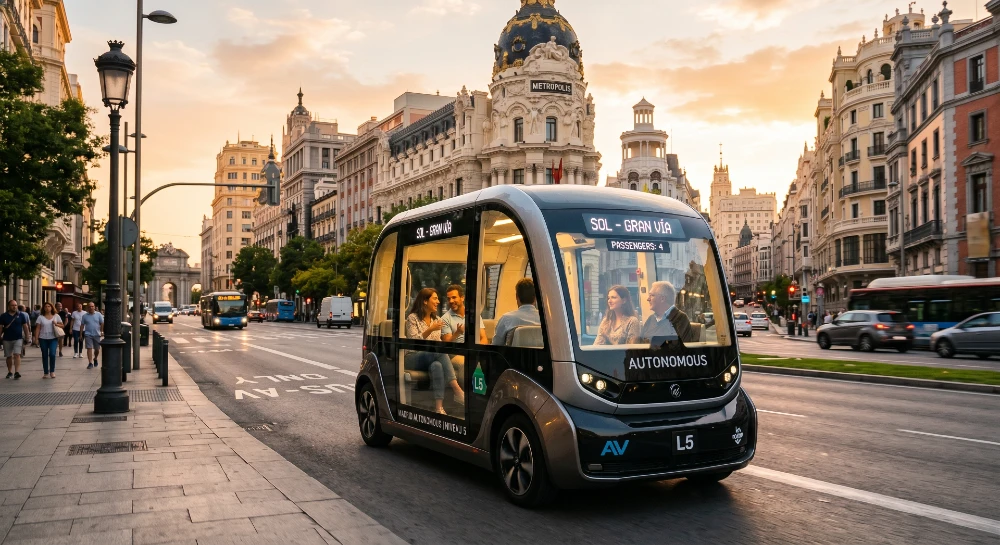
Madrid just became the first city in Europe to have a fully commercial robotaxi service running on public roads. Not a trial. Not a closed-loop demo. A real, paying-passenger service operating in one of the continent’s most chaotic traffic environments.
That’s not a small thing.
What Actually Happened And Why Madrid?
The service launched through Motional and Uber’s European expansion push, with additional backing from local Spanish transport authorities. The vehicles modified Hyundai IONIQ 5s running Motional’s autonomous stack are now picking up passengers in designated Madrid zones without a safety driver in the front seat.
Madrid wasn’t chosen randomly. Spain’s transport ministry had been quietly building one of the more permissive autonomous vehicle regulatory frameworks in the EU since 2023. While Germany, France, and the UK were still debating liability clauses and sensor data privacy rules, Spain moved. They created a specific licensing tier for Level 4 autonomy in defined urban geofences, which is exactly what companies like Motional needed to go commercial.
The city itself also helped. Madrid’s road grid in districts like Salamanca and Chamartín is relatively predictable — wide lanes, clear signage, decent infrastructure. It’s not Shanghai’s highway chaos or San Francisco’s fog-heavy hills. For a first deployment, it made sense.
Here’s the thing most coverage missed: this wasn’t a sudden launch. Motional had been running shadow-mode testing in Madrid since late 2024, accumulating over 2 million kilometers of local data before a single paying customer sat in the back seat. That’s the part that actually matters.
How the Robotaxi Actually Works The Real Mechanics
You open the Uber app, request a ride, and if you’re in the service zone, you might get matched to an autonomous vehicle. There’s no opt-out prompt you just get what you get, same as Uber Pool routing. The vehicle arrives, you verify your identity via the app (a QR code scan), and the door unlocks.
Inside, there’s a touchscreen panel where you can adjust temperature, ask the system to pull over, or contact a remote human operator if something feels off. That remote operator piece is important there’s always a trained human monitoring the vehicle fleet from a central operations center. They can take over steering via remote if needed, though in practice this rarely happens.
The sensor suite on these vehicles is significant: a combination of LiDAR arrays (Luminar’s Iris system), radar, and 360-degree cameras feeding into Motional’s DRIVE platform. The AI stack processes roughly 4 terabytes of sensor data per hour of driving. That number sounds wild until you realize it’s the only way the system can identify a child chasing a ball into the road from 40 meters away and react in 0.2 seconds.
Pricing sits about 10-15% above a standard UberX fare. Not cheap, but not absurd. Early adopters seem fine with it — the reviews coming out of Madrid’s early access program described the ride experience as “eerily smooth” and “better than most human drivers during rush hour,” which, honestly, tracks.
The Regulatory Path That Made This Possible
This is where it gets genuinely interesting, and where Europe’s internal tension becomes visible.
The EU’s AI Act — which officially classifies certain autonomous vehicle decision systems as high-risk AI under Article 6 — created a framework that many assumed would slow commercial AV deployment across the continent. And for most member states, it did. The conformity assessments, transparency requirements, and human oversight mandates in the AI Act added significant compliance overhead.
Spain found a workaround. Not a legal loophole an actual regulatory innovation. They created a “sandbox deployment” classification under Royal Decree 659/2023, which allows commercial operation of Level 4 AVs in defined urban zones under enhanced monitoring conditions. The enhanced monitoring (that remote operator setup I mentioned earlier) satisfies the EU AI Act’s human oversight requirement. Technically compliant. Practically operational.
Other EU countries are watching this closely. France’s transport ministry has already requested a technical briefing from Spain’s Dirección General de Tráfico. Germany’s Federal Ministry for Digital Affairs put out a statement saying they’re “reviewing the Spanish framework.” That’s bureaucratic language for “we’re about to copy this.”
The broader regulatory picture for AI systems including autonomous vehicles is evolving fast. Understanding how organizations are classifying AI risk is becoming essential context for anyone following this space. The EU’s approach to AI risk classification is shifting how companies structure deployment timelines across every sector, not just transport.
What Could Go Wrong The Honest Version
Look, I’ve spent time analyzing AV deployments across the US, China, and now Europe, and the pattern is consistent: the first 6 months are the honeymoon phase. Then reality shows up.
San Francisco’s Waymo and Cruise launches both started smoothly. Then Cruise had the October 2023 incident a pedestrian struck by a human driver was then stopped on by a Cruise vehicle that failed to handle the scenario correctly. The fallout wasn’t just reputational. California’s DMV suspended Cruise’s permit. The company never fully recovered.
Madrid’s deployment faces different risks, but risks exist.
The most likely friction points:
Emergency vehicle recognition. Spanish ambulances and police vehicles use different siren frequencies and light patterns than US ones. Motional’s system was trained heavily on North American data. They’ve done localization work, but edge cases in emergency scenarios are exactly where AV systems fail unexpectedly.
Pedestrian behavior. Madrid pedestrians are… assertive. Jaywalking isn’t just common it’s culturally embedded. The AV system’s conservative braking behavior, designed to handle these situations safely, can create rear-end collision risk from following human drivers who don’t expect sudden stops.
Weather edge cases. Madrid gets intense summer dust storms (calima events, when Saharan dust reduces visibility dramatically). Neither LiDAR nor cameras perform well in heavy particulate conditions. The operational design domain for the robotaxis likely excludes these conditions, but managing that exclusion gracefully pulling over, alerting passengers, rerouting is harder than it sounds in practice.
Public trust. This is the quiet one. A single high-profile incident even a minor fender bender that would barely make local news if a human driver caused it will generate outsized media coverage and political pressure. The Spanish public’s tolerance for autonomous vehicle errors is genuinely unknown. We’re about to find out.
Why This Matters Beyond Transport
The Madrid launch is being covered as a mobility story. It’s actually a broader AI deployment story, and that reframing matters.
Autonomous vehicles are, at their core, AI agents operating in physical space, making consequential real-time decisions. The governance questions they raise — about identity verification, liability, behavioral consistency, incident response mirror questions being asked about AI agents in enterprise software, healthcare, and financial services.
The identity verification piece is one I find particularly interesting. When you get into a Motional robotaxi in Madrid, the system needs to confirm you’re the right passenger, maintain awareness of everyone in the vehicle, and log interactions for liability purposes. That’s essentially the same challenge facing AI agent identity security in enterprise contexts — confirming that the entity interacting with the system is who they claim to be, and maintaining an auditable record of that interaction.
Incident response frameworks for autonomous vehicles also map closely onto broader AI incident governance. What happens when the system makes a wrong call? Who gets notified? What’s the escalation path? How do you prevent a one-off failure from becoming a pattern? These aren’t transport questions they’re AI governance questions. Organizations building incident governance playbooks for AI systems are essentially solving the same problem Motional’s operations team deals with every day in Madrid.
The behavioral drift question is equally relevant. An AV system trained on 2024 Madrid traffic data will encounter 2026 traffic realities — new construction zones, changed road layouts, evolved pedestrian patterns. If the system’s behavior shifts gradually in response without explicit retraining, that’s silent behavioral drift. It’s a known failure mode in deployed AI systems, and the transport context makes it viscerally obvious in a way that enterprise software drift often isn’t.
The Competitive Picture Who’s Watching Madrid
Waymo is the obvious comparison point. They’ve been running commercial robotaxi service in San Francisco, Phoenix, and Los Angeles for years now, accumulating the operational experience and public trust data that European companies are trying to build. Waymo’s parent, Alphabet, has been in conversations with multiple European city governments about expansion, but regulatory complexity kept pushing timelines back.
The Madrid launch potentially accelerates that. If Spain’s sandbox framework proves viable and incident-free through 2026, Waymo has a clear template for European regulatory engagement. Alphabet’s legal team is almost certainly already mapping the Spanish framework onto their existing compliance infrastructure.
Chinese competition is the less-discussed factor. Baidu’s Apollo Go service has been operating commercially in Wuhan, Chongqing, and parts of Beijing for years now. WeRide and Pony.ai have both been expanding across Chinese tier-2 cities. These companies have accumulated operational hours that dwarf anything in the US or Europe — and they’re starting to look at international markets seriously. The EU’s data sovereignty rules and China’s export control environment create friction, but that friction isn’t permanent.
Wayve, the UK-based AV startup that raised $1 billion in 2024 with backing from Microsoft, SoftBank, and NVIDIA, is the European dark horse. Their approach training a single neural network end-to-end rather than using rule-based systems could scale faster across diverse European road environments than sensor-fusion approaches like Motional’s. They haven’t announced a commercial launch date, but the Madrid moment probably just moved their timeline up.
What Madrid Residents Actually Experience
Early passenger reports from Madrid’s beta users (the city ran a limited invite program before public launch) described something interesting: the discomfort isn’t from the driving quality. It’s from the silence.
Human drivers provide subtle social cues a nod, a glance in the mirror, occasional small talk. The robotaxi gives you none of that. It’s technically proficient and socially inert. Some people found that liberating. Others found it unsettling in a way they couldn’t quite articulate.
The in-car UI matters more than anyone initially expected. The touchscreen’s calm, clear interface showing the planned route, explaining why the car is taking a particular path, indicating when it’s yielding to a cyclist made passengers feel informed rather than passive. That design decision, apparently pushed by Motional’s UX team against early engineering resistance, turned out to be critical for passenger comfort.
Accessibility is a real win. Several early users with mobility limitations reported that the robotaxi experience was significantly better than standard taxi or rideshare, because the vehicle waits without impatience, the door-assist system is consistent, and there’s no awkward negotiation with a driver about wheelchair space or assistance needs.
The downside? Service zones are limited. The current operational area covers roughly 12 square kilometers in Madrid’s northern districts. If you need to get from Vallecas to the airport, you’re still calling a human driver. That limitation will frustrate people, and it should it’s the honest gap between the press release and the reality.
The Labor Question Nobody Wants to Answer Directly
Every robotaxi launch comes with this conversation, and it’s fair to have it directly.
Madrid has roughly 28,000 registered taxi drivers and thousands more Uber and Bolt drivers operating in the metro area. The Motional launch currently operates a small fleet estimates put it at 40-60 vehicles in initial deployment. That’s not displacing anyone today.
But trajectory matters. Waymo went from 20 vehicles in San Francisco to over 700 within three years. If Madrid’s deployment follows a similar growth curve and expands to additional Spanish cities, the employment math changes significantly within a decade.
The Spanish transport unions particularly Élite Taxi, which has a history of aggressive action (they were central to the anti-Uber protests that shut down Spanish cities in 2014) are already organizing. They’re not wrong to be paying attention. The question is whether policy frameworks can create transition pathways that don’t leave experienced drivers behind, or whether this plays out the way manufacturing automation did: fast adoption, slow policy response, real human cost in the gap.
There’s no clean answer here. The technology is happening. The economic pressure is real on both sides. Anyone telling you this is simple either has a financial stake in one outcome or hasn’t thought it through carefully.
What Comes Next The Realistic Timeline
2026 (rest of year): Motional expands the Madrid fleet, likely to 100-150 vehicles. They’ll apply for permission to extend the service zone into additional districts. One or two minor incidents will happen statistically guaranteed and how they handle public communication will define the next phase.
2027: If Spain’s framework holds, expect announcements from at least two other EU cities adopting similar sandbox frameworks. Barcelona is the obvious next Spanish candidate. Amsterdam and Vienna are the most likely non-Spanish first movers based on their existing AV testing infrastructure.
2028: This is when the real competition arrives. By 2028, Wayve will likely have a commercial product, Waymo’s European expansion will be in active negotiation with multiple governments, and Chinese players will be testing regulatory entry points. The market Madrid opened will look very different.
Long-term: The honest projection from people who study this seriously is that Level 4 robotaxis will be a significant portion of urban mobility in major European cities by the early 2030s not dominant, but significant. The 10-15 year window for that transition is actually relatively short for infrastructure change of this magnitude.
The One Thing Most Coverage Gets Wrong
Robotaxis are being framed as a transport story. They’re really an AI reliability story.
The question isn’t whether autonomous vehicles can drive they demonstrably can. The question is whether AI decision systems can maintain consistent, safe behavior across millions of edge cases, evolving environments, and adversarial conditions (yes, adversarial there are already reports of people in San Francisco trying to confuse Waymo vehicles with unusual behavior to see what happens).
That reliability question is the same one being asked about AI systems in healthcare, finance, security, and enterprise software. The Madrid robotaxi is a particularly visible, physical manifestation of a challenge that’s playing out in less visible ways across every sector where AI is making consequential decisions.
Pay attention to how Motional handles the first real incident in Madrid. Not the press release response the actual operational response. That’ll tell you more about the maturity of commercial AI deployment than any benchmark score or technology demo ever could.
The vehicles are running. The real experiment has just begun.
For more on how AI systems are being governed and monitored across industries, see our coverage on AI risk classification frameworks organizations are adoptingand how enterprises are handling AI incident governance. If you’re watching how autonomous AI agents handle identity and security,this breakdown of AI agent identity and voice biometricsis directly relevant. And the silent behavioral drift problem in deployed AI systemsmaps directly onto the long-term reliability questions every robotaxi operator will face.


