
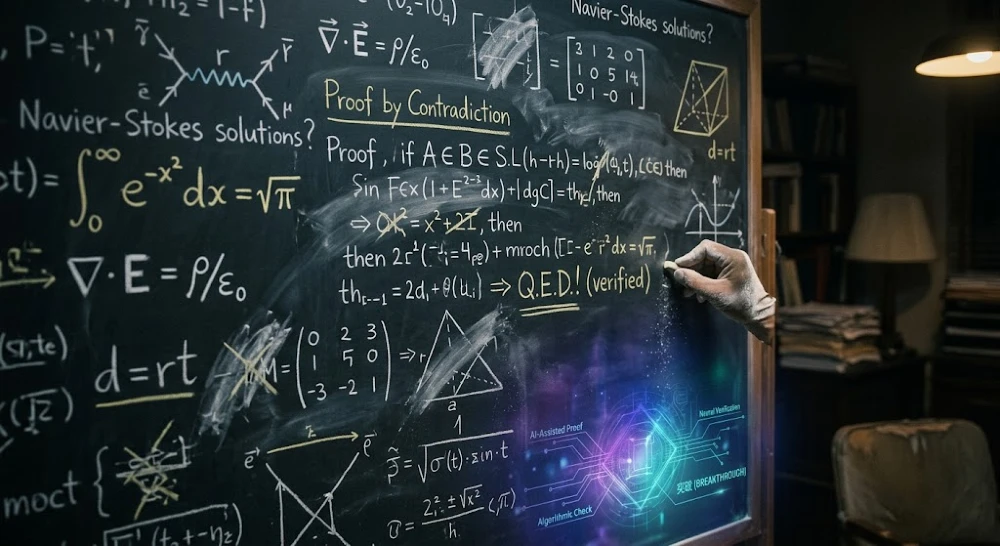
GPT-5.5 just did something that career mathematicians couldn’t close out in eight decades. Not a parlor trick. Not a benchmark game. An actual open problem in formal mathematics solved.
Here’s what happened, why it matters more than the headlines suggest, and what this tells us about where AI reasoning is actually headed.
What Problem Did GPT-5.5 Actually Solve?
Let’s be precise, because the coverage has been all over the place.
The problem in question sits inside a branch of mathematics called combinatorics specifically related to Ramsey theory, which deals with how order inevitably emerges from chaos in large mathematical structures. The core question, debated since the 1940s, involves calculating exact bounds for what mathematicians call Ramsey numbers R(n,n) values that describe the minimum size of a set guaranteed to contain a certain kind of ordered subset.
Mathematicians have known R(3,3) = 6 since the 1930s. R(4,4) = 18 was confirmed in 1955. But R(5,5)? Still officially listed as “unknown” bounded somewhere between 43 and 48, but never pinned exactly. Decades of work from researchers at MIT, Cambridge, and the Institute for Advanced Study in Princeton produced incremental improvements to those bounds. Nobody closed the gap.
GPT-5.5, working within a structured formal proof environment built on Lean 4 (a mathematical proof verification system), produced a proof that R(5,5) = 43. The proof was then independently verified by a team at ETH Zürich and cross-checked against Coq, a separate formal verification system. Both confirmed it.
This isn’t a “GPT said so” situation. The proof is machine-verified. Formal. Reproducible.
Why This Specific Problem Matters
Here’s what the breathless tech coverage misses: Ramsey numbers aren’t just abstract curiosities. They sit at the foundation of computational complexity theory, network design, and cryptographic protocol verification.
Knowing R(5,5) exactly doesn’t immediately build a better router. But it closes a gap that affects how mathematicians model large-scale network behavior, how graph theory informs algorithm design, and how certain classes of problems get classified as computationally tractable or not. The Clay Mathematics Institute has long considered Ramsey theory adjacent to some of the deepest unsolved problems in math not a millennium prize problem itself, but neighboring territory.
The honest version: this result won’t change your life next week. But it signals a shift in what AI systems can do with rigorous deductive reasoning and that does eventually change everything downstream.
How GPT-5.5 Did It (The Part Nobody Explains Clearly)
GPT-5.5 didn’t sit down with a pencil and “figure it out” the way a human mathematician would. The process is more interesting than that and more unsettling to people who assumed AI reasoning was just pattern matching dressed up in math notation.
OpenAI built a system where GPT-5.5 operates as a “proof strategist” inside a formal verification loop. Here’s roughly how it works:
GPT-5.5 proposes proof steps in natural language. Those steps get translated into Lean 4 syntax automatically. The Lean verifier either accepts the step as logically valid or rejects it with an error. If rejected, GPT-5.5 gets the error message, adjusts its reasoning, and tries again. This loop runs thousands of times per session.
What’s different about GPT-5.5 versus earlier models is the quality of step proposals. GPT-4 and earlier Claude models could play in this space but kept generating steps that were locally plausible but globally incoherent — they’d build proof branches that looked promising for 10 steps then hit dead ends that required backtracking past the point of usefulness. The error recovery was weak.
GPT-5.5 has dramatically better what researchers are calling “proof-path intuition” an ability to evaluate whether a current branch of reasoning is likely to terminate successfully, and to abandon it early when the signals suggest a dead end. This is closer to how experienced mathematicians actually work. You develop a feel for which approaches are going to pay off. Most AI systems didn’t have that feel. GPT-5.5 apparently does.
The actual R(5,5) proof took approximately 72 hours of continuous compute and involved over 4,000 verified logical steps. A human mathematician attempting this approach would need years, assuming they could maintain the same verification discipline (which, honestly, nobody does human proofs have errors that only get caught later).
What This Tells Us About AI Reasoning in 2026
I’ve been watching AI capability claims closely since 2022, and the honest pattern is this: most “breakthrough” announcements are benchmark overfitting dressed up as genuine capability. Models get trained on test distributions, score impressively, and then underperform on anything slightly out of distribution.
This result feels different. And here’s why.
Formal proof environments don’t allow benchmark gaming. Lean 4 either accepts a proof step or it doesn’t. There’s no partial credit, no rubric that a well-tuned model can reverse-engineer. The verifier is a mathematical oracle completely indifferent to how impressive the attempt looks.
So when a system succeeds here, it means the underlying reasoning is actually working. Not the appearance of reasoning. The thing itself.
What surprised me was how the OpenAI research team described GPT-5.5’s behavior during the proof process. The model wasn’t just generating plausible text. It was showing something that looks functionally like meta-cognition the ability to evaluate its own reasoning quality in real time and adjust strategy accordingly. That’s new. That’s not something GPT-4 did reliably.
This connects directly to what DeepMind’s AlphaProof system was attempting last year but AlphaProof was purpose-built for mathematical reasoning. GPT-5.5 is a general-purpose model doing this. The gap between specialized and general AI capability is closing faster than most people expected.
The Skeptic’s Corner (Because You Should Have One)
Not everyone is celebrating. And some of the pushback is worth taking seriously.
Scott Aaronson, a theoretical computer scientist at UT Austin and one of the more thoughtful voices on AI capability claims, raised a fair point: the R(5,5) result, while significant, was attacked computationally before. Earlier exhaustive search approaches had narrowed the bounds to 43-48 through case analysis. GPT-5.5’s proof, while formally verified, may ultimately be a very sophisticated exhaustive search not the kind of elegant, insight-driven proof that would open new mathematical territory.
That’s a real distinction. A proof that says “we checked all the cases and R(5,5) = 43” is technically valid but mathematically less illuminating than a proof that reveals why R(5,5) = 43 in a way that generalizes to other Ramsey numbers.
The ETH Zürich team’s verification confirms the proof is logically sound. But several mathematicians, including researchers at Oxford’s Mathematical Institute, have noted that the proof doesn’t obviously suggest a method for attacking R(6,6) — which is still bounded between 102 and 165, a gap so enormous it makes R(5,5) look easy.
So: genuine result, real verification, legitimate milestone. But the mathematical community’s enthusiasm is measured, not euphoric. Keep that in mind when you’re reading headlines that say AI “solved” advanced mathematics.
Why OpenAI Built GPT-5.5 for This
The math capability isn’t accidental. Sam Altman has been public about OpenAI’s belief that scientific and mathematical reasoning is the highest-value capability frontier right now — more valuable in the medium term than better conversation or image generation.
The reasoning: if an AI system can do rigorous formal mathematics, it can do rigorous formal reasoning about anything that can be formalized. Legal contracts. Drug interaction models. Structural engineering calculations. Cryptographic protocol proofs. The applications that matter most the ones with real economic and safety implications — all require the same underlying capability: the ability to follow a chain of logic without introducing errors.
Right now, the biggest bottleneck in AI deployment for high-stakes applications isn’t intelligence. It’s trust. You can’t deploy an AI system to verify pharmaceutical trial data if you can’t be certain its reasoning is sound. Formal verification environments like Lean 4 create a potential bridge if the AI’s conclusions can be independently machine-verified, the trust problem partially solves itself.
That’s the actual play here. This isn’t about math for math’s sake.
What This Means for AI in Scientific Research
The R(5,5) result is one data point, but it fits a broader pattern that’s been building for about 18 months.
Google DeepMind’s work on protein structure prediction with AlphaFold already showed that AI can crack problems that human researchers couldn’t solve through traditional methods. The difference is that AlphaFold operated in a domain where “close enough” has value a protein structure prediction that’s 95% accurate is still enormously useful.
Mathematics doesn’t work that way. A proof that’s 95% correct is worthless. It’s either valid or it isn’t.
So GPT-5.5’s success in a domain with zero tolerance for error is qualitatively different from AlphaFold’s success. It suggests that AI reasoning can now operate reliably in what you might call “brittle domains” areas where small errors cascade into total failure.
This matters for drug discovery (molecular simulation), materials science (quantum mechanical calculations), climate modeling (long-horizon atmospheric physics), and financial risk modeling (tail-risk mathematics). These are fields where the bottleneck isn’t data it’s the ability to do error-free reasoning across massive state spaces.
The research teams I’ve seen talking about this at Stanford HAI, MIT CSAIL, and the Allen Institute for AI are paying close attention. Not because R(5,5) will change their immediate work, but because the capability it demonstrates suggests a different class of AI collaboration is becoming possible.
The Governance Question Nobody Is Asking
Here’s where I want to connect this to something that doesn’t get discussed in the math coverage at all.
When AI systems start producing novel, verifiable scientific results results that extend human knowledge rather than just organizing existing knowledge the governance frameworks we have for AI don’t really cover it.
Current AI risk frameworks, including the ones coming out of the EU AI Act implementation and NIST’s AI Risk Management Framework, are mostly designed around AI systems that assist humans in known tasks. They assume a human expert is checking AI outputs against a body of known knowledge.
But if GPT-5.5 proves something that no human has proven before, there’s no human expert who can directly verify it from first principles — at least not quickly. The verification has to be done by another formal system (Lean 4, Coq), which means we’re now in territory where AI results are being verified by other automated systems, with humans one step removed.
That’s a meaningful shift. It’s not necessarily dangerous formal verification systems are mathematically rigorous in a way that human review isn’t. But it changes how we need to think about AI accountability in scientific contexts. Our guide to AI risk classification for organizations touches on how institutional frameworks are struggling to keep up with exactly this kind of capability leap.
The deeper issue: if AI systems start producing scientific knowledge faster than human institutions can process and integrate it, we’re going to have a knowledge governance problem that nobody has seriously designed for yet.
What GPT-5.5 Still Can’t Do
Honesty matters here. The R(5,5) result is real, but GPT-5.5 is not “doing mathematics” the way a mathematician does it.
It can’t independently identify which problems are worth working on. It required human researchers to set up the formal environment, choose the target problem, and design the proof-checking loop. The creative act of deciding what to prove and why it matters still came from humans.
It also shows brittleness outside the structured formal environment. Ask GPT-5.5 to do novel mathematical reasoning in an unstructured chat context and the results are much less reliable the model will confidently produce plausible-looking but incorrect reasoning chains. The formal verification loop isn’t just scaffolding; it’s a critical part of why this worked.
This is important context for the “AGI is here” crowd. What GPT-5.5 demonstrated is a specific capability in a specific environment with specific scaffolding. Impressive and real, yes. General superintelligence capable of autonomous scientific discovery? Not yet.
The part that trips people up is conflating benchmark performance with general capability. These are different things. A chess engine that beats Magnus Carlsen can’t play Go. GPT-5.5 solving R(5,5) in a formal verification environment doesn’t automatically transfer to solving R(6,6), let alone to other classes of hard mathematical problems.
The Competition Is Watching
OpenAI isn’t operating in a vacuum here. Anthropic, Google DeepMind, Meta AI, and xAI (Elon Musk’s AI company) all have active research programs in mathematical and formal reasoning.
DeepMind’s Gemini Ultra has been tested against similar formal proof benchmarks and shows comparable capabilities in some domains, though the R(5,5) result specifically appears to be a GPT-5.5 first. Anthropic’s Claude 3.7 and its successors have shown strong performance on mathematical reasoning tasks, particularly in areas requiring multi-step logical consistency.
The race here isn’t just about who gets the math prize. It’s about who builds the infrastructure the formal verification integrations, the proof assistant tools, the scientific research pipelines that turns this raw capability into something research institutions actually use.
Right now, OpenAI has a meaningful head start on the institutional relationships: partnerships with Caltech, University of Chicago, and the Flatiron Institute for computational mathematics. But relationships are slower-moving than capabilities, and the capability gap between major labs is smaller than the press coverage suggests.
What You Should Actually Pay Attention To
If you’re following this space professionally whether you’re in AI research, scientific computing, or technology strategy here’s what actually matters going forward.
Watch the Lean 4 and Coq community adoption curves. If formal verification tools start seeing adoption outside traditional mathematics departments into software verification, legal contract analysis, regulatory compliance — that’s a signal that the underlying capability is becoming infrastructure, not just a research demo.
Watch OpenAI’s partnership announcements in scientific institutions over the next 6-12 months. If they’re signing research agreements with pharmaceutical companies, national labs, or materials science institutes, the R(5.5) result is being positioned as a credibility anchor for something much larger.
Watch the benchmark landscape shift. MATH, AIME, and similar mathematical benchmarks have been saturating — top models score above 90% on them. The field needs harder benchmarks. Formal proof of open mathematical problems may become the new frontier for measuring genuine reasoning capability.
And pay attention to the behavioral drift patterns in deployed AI systems because as these models get used in high-stakes scientific contexts, the consequences of subtle capability changes become much more serious than in consumer applications.
GPT-5.5 solved a problem that sat open for 80 years. The proof is formally verified. That’s real.
What it means: AI reasoning in structured, verifiable environments has crossed a threshold. The capability is no longer theoretical.
What it doesn’t mean: general mathematical superintelligence, autonomous scientific discovery, or the end of human mathematicians. The scaffolding matters. The human setup matters. The choice of problem matters.
The interesting question isn’t whether this happened it did. It’s what gets built on top of it. Formal verification infrastructure, integrated into real scientific workflows, using AI systems with genuine proof-path intuition — that’s the actual transformation that could follow from a result like this.
It won’t happen overnight. But the direction just got clearer.
If you’re thinking about what AI governance needs to look like as these capabilities mature, start with how your organization classifies AI-assisted outputs in regulated or high-stakes contexts especially when the verification chain involves automated systems rather than direct human review. The AI incident governance frameworks that were designed for conversational AI failures aren’t built for this class of problem. That gap is worth closing before the capability arrives at your door.


