
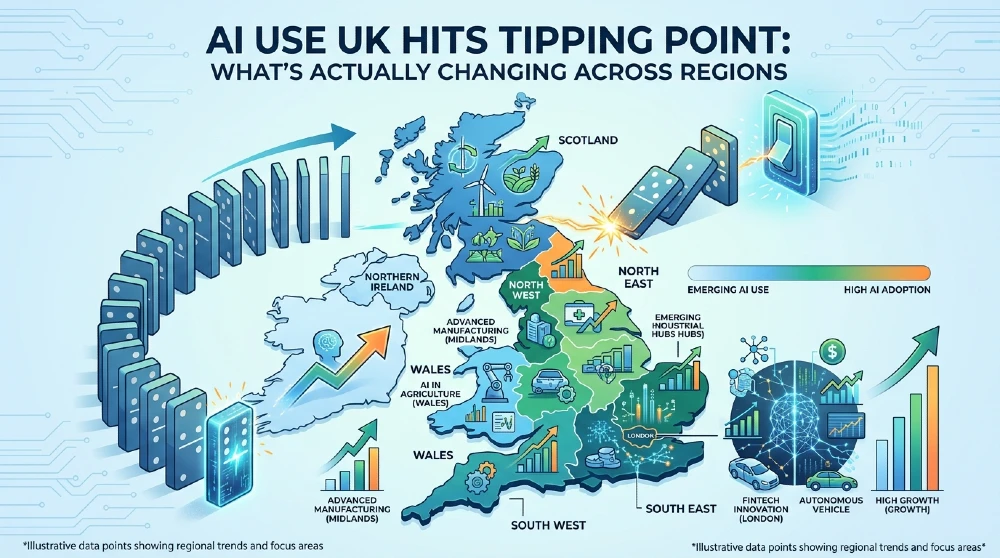
AI stopped being a side project. Here we are going to discuss: AI Use UK Hits Tipping Point
The headline figures are impressive — roughly 68% of UK businesses now use some form of AI in operations, up from 39% just eighteen months ago. That stat gets thrown around a lot. What doesn’t get discussed is what they’re using it for and how badly most of them started.
Here’s the thing about that growth curve: it wasn’t smooth. Talk to operations leads at companies in Leeds, Bristol, or Glasgow and they’ll tell you the same story. They bought a tool in 2024, barely used it for six months, then something clicked — usually a competitor getting faster, or a client expecting turnaround times that simply weren’t possible without automation.
That’s what a tipping point actually looks like. Not a press release. A quiet panic that turns into a genuine workflow change.
The McKinsey Global Institute estimated in late 2025 that UK productivity gains from AI adoption could reach £400 billion annually by 2030 — but only if adoption deepens past surface-level chatbot use. Right now, a significant portion of that 68% is still using AI for things like drafting emails or summarising meeting notes. Useful, yes. Transformative? Not quite.
The companies genuinely pulling ahead are doing something different
What “Scaling AI” Actually Means in 2026
Scaling isn’t buying more licences. I’ve seen that mistake made repeatedly — a finance team in Birmingham got access to 80 Copilot seats in January 2025 and by June, maybe 12 people were actually using them beyond the basics.
Real scaling means embedding AI into the decisions that cost you money when they’re slow or wrong.
Think: procurement teams using AI to flag contract anomalies before legal reviews. Think: logistics companies in the Midlands running predictive routing that cuts fuel costs by 11-15%. Think: customer support operations where AI handles tier-one queries without the usual 48-hour response lag.
That’s the version of AI adoption nobody’s writing click-bait about, because it’s not flashy. It’s just… operational. And it compounds quietly.
The regional split here is genuinely interesting, so let’s get into it.
The Regional Picture (And Why It’s Not What You’d Expect)
London is obviously the centre of gravity for UK AI investment — fintech firms in the City, agencies in Shoreditch, consulting firms everywhere else. But London also has the highest rate of “AI theatre,” which is my term for companies that announce AI initiatives, run pilots, and then… nothing changes. The incentive to appear innovative sometimes outpaces the incentive to actually be innovative.
Manchester has surprised me. The media and creative sector up there — ITV Studios, dock10, smaller production houses — adopted AI content tools faster than most London agencies I’ve talked to. Partly because cost pressure is higher outside the M25, and partly because there’s less ego around admitting you need help. The AI use UK hits tipping point story is genuinely more visible in Manchester than the coverage suggests.
Edinburgh and Glasgow are interesting cases. Scottish fintech — companies like Nucleus Financial, FreeAgent (now part of NatWest) — started AI integration in back-office compliance and fraud detection earlier than most. Scotland also has a quieter but real AI research ecosystem through the University of Edinburgh, Alan Turing Institute partnerships, and companies like Skyscanner that have been running ML systems for years. This isn’t new for them. They just don’t shout about it.
Bristol and the South West is having a moment in health tech and agricultural AI. Companies like Graphcore (processing chips), Ultraleap (hand-tracking), and a cluster of AgriTech firms are doing things with computer vision and sensor data that most boardrooms in London haven’t even heard of yet.
Leeds and the wider Yorkshire region is where I’d watch in the next 18 months. Legal services and professional services firms there are adopting AI for document review and client intake at a rate that’s genuinely ahead of the curve. Partly driven by necessity — talent costs less there but competition is fierce — and partly because a few early movers set a benchmark that everyone else felt pressure to meet.
The honest takeaway? The “AI is a London thing” narrative is about two years out of date.
What’s Actually Driving the Scale-Up Right Now
Three things pushed adoption from “nice experiment” to “business necessity” between Q3 2025 and Q1 2026.
Client expectations changed. Specifically in professional services, media, and logistics. Clients started expecting deliverables faster, more personalised, with less back-and-forth. The only way to hit those expectations without burning your team out was to automate the parts that didn’t need human judgment. Companies that held out started losing pitches.
The tooling got genuinely usable. I’d been testing AI tools for workflow integration since 2022, and the gap between “impressive demo” and “actually works in my business” was frustrating for a long time. That gap closed significantly in late 2025. Tools like Microsoft Copilot, Salesforce Einstein, and purpose-built vertical AI platforms finally got to a point where non-technical staff could use them without IT holding their hand. That’s not a small thing.
The cost of not adopting became visible. This is the one that’s hardest to quantify but easiest to feel. When a competitor quotes a project at 60% of your price and delivers in half the time — you don’t need a report to tell you what’s happening. You see it in your win rate. UK companies started doing the maths and realising the risk wasn’t adopting AI. The risk was waiting.
The Mistakes Companies Are Making Right Now
This is where I’ll be direct, because the coverage on UK AI adoption tends to be relentlessly positive and that’s not doing anyone favours.
Mistake 1: Buying the tool before defining the problem.
I’ve watched companies spend £40,000+ on enterprise AI contracts without being able to answer the question: “Which specific process costs us the most time per week?” They treat AI like a vitamin — take it daily and health improves generally. It doesn’t work like that. You need to find the bleeding wound first, then apply the tool.
Mistake 2: Training once and expecting change.
Adoption doesn’t happen because you ran a two-hour workshop in January. The companies getting ROI from AI tools ran short, specific training sessions tied to actual tasks their teams were doing that week. Not abstract demos. Not “here are 50 things Copilot can do.” Just: “Here’s how to do the client brief you’re working on right now, twice as fast.”
Mistake 3: No human oversight on AI outputs.
This one’s serious. I know of at least three cases — one in legal services, two in marketing agencies — where AI-generated content or analysis went out to clients without proper review and caused relationship damage. The time pressure to move fast is real, but it’s created a dangerous shortcut culture. The AI oversight debate is sharper than most people realise, and companies that skip the review step are building a liability they don’t see yet.
Mistake 4: Treating all AI tools as interchangeable.
There’s a tendency to say “we use AI” without distinguishing between a large language model, a machine learning model trained on proprietary data, and a rules-based automation system. They do fundamentally different things, they have different failure modes, and the one that works for your sales team probably won’t work for your compliance team. Specificity matters.
Mistake 5: Ignoring the regional talent gap.
AI adoption requires people who can manage AI systems — prompt engineers, data analysts, AI ops roles. London can pull from a deep talent pool. A mid-size firm in Hull or Stoke? Significantly harder. The tools are accessible; the human layer to manage them isn’t always there. Companies scaling AI outside major cities need to plan for this explicitly, not assume they’ll figure it out.
The Sectors Actually Ahead of the Curve
Financial services — unsurprisingly — but the interesting part isn’t the big banks. It’s the challenger banks and wealth management firms using AI for fraud detection, personalised financial planning, and regulatory reporting. Monzo, Starling, and Revolut have been AI-native from the start. What’s new is that mid-tier advisors and regional building societies are catching up fast.
Legal and professional services are moving faster than their reputation suggests. AI use in document review, contract analysis, and case research has gone from fringe to standard at the top 50 UK law firms. The Magic Circle — Allen & Overy, Clifford Chance, Linklaters — are all running AI-augmented services now. But the real story is regional mid-size firms doing the same with less budget and more creativity.
Healthcare is complex. The NHS has been piloting AI diagnostics, pathway optimisation, and administrative automation in pockets — particularly in radiology and triage. But procurement cycles, data privacy requirements, and budget constraints mean it’s moving slower than the private sector. The potential is enormous. The reality is still catching up.
Retail and e-commerce — demand forecasting, personalised recommendations, returns prediction. ASOS, Marks & Spencer, Ocado. Ocado in particular has one of the most sophisticated AI-driven logistics operations anywhere in the world. But smaller retailers are finding accessible entry points through Shopify AI features, Google Merchant Centre tools, and purpose-built inventory AI.
Media and content — this is where things get complicated. AI use in content production is real and growing, but the quality gap between well-managed AI content and poorly-managed AI content is getting wider, not narrower. The publications using AI as a draft layer with strong editorial oversight are producing good work. The ones using it to publish at volume without oversight are producing something that’s starting to damage their search visibility. Worth being honest about that.
What Real Scaling Looks Like: The Minimum Viable AI Stack
If you’re a UK business trying to move from dabbling to actually scaling, here’s what a practical starting setup looks like — not the enterprise dream version, the version you can actually run with a normal team.
Start with one workflow, not the whole company. Pick the process that takes the most time and has the most repeatable structure. Content briefs, proposal drafts, customer support responses, financial report summaries — something where you can measure output quality before and after.
Use AI tools that connect to what you already have. If your team lives in Microsoft 365, start with Copilot. If you’re Google Workspace, look at Gemini for Workspace. Fighting tool fatigue is real — adding a ninth platform is a harder sell than improving the one people already open every morning.
Build a review layer. Specifically: who checks AI outputs before they go anywhere important? Name the person, set the expectation. This isn’t about distrust of the tool. It’s about catching the 15% of outputs that are confidently wrong.
Measure two things. Time saved per task, and error rate compared to the previous process. Everything else is vanity. If it saves 3 hours a week and doesn’t introduce new errors, it’s working. If it saves time but creates problems downstream, it’s not.
Don’t try to automate AI tools you actually need active for real-time decisions. There’s a difference between automating a report that gets read tomorrow and automating a decision that affects a customer today. Know which one you’re dealing with.
The Skills Gap Nobody Wants to Talk About
Here’s an uncomfortable truth about AI use UK adoption: a lot of the scaling is being done by a small number of people inside each organisation who are quietly carrying everyone else.
You’ve got the one person on the marketing team who actually knows how to write prompts. The finance analyst who taught herself Python to connect the AI tool to the company’s data. The operations manager who built the workflow automations in Zapier that everyone else thinks are magic.
This isn’t sustainable. And it creates a fragility — if that person leaves, the AI capability walks out with them.
The companies getting this right are doing two things. First, they’re documenting. Not the fancy documentation — literally a shared doc that says “here’s how we use AI for X” with screenshots. Second, they’re creating peer learning, not top-down training. The person who knows the most teaches the team around them in a 30-minute session. Then that group teaches the next group.
Skills transferral through proximity, not PowerPoint.
The UK government’s AI Opportunities Action Plan, released in early 2026, allocated funding for AI skills programmes through partnerships with institutions like Imperial College London, the Alan Turing Institute, and regional further education colleges. Whether that translates to practical workforce capability at the speed businesses need it — that’s still an open question.
What the Next 12 Months Looks Like
Predictions are dangerous, but patterns are useful.
The companies that are 12-18 months into genuine AI integration are starting to talk about the second wave — not just AI assistants, but AI agents. Tools that don’t just help you do a task but actually do the task on your behalf, check back with you at decision points, and log what they did. That’s a different category of capability and a different category of risk.
For businesses earlier in the journey — which is most of the UK outside major tech hubs — the immediate opportunity is still the basics done well. Consistent AI assistance in the workflows that eat your team’s time. That’s still where most of the ROI lives, and most businesses haven’t fully extracted it yet.
There’s also a bifurcation coming in AI tooling. You can already see the early signs — some categories of AI tool are consolidating around two or three dominant players (Microsoft, Google, Salesforce on the enterprise side). Others are fragmenting into increasingly vertical, specialised tools that do one thing better than any general platform can. Exploring alternatives to dominant AI platforms is going to be a more important exercise in the next 12 months than most people currently think.
The tipping point happened. What comes next depends on whether companies treat it as a moment to capitalise on or just another thing to announce.
AI use in the UK has crossed the tipping point — not because of hype, but because the cost of being slow became visible and companies started responding to it.
The regional picture is more nuanced and more interesting than “London leads, everyone else follows.” Manchester, Edinburgh, Bristol, and Leeds are all producing genuine AI capability in ways that don’t get enough attention.
The companies scaling well are the ones who found a specific problem, applied a specific tool, measured the specific result, and then repeated that process. Not the ones with the biggest AI budgets or the flashiest announcements.
If you want to benchmark where your company actually sits in UK AI adoption — not where you’d like to be, but where you are — the AI Journal’s coverage on what’s actually working is worth bookmarking. Not for the trend pieces. For the specifics.
The next move is yours. Pick one process, measure it properly, and start there. That’s it.
For context on how AI tools are reshaping specific industries, see our breakdown on iTero AI features and what they signal about vertical AI adoption.


