
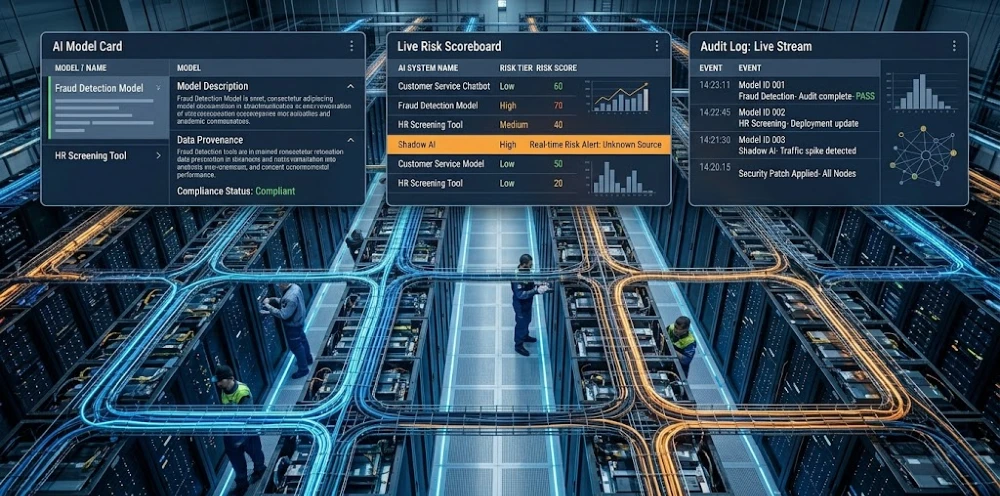
| What It Is | What It Isn’t |
|---|---|
| A live registry of every AI system in production | A one-page AI ethics statement |
| Real-time monitoring with automated alerts | A checklist you fill out before launch |
| Cross-functional ownership: legal, IT, risk, product | An IT-only compliance task |
| Aligned with NIST AI RMF, ISO 42001, or EU AI Act | A vague “responsible AI” pledge |
| Enforced at runtime — not just on paper | A policy doc sitting in a shared drive |
If your AI governance program doesn’t have logs, roles, escalation paths, and a system inventory, it doesn’t exist — it’s just intentions.
The Policy-as-Governance Problem
Here’s the core issue: most organizations treated AI governance like they treat terms of service. They wrote something, posted it somewhere, and moved on.
That worked — until it didn’t. For most of the last decade, AI governance was a matter of intent. Enterprises wrote ethical principles, formed review committees, and relied on internal guidelines to manage risk. According to Dataversity, that approach stopped working in 2025 when regulators globally shifted from guidance to enforcement.
The problem isn’t bad faith. It’s a structural mismatch. When a company runs AI in production — making hiring decisions, approving loans, personalizing content — a document doesn’t govern anything. The model does. And unless there’s infrastructure watching, auditing, and controlling that model at runtime, the document is just decoration.
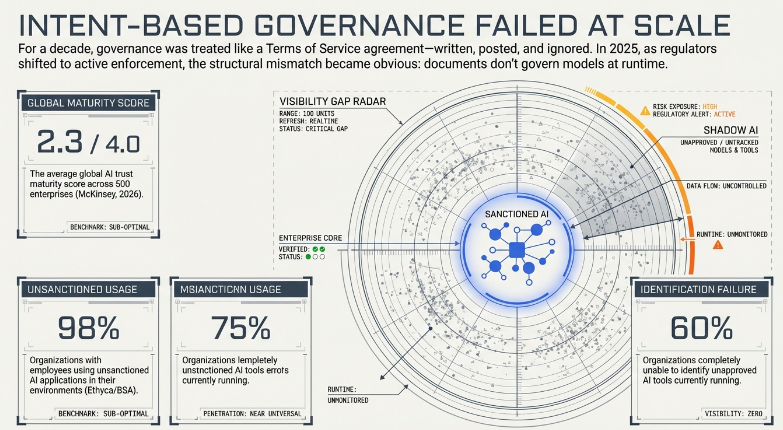
This is the governance gap in 2026. According to a McKinsey survey covering roughly 500 organizations, the average AI trust maturity score sits at 2.3 out of 4 — and only about one-third of organizations have reached level 3 or higher in governance specifically. Companies are technically advancing faster than their oversight structures can keep up.
The fix isn’t more documents. It’s treating governance the same way you treat cybersecurity: as operational infrastructure that runs continuously, not a compliance task you do once.
Why the “Document First” Approach Fails in Production
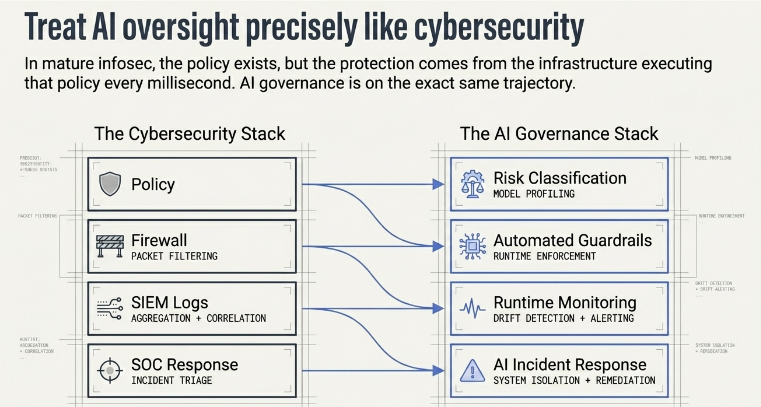
Think about how cybersecurity works in a mature organization. Nobody just writes a security policy and considers the job done. There are firewalls, logging systems, intrusion detection, incident response playbooks, and regular audits. The policy exists, but the real protection is the infrastructure executing that policy every day.
AI governance hasn’t reached that level at most companies — and the consequences are now measurable.
An estimated 98% of organizations have employees using unsanctioned AI applications, according to analysis by Ethyca citing BSA data. Meanwhile, 60% of organizations can’t even identify what unapproved AI tools are running in their environments. You cannot govern what you cannot see.
The practical failure mode looks like this: a company deploys an AI-powered hiring screening tool. Legal approves it. The model gets a sign-off. But six months later, the model has drifted — different performance on different demographic groups, different outputs than what was originally tested. Who catches this? Under a document-only governance model: nobody, until something goes wrong publicly.
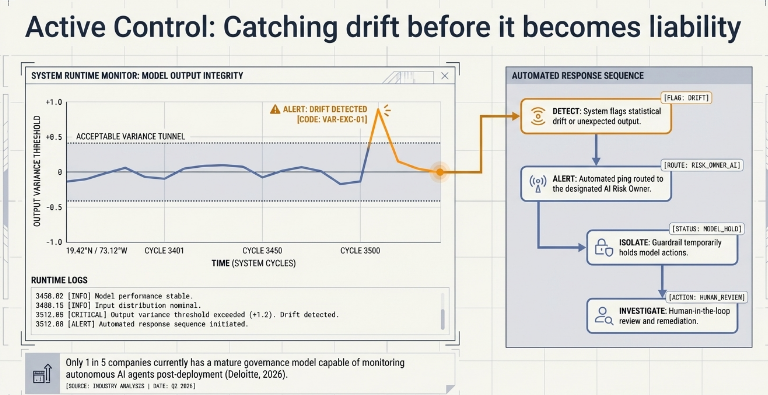
Under an infrastructure model: a monitoring system flags statistical drift, an alert goes to the AI risk owner, and the model either gets re-evaluated or rolled back. The difference is operational control vs. paper compliance.
What “AI Governance as Infrastructure” Actually Means
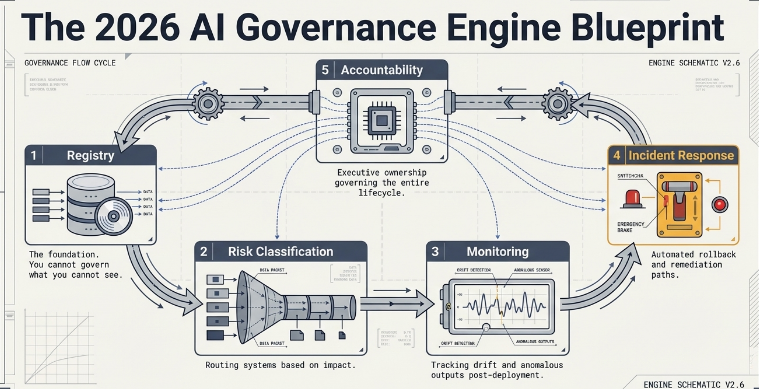
When governance becomes infrastructure, it has five concrete components. Every serious program in 2026 has all five. Missing even one creates a structural gap.
1. An AI System Registry
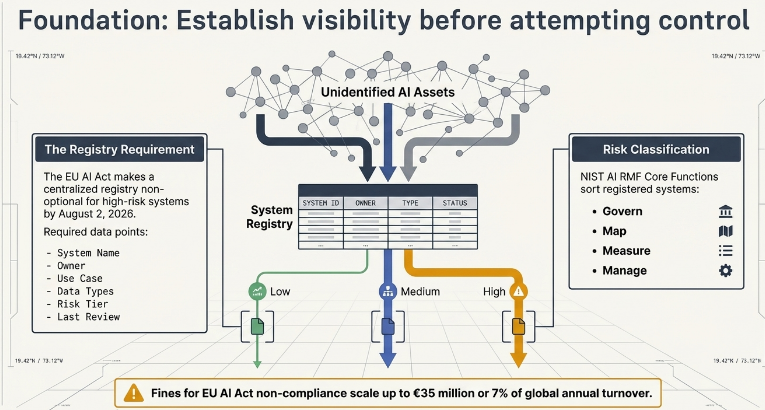
Before you can govern your AI, you need to know what AI you have. This sounds obvious, but most organizations don’t have a complete picture. The first step in any real governance program is building an internal registry: every AI use case, every model in production, who owns it, what data it touches, and what decisions it influences.
The EU AI Act makes this non-optional for organizations operating in or serving the European market — high-risk AI systems must be registered in an EU database by August 2, 2026. But even for organizations not directly subject to the EU AI Act, the registry concept is foundational. You can’t do risk classification, you can’t do audits, and you can’t respond to incidents if you don’t have a system inventory.
Practically, this registry doesn’t need to be a complex tool at first. Teams that have done this well often start with a shared spreadsheet covering six columns: system name, owner, use case, data types used, risk tier, and last review date. The discipline of maintaining it matters more than the tool.
2. Risk Classification
Not every AI system carries the same risk. An AI that auto-tags internal emails carries different risk than one that scores job candidates or flags insurance claims. Modern governance programs classify every registered system by risk tier — typically low, medium, and high — and apply different oversight requirements to each tier.
The NIST AI Risk Management Framework (AI RMF), first published by the National Institute of Standards and Technology in January 2023, provides a practical structure for this. Its four core functions — Govern, Map, Measure, Manage — create an iterative process for identifying and responding to AI risk across a system’s lifecycle. The framework is voluntary in the US, but it’s increasingly referenced in federal procurement requirements, enterprise vendor questionnaires, and cyber insurance applications. If your company sells AI products to enterprise customers or federal agencies, alignment with NIST AI RMF is effectively expected.
The EU AI Act takes a harder line. It defines specific high-risk categories — AI used in hiring, credit scoring, biometric identification, healthcare, education, law enforcement, and critical infrastructure. For systems in these categories, compliance isn’t optional. Full requirements for Annex III high-risk AI systems take effect on August 2, 2026, covering risk management, technical documentation, human oversight, accuracy, robustness, and cybersecurity.
Fines for non-compliance go up to €35 million or 7% of global annual turnover — whichever is higher.
3. Runtime Monitoring and Automated Guardrails
This is where governance becomes infrastructure in the truest sense. Monitoring happens after deployment, not just before it.
What does this look like in practice? For a production AI system, runtime monitoring means: tracking model outputs over time for statistical drift, logging inputs and outputs for audit purposes, setting automated alerts when outputs fall outside expected ranges, and defining escalation paths when something unexpected happens.
IBM’s watsonx.governance platform, for example, added an Agent Monitoring capability in Q1 2026 specifically to extend oversight to agentic AI — AI that can take autonomous actions, not just generate text. That distinction matters a lot because the risk profile of an AI agent that can send emails, book appointments, or execute transactions is categorically different from one that just answers questions.
Deloitte’s 2026 State of AI in the Enterprise survey found that only one in five companies has a mature governance model for autonomous AI agents. That’s a significant gap given how fast agentic AI is being deployed.
4. Defined Accountability Structure
Infrastructure requires ownership. Every component in a governance program needs a named person or team responsible for it. The model registry needs an owner. The monitoring alerts need someone receiving them. The incident response plan needs someone who executes it.
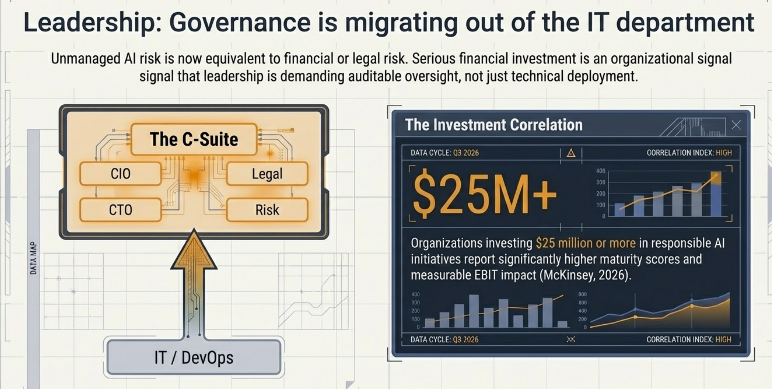
What’s changing in 2026 is where this ownership sits. Governance is moving out of IT and into executive oversight. Dataversity reports that as regulatory exposure grows, leadership teams are beginning to treat unmanaged AI risk the way they treat financial or legal risk — not as technical debt. CTOs and CIOs are now being asked questions like: Which systems are high-risk? Where are we exposed across jurisdictions? Can we pass an audit?
Organizations that delegate governance entirely to technical teams, without executive accountability, consistently show weaker outcomes. The McKinsey 2026 survey found that organizations investing $25 million or more in responsible AI initiatives reported significantly higher maturity scores and more measurable business impact. That correlation isn’t about the money per se — it’s about the organizational signal. Serious investment means leadership is paying attention.
check about AI Governance Accountability: Who Owns What in Your Organization?
5. Incident Response and Continuous Improvement
The last component is what happens when something goes wrong — and something will go wrong. An AI model produces biased outputs. A vendor model gets updated and behaves differently. A data feed gets corrupted and the model starts making bad predictions. These aren’t hypotheticals; they’re operational realities.
A governance program without an incident response plan is incomplete. The EU AI Act formalizes this with post-market monitoring and incident reporting requirements that take effect in August 2026. But even without regulatory pressure, the operational case is clear: you need a documented process for detecting, isolating, investigating, and remediating AI failures.
The Three Frameworks That Matter Right Now
There are a lot of governance frameworks out there. In 2026, three are actually shaping what organizations do in practice.
NIST AI RMF: The US Reference Point
The NIST AI RMF is voluntary, but that understates how influential it’s become. Federal agencies are required to use it when procuring AI systems under executive guidance from 2023. Enterprise vendor assessments regularly include NIST AI RMF alignment as a question. Cyber insurance carriers are starting to ask about AI governance practices, and documented alignment with NIST AI RMF is increasingly a baseline requirement for coverage, not a differentiator.
The framework’s four functions — Govern, Map, Measure, Manage — are designed as an iterative cycle, not a one-time checklist. Govern sets organizational policy and accountability. Map identifies the context and risk of specific AI systems. Measure tests and evaluates performance. Manage responds to identified risks through mitigations and monitoring.
NIST released a concept note on April 7, 2026 for an AI RMF Profile specifically for critical infrastructure, extending the framework’s reach into sectors like energy, water, and transportation.
The implementation challenge with NIST AI RMF is that it’s deliberately non-prescriptive — it tells you what to achieve, not exactly how. Teams that have gotten good results typically start with the Govern function first: establishing who owns AI decisions in the organization and what the accountability structure looks like. Without that, the Map and Measure functions lack clear ownership and tend to stall.
ISO/IEC 42001: The International Standard
ISO 42001, published in 2023, is the first formal AI management system standard. It’s documentation-heavy and aligns neatly with ISO 27001, which means organizations already running an information security management system have a natural path to adoption.
For multinational companies, ISO 42001 is increasingly the framework of choice because it provides a consistent structure across jurisdictions. Certification is possible (unlike NIST AI RMF), which matters for vendor relationships and enterprise contracts. One practical note: ISO 42001 implementation runs complex — particularly the risk assessment and treatment documentation requirements. Teams going this route for the first time often find it easier to build the foundational registry and monitoring infrastructure first, then layer ISO 42001’s management system requirements on top.
EU AI Act: The Legal Hard Floor
The EU AI Act isn’t a framework you choose — it’s a regulation you comply with if your AI systems operate in or affect the EU market. Its extra-territorial reach mirrors GDPR: US-based companies serving European customers fall within scope regardless of where their models run.
The key compliance milestones:
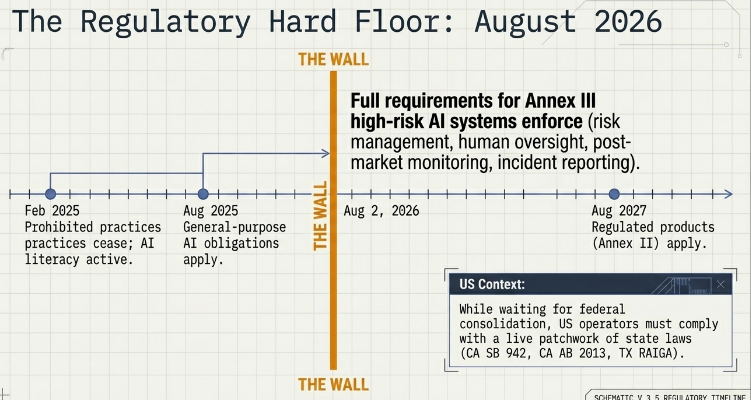
- February 2025: Prohibited AI practices must have ceased. AI literacy requirements in place.
- August 2025: Governance provisions and obligations for general-purpose AI models apply.
- August 2, 2026: Full requirements for Annex III high-risk AI systems become enforceable. This includes risk management, technical documentation, human oversight, post-market monitoring, and incident reporting. Transparency obligations under Article 50 — requiring disclosure of AI interactions and labeling of synthetic content — also activate.
- August 2027: Obligations for AI systems embedded in regulated products (Annex II) apply.
A Digital Omnibus proposal from the European Commission in late 2025 could extend some Annex III deadlines to December 2027, but this is not yet enacted and compliance experts universally advise treating August 2026 as the binding date.
For organizations not currently tracking the EU AI Act: the first practical step is classification. Does your organization develop, deploy, or use AI systems that fall into Annex III categories? If yes, the clock is running.
The Agentic AI Governance Problem Nobody Has Fully Solved
Here’s where things get genuinely harder. Most governance frameworks and monitoring tools were designed for AI systems that take inputs, produce outputs, and stop. A model reads a resume and returns a score. A model reads a customer query and generates a response. The interaction is bounded.
Agentic AI systems don’t work that way. They take on tasks, make sequences of decisions, use tools, access external systems, and take actions — sometimes irreversibly. An agentic AI that can send emails, create calendar events, execute code, or query databases introduces a risk profile that existing governance infrastructure wasn’t designed for.
The Partnership on AI identified agentic systems as a top governance priority for 2026, specifically highlighting the potential non-reversibility of actions, open-ended decision-making pathways, and expanded data access as new governance challenges. Current frameworks have principles for this but limited operational guidance.
What organizations running agentic AI responsibly in 2026 are actually doing:
- Defining explicit permission boundaries for what each agent can and cannot do (which systems it can access, what actions it can execute, volume limits)
- Building human-in-the-loop checkpoints for high-stakes or irreversible actions
- Logging every tool call and action taken by agents, not just final outputs
- Running agents in sandboxed environments before production deployment
The Lexology review of governance trends notes that controlling what actions AI systems can perform — data flow destinations, volumes, formats, access to external resources — is becoming a central operational security challenge as agentic AI scales. It’s governance at the action level, not just the output level.
What Real AI Governance Programs Actually Look Like: Three Maturity Levels
One of the more useful frames for this is maturity levels. Not every organization needs the same governance infrastructure. Here’s a practical breakdown.
Level 1 – Foundational (Where Most Organizations Are)
What exists: Some AI policies, maybe a list of approved tools, limited awareness of what AI is running across the business.
What’s missing: A formal system registry, risk classification, monitoring, defined accountability.
Immediate priorities at this level: Build the registry first. Spend one sprint documenting every AI system in production — who owns it, what it does, what data it uses. This single artifact unlocks everything else. Alongside that, run a risk classification pass: which systems, if they failed or produced biased outputs, would cause significant harm to users or legal exposure to the company?
Level 2 – Operational (Where Serious Programs Are)
What exists: A complete system registry, basic risk classification, some monitoring, defined ownership.
What’s developing: Formal alignment with a framework (NIST AI RMF or ISO 42001), regular audit cycles, incident response process, vendor AI risk management.
The most common gap at this level is vendor risk. Many organizations govern their internally built AI systems reasonably well, but the AI baked into their SaaS tools — HR platforms, CRM, customer support — often goes unexamined. Those systems are still subject to the EU AI Act if they’re used by EU customers or employees. The corporate compliance guide from Corporate Compliance Insights specifically flags reviewing vendor contracts for liability, audit rights, and data rights as a 2026 priority action.
Level 3 – Advanced (Where Leaders Are)
What exists: Continuous runtime monitoring, automated guardrails, executive-level AI risk reporting, full EU AI Act compliance posture, agentic AI governance controls.
What defines this level: Governance is embedded into the development process itself, not reviewed at the end. Model cards and risk assessments are created during development, not after. New AI systems go through a governance review before deployment, and that review is tied to the registry, not a separate one-off process.
McKinsey’s data shows that organizations investing seriously in responsible AI maturity are significantly more likely to report measurable business impact from AI — specifically EBIT impact above a threshold. Governance isn’t just risk reduction; it’s becoming a capability that enables faster, more confident AI deployment.
The Vendor Governance Gap: AI You Don’t Build but Still Own
A lot of organizations focus governance effort on AI they built internally. That’s understandable — those systems are most visible. But the harder problem in 2026 is vendor AI.
When a company uses an AI-powered ATS (applicant tracking system) to screen resumes, or uses an AI call analysis platform, or embeds a third-party AI model into a customer-facing product — they’re deploying AI. Under the EU AI Act, the deployer has obligations even if they didn’t build the model.
This creates a practical problem: most vendor contracts don’t give organizations the audit rights, documentation access, or transparency into model behavior they need to meet their own compliance obligations.
The 2026 operational guide from Corporate Compliance Insights recommends treating vendor AI risk as inherent risk — the same category as counterparty credit risk or data breach risk. The practical response is updating vendor review processes to include AI-specific questions: What AI does this vendor use? Is it a high-risk use case under EU AI Act criteria? What documentation can they provide? What monitoring do they do? What happens when their model changes?
This is one area where governance frameworks lag behind practice. Neither NIST AI RMF nor ISO 42001 provide detailed guidance on third-party AI risk management — organizations are largely building this on their own.
The US Regulatory Landscape: More Complex Than a Single Law
Unlike the EU, the US doesn’t have a single federal AI law. What exists is arguably harder to navigate: a rapidly expanding patchwork of state laws with different requirements, thresholds, and enforcement mechanisms.
As of January 2026, California’s AI Transparency Act (SB 942) and the Generative AI Training Data Transparency Act (AB 2013) require disclosure of AI-generated content and training data provenance. Texas’s RAIGA (Responsible Artificial Intelligence Governance Act) applies to developers and deployers of AI serving Texas residents.
An executive order signed in December 2025 signaled intent to consolidate AI oversight at the federal level, but legal experts note that state laws remain in effect until specifically overridden — and court challenges are expected. The practical advice from every compliance professional watching this space: don’t use federal uncertainty as a reason to delay building governance infrastructure. The state-level obligations are real now.
A Practical Starting Point: The 90-Day Governance Sprint
For organizations that know they need to build governance infrastructure but aren’t sure where to start, a 90-day sprint covers the foundational work.
Weeks 1–3: Inventory
Map every AI system in production or active deployment. Include internal builds and third-party tools. The output is a registry with at minimum: system name, use case, data types, owner, and deployment status. Don’t try to make this perfect — make it complete. A rough registry is infinitely more useful than a perfect process with no inventory.
Weeks 4–6: Risk Classification
Classify each system in the registry using a simple three-tier model: high, medium, low. High means the system influences consequential decisions about individuals (hiring, lending, health, legal), handles sensitive data, or operates autonomously. Medium means it influences business decisions without directly affecting individuals at scale. Low means internal tooling or low-stakes automation. This classification drives what governance controls each system needs.
Weeks 7–9: Accountability Assignment
For every high and medium risk system, name an owner. This person is responsible for monitoring, incident response, and keeping the registry entry current. Run a cross-functional session with legal, IT, risk, and product to agree on escalation paths: when does a governance issue go to legal? When does it go to the executive team? What’s the threshold for halting a system?
Weeks 10–12: Monitoring Baseline
For high-risk systems, establish baseline monitoring. What does normal output look like? What would constitute an alert-worthy anomaly? Set up logging if it doesn’t exist. Document the incident response process: detect, isolate, investigate, remediate, report.
This 90-day sprint doesn’t make you fully compliant with the EU AI Act or fully aligned with NIST AI RMF. What it does is create the operational foundation — registry, classification, ownership, monitoring — that every other governance work builds on. Organizations that try to jump straight to framework certification without this foundation consistently stall.
Check about:How to Build an AI Inventory: The Foundation of Every Governance Program
The Business Case Beyond Compliance
It’s worth being direct about something: governance as infrastructure isn’t only about avoiding fines. There’s a growing commercial argument.
For organizations selling AI products to enterprise customers, demonstrating mature governance posture is becoming a deal requirement, not a differentiator. Enterprise procurement teams are including AI governance questions in vendor assessments. In 2026, cyber insurance carriers have begun requiring documented evidence of AI risk management practices as prerequisites for coverage — not as preferred attributes, but as requirements.
For organizations deploying AI at scale internally, governance infrastructure reduces the cost of AI failures. A hallucinating model that produces bad outputs for six months before anyone notices costs more — in lost decisions, remediation work, and reputational damage — than the governance infrastructure that would have caught it in week two.
The Dataversity analysis frames it clearly: organizations without consistent, auditable oversight across AI systems will face higher costs whether through fines, forced system withdrawals, reputational damage, or legal fees. That’s not a prediction — it’s already happening.
What Still Doesn’t Work
A fair analysis can’t skip the gaps. Even in organizations with mature governance programs, several things remain genuinely hard.
Agentic AI: As noted above, the frameworks haven’t kept up with agentic systems. Organizations running multi-agent pipelines are largely inventing their own governance controls.
AI supply chain transparency: Upstream model providers don’t always share the documentation that downstream deployers need. The Partnership on AI notes that gaps remain in how documentation artifacts connect across the AI value chain — upstream developers document models without clarity on what downstream deployers need.
Speed vs. oversight: The governance review process, done rigorously, adds time to AI deployment. Organizations under competitive pressure to ship AI features fast often cut governance corners. The long-term cost of this is governance debt — a backlog of unreviewed systems that eventually becomes a compliance and operational liability.
Measurement: Governance is only meaningful if it’s measured. But most organizations don’t have clear metrics for governance program effectiveness. Incident rate, mean time to detect, percentage of systems with current risk assessments — these metrics exist in theory but aren’t widely tracked in practice.
The Shift That’s Actually Happening
The organizations that are getting this right aren’t treating AI governance as a compliance project with a finish line. They’re treating it as a continuous operational capability — like cybersecurity or financial controls — that runs alongside AI deployment indefinitely.
That shift in mindset changes everything. You stop asking “are we compliant?” (a point-in-time question) and start asking “is our governance infrastructure keeping pace with our AI deployment?” (an operational question). You stop assigning governance to a single team and start embedding it across functions. You stop writing policies and start building systems.
The comparison to cybersecurity is the right mental model. Twenty years ago, many organizations treated cybersecurity as documentation: write a policy, train employees, check a box. Then the incidents happened, the regulations came, and security evolved into infrastructure — SOCs, monitoring systems, incident response teams, continuous vulnerability scanning. Nobody treats cybersecurity as a document now.
AI governance is on that same trajectory. The organizations building the infrastructure today are positioning themselves well — not just for compliance, but for the kind of AI deployment that doesn’t blow up on them six months after launch.
Check about: EU AI Act vs. NIST AI RMF vs. ISO/IEC 42001


