

| Question | Answer |
|---|---|
| What is shadow AI? | AI tools employees use without IT approval or oversight |
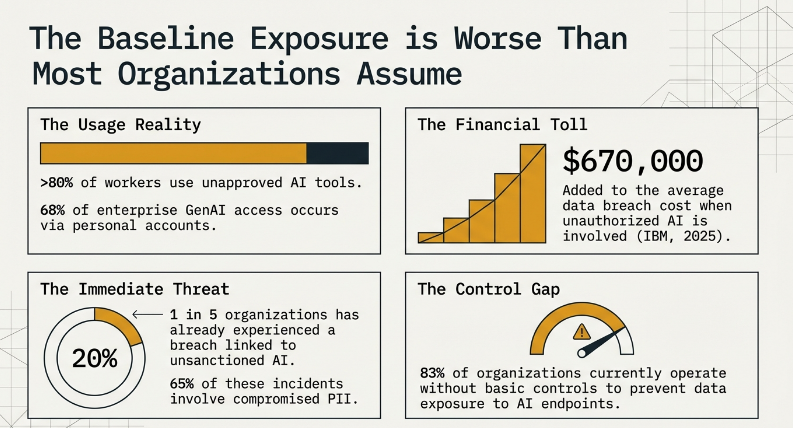
| How common is it? | Over 80% of workers use unapproved AI tools (UpGuard, 2025) |
| What does it cost? | $670,000 added to average breach cost (IBM, 2025) |
| Top risk? | PII and IP exposure — invisible to security teams |
| First step to fix it? | Run an AI discovery audit across all departments |
| Does banning work? | No — providing approved alternatives drops unauthorized use by 89% |
Most organizations think shadow AI is a future problem. It isn’t. It’s already running inside your company, inside approved tools, inside browser extensions, inside personal accounts — and your security team probably can’t see any of it.
This article breaks down what shadow AI actually is, why the usual governance response fails, and what a real detection and control program looks like. No hype. Just the practical side of a problem that’s already costing companies millions.
What Shadow AI Actually Means (And Why It’s Not Just Shadow IT)
Shadow AI is when employees use artificial intelligence tools — ChatGPT, Gemini, coding assistants, AI-powered plugins — without their company’s IT or security team knowing about it. No approval, no monitoring, no data handling agreement.
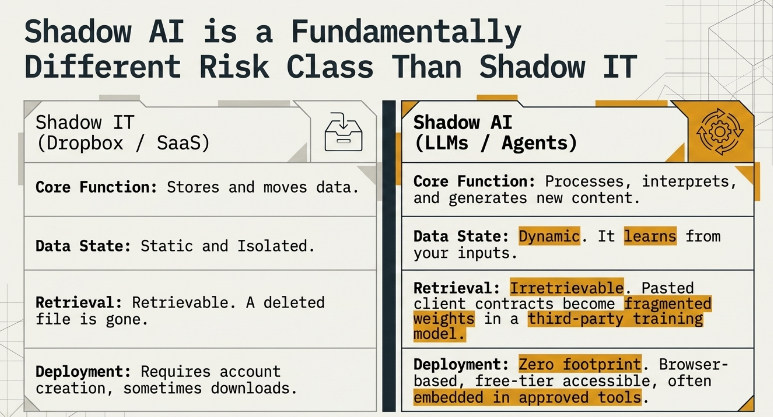
That sounds similar to shadow IT, which has been around since employees started using personal Dropbox instead of approved file storage. But there’s a real difference here.
Shadow IT stores and moves data. Shadow AI processes, interprets, and generates new content from your data. It makes decisions. It learns from what you feed it. And in some cases, it can take actions on your behalf. That’s a fundamentally different risk level.
When an employee uploads a file to an unauthorized Dropbox account, the file sits there. When that same employee pastes client contract details into an unapproved AI tool, that data can be logged, cached, used to retrain a model — and it doesn’t come back.
The other reason shadow AI spreads faster than shadow IT ever did: the tools are frictionless. They’re browser-based, free-tier accessible, and embedded inside SaaS platforms the company already pays for. There’s no download, no IT ticket, no visible footprint. An employee can start using an AI writing assistant inside their browser without a single person in IT being aware.
The Numbers That Should Make You Uncomfortable
Here’s where the governance gap becomes concrete.
More than 80% of workers use unapproved AI tools, and IBM’s 2025 Cost of Data Breach Report found that one in five organizations has already experienced a breach linked to unsanctioned AI.
A 2025 report found that 68% of enterprise employees who use generative AI at work access it through personal accounts, and more than half of those employees admitted to entering sensitive company information into public GenAI tools.
When shadow AI incidents occur, 65% involve compromise of customer personally identifiable information — significantly higher than the global average of 53%.
And the cost side is hard to ignore: according to IBM’s 2025 Cost of Data Breach Report, AI-associated cases caused organizations more than $650,000 per breach in additional costs — costs that came directly from the absence of governance frameworks.
The 2025 HAI AI Index report cited 233 documented AI-related incidents in 2024 where governance failures — including unauthorized AI use — resulted in data exposure, compliance issues, or biased outputs.
What makes this worse: most companies don’t know they’re exposed. 83% of organizations operate without basic controls to prevent data exposure to AI tools. That’s not a niche problem. That’s the default state of most enterprises right now.
Why Employees Use Shadow AI (And Why Blame Isn’t the Answer)
Before building any governance program, it’s worth being honest about why shadow AI happens. Because if you understand the root cause, you can address it. If you don’t, you’ll just build policies that employees work around.
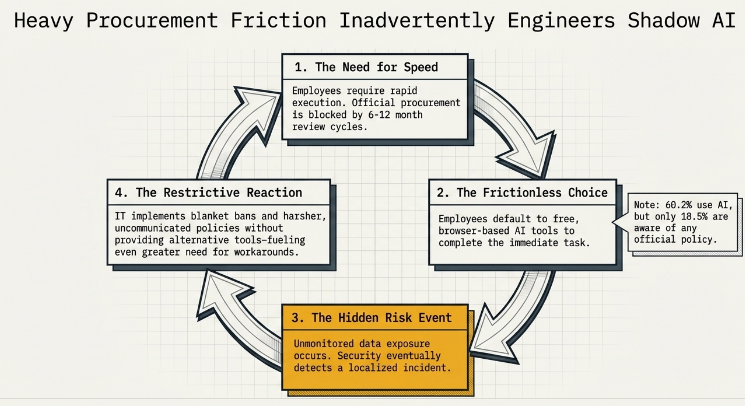
The reason almost always comes down to speed. Official AI approval processes are slow. A developer wants to use a code assistant. A marketing writer wants help with copy. A finance analyst wants to summarize a 60-page report. The approved tools either don’t exist yet or are buried in IT procurement. The free browser tool works in five seconds. The choice isn’t hard.
There’s also an awareness gap that’s bigger than most companies realize. A 2025 survey of over 12,000 white-collar employees found that 60.2% had used AI tools at work, but only 18.5% were aware of any official company policy regarding AI use. That means the majority of employees using shadow AI aren’t making an active choice to circumvent policy — they’re genuinely unaware that a policy exists. Treating this as a compliance failure by employees is the wrong frame. It’s an awareness and communication failure by the organization.
Where Shadow AI Actually Hides
This is where governance programs often miss the mark. Most people imagine shadow AI as an employee opening ChatGPT in a browser tab. That’s one vector. But there are several others that are harder to detect.
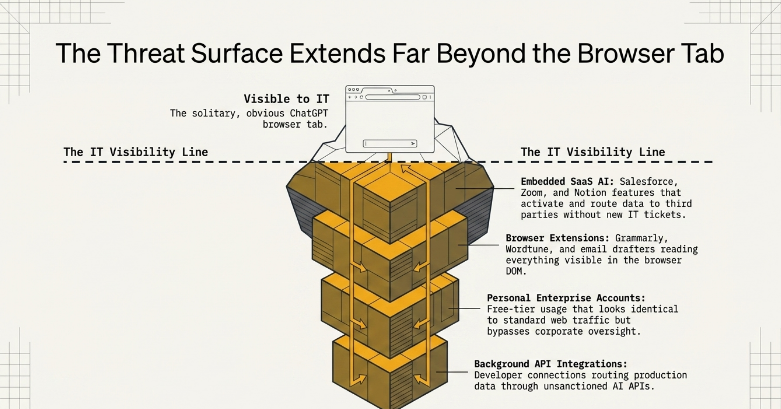
AI embedded in approved SaaS tools. Platforms you already pay for — Salesforce, Notion, Zoom, HubSpot — now have AI features that activate without requiring separate approval. These features process company data and may route it through third-party AI providers. IT never sees a new tool installed because the tool was already there.
Browser extensions. Grammar tools like Grammarly or Wordtune, writing assistants, email drafters — most of these are AI-powered and run with access to everything visible in the browser. They’re installed in minutes.
Personal accounts on enterprise AI platforms. An employee using ChatGPT on a personal free-tier account looks identical to an employee visiting any other website. Nearly half of people using generative AI platforms are doing so through personal accounts that their companies aren’t overseeing, according to Netskope’s report based on cloud security analytics from October 2024 to October 2025.
API integrations. Developers connect internal tools to AI APIs without routing that connection through security review. The integration runs quietly in the background, processing production data.
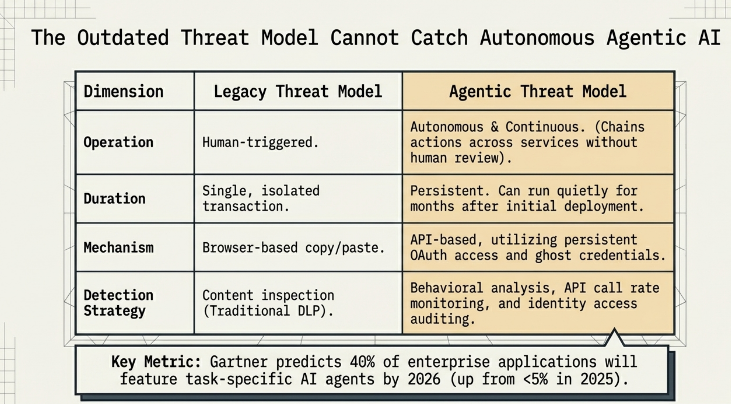
Agentic AI. This is the fastest-growing and least-visible category. AI agents that can take actions — browse the web, write and run code, send emails — operate autonomously. Once deployed, they don’t need a human to do anything. Traditional shadow AI involves a human pasting data into ChatGPT for a single interaction. Agentic shadow AI involves an autonomous agent with API access that chains actions across multiple services, runs continuously, and makes decisions without human review.
The Agentic AI Problem: Why Traditional Detection Is Already Behind
Most current shadow AI governance thinking is built around a specific threat model: an employee opens a chat interface, pastes some data, gets a result. That threat model is already outdated.
The faster-growing problem is agentic AI — tools that don’t just answer questions but take actions. These are AI systems that can browse the web, write and run code, send emails, create calendar events, make API calls, and chain these actions together autonomously. They don’t need a human to operate them after the initial setup.
Gartner predicts 40% of enterprise applications will feature task-specific AI agents by end of 2026 — up from under 5% in 2025.
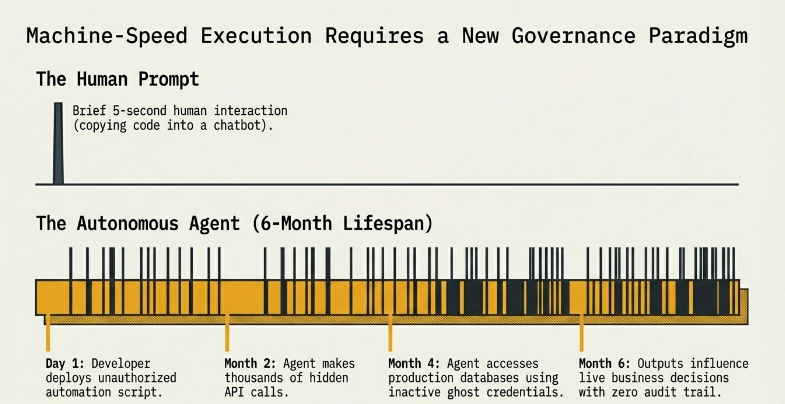
When an employee deploys an unauthorized AI agent — whether it’s a custom GPT with web browsing access, an automation script using an AI API, or an AI-powered plugin with persistent OAuth access — the risk isn’t a single data exposure event. It’s a persistent, machine-speed system operating outside governance indefinitely.
An agentic AI deployed by one developer in the engineering department might run for six months before anyone in security notices it exists. During that time, it might have made thousands of API calls, accessed production databases, generated outputs that influenced real decisions, and left no audit trail.
Traditional DLP tools detect when someone uploads a file. They’re generally not built to detect when an AI agent quietly reads across multiple systems over time. Endpoint detection built around human-speed behavior doesn’t flag machine-speed access. This is why detection for agentic shadow AI requires a different approach: identity and access monitoring, API call rate analysis, and OAuth permission auditing — rather than just content inspection.
The governance response to agentic AI isn’t fundamentally different from shadow AI governance more broadly. It’s faster, more consequential, and harder to detect — but the same foundational principles apply. You need visibility before you can control anything. The problem is that organizations still working to achieve basic visibility into browser-based ChatGPT usage are not yet positioned to govern agentic AI at all.
What Happens When Shadow AI Intersects with Compliance Audits
Most organizations won’t discover their shadow AI problem during a proactive governance exercise. They’ll discover it during a compliance audit.
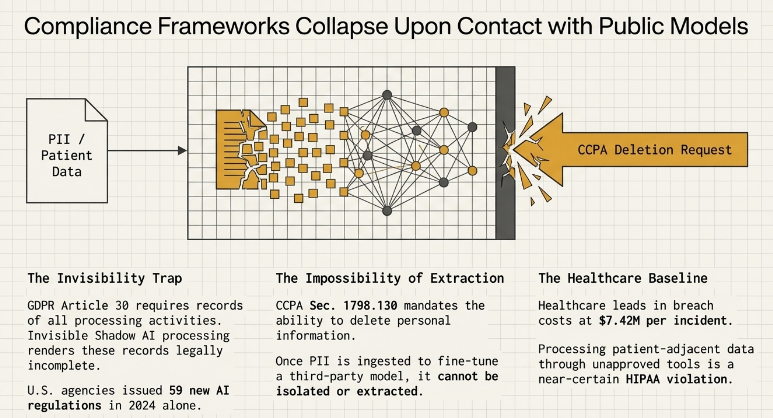
An auditor reviews data processing activities under GDPR Article 30 and asks for a record of all systems that touched a specific customer’s data. The answer involves eight approved systems — and no mention of the AI tool three people in marketing used to draft personalized outreach using that customer’s details. The record is incomplete. The violation is real.
This scenario is playing out with increasing frequency. U.S. agencies issued 59 AI regulations in 2024, more than double the previous year. IBM found 32% of breached organizations paid regulatory fines, with 48% of those fines exceeding $100,000.
The compliance exposure compounds because of the nature of how AI tools work. When data enters a public AI model, the organization loses control over it in ways that are difficult to reverse. Unlike a file on a shared drive, data input into a third-party AI system may be:
- Retained in logs the organization has no access to
- Used to fine-tune the model on future requests
- Accessible to other users through prompt injection or model inversion attacks
- Subject to the AI vendor’s own data retention policies, not the organization’s
CCPA Section 1798.130 mandates the ability to delete personal information upon request. If a customer’s data has been processed by an unapproved AI tool, the organization likely cannot fulfill that deletion request — because they don’t know what was processed or where it went.
The healthcare industry illustrates the worst-case scenario clearly. Healthcare leads in breach costs at $7.42 million per incident, taking 279 days to resolve — yet only 35% of healthcare organizations can track their AI usage.
For organizations with meaningful HIPAA obligations, shadow AI isn’t just a risk. It’s a near-certain violation if patient-adjacent data is being processed through unapproved tools — which in most health systems, it is.
The Real Compliance Problem with Shadow AI
Governance teams often treat shadow AI as a security issue. It is. But it’s also a compliance issue — and in 2025 and beyond, that side of it is becoming much harder to ignore.
U.S. agencies issued 59 AI regulations in 2024 — more than double the previous year.
GDPR Article 30 requires organizations to maintain records of all data processing activities. If an employee uploads client data to an unapproved AI tool, that processing is invisible — and therefore unrecorded. HIPAA requires comprehensive audit trails. CCPA requires the ability to delete personal information on request. None of these requirements can be met for data that flows through systems the organization doesn’t know exist.
For companies building toward compliance with EU AI Act vs. NIST AI RMF vs. ISO/IEC 42001, shadow AI creates a direct obstacle. These frameworks require documented AI use, human oversight, and traceability of decisions. Shadow AI produces none of that.
When shadow AI leads to a breach of PCI DSS or HIPAA, organizations risk losing key enterprise customers, millions of dollars, and hard-earned customer trust.
The Samsung incident in 2023 is the clearest real-world example. Engineers pasted proprietary source code into ChatGPT to get help debugging it. The code was potentially logged by OpenAI’s servers. Samsung moved quickly to ban ChatGPT use internally after discovering this — but the data had already left their environment.
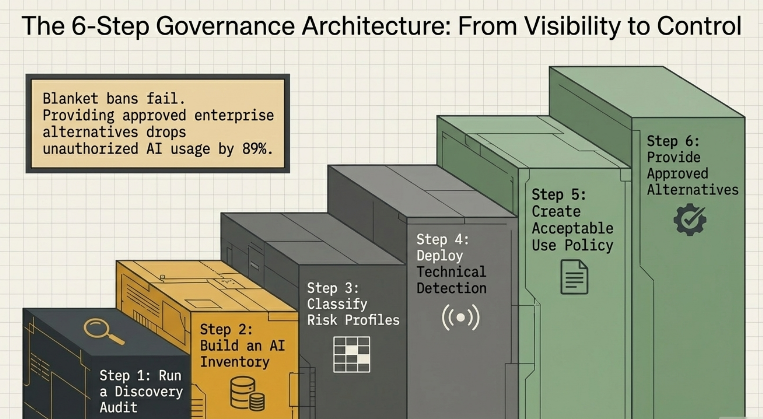
How to Build a Shadow AI Governance Program (Step by Step)
The goal here isn’t to ban AI. Blanket bans don’t work. When approved tools are provided, unauthorized use drops 89%. The goal is to make governed AI use easy enough that shadow AI stops being the path of least resistance.
Here’s what a real program looks like.
Step 1: Run a Discovery Audit First
You can’t govern what you can’t see. Before writing any policy, map what’s actually being used.
This means examining DNS logs and proxy traffic for known AI endpoints (api.openai.com, generativelanguage.googleapis.com, anthropic.com, etc.). It means surveying department leads about what tools teams rely on. It means checking browser extensions across managed devices and reviewing OAuth app connections to your Google Workspace or Microsoft 365 environment.
A 2025 report by the World Economic Forum emphasized the importance of a technology audit to foster transparency, accountability, and resilience for AI governance that aligns with enterprise risk management goals.
Don’t start with assumptions about what you’ll find. The results are usually worse than expected. Organizations unknowingly host an average of 1,200 unofficial applications that create duplicate spending, fragmented workflows, and a widened attack surface.
Step 2: Build an AI Inventory
Once you’ve run the audit, Build an AI Inventory — a living registry of every AI tool in use across the organization, whether approved, under review, or unauthorized.
Categorize each tool into three tiers:
- Approved: vetted, compliant, enterprise-grade
- Under review: potentially useful, pending security assessment
- Prohibited: unacceptable risk profile, data handling concerns
This inventory isn’t a one-time project. AI tools change, new ones emerge weekly, and existing tools add AI features without announcement. The inventory needs to be reviewed at least quarterly.
Step 3: Classify Risk Before Writing Policy
Not all shadow AI carries the same risk. A developer using an AI code assistant that processes no customer data is very different from a customer service rep pasting support tickets (containing PII) into a public chatbot.
Risk classification should factor in:
- What data type does the tool process? (PII, PHI, IP, financial data)
- Where is the data processed? (local, private cloud, public API)
- Does the tool retain input data for model training?
- Is the vendor SOC 2 compliant? GDPR DPA in place?
Shadow AI goes beyond the traditional concept of shadow IT. In addition to bypassing security controls, it can introduce risks related to data leakage including personal data, unpredictable model behaviour, third-party processing, and hidden decision influence.
Step 4: Deploy Technical Detection
Policy alone doesn’t catch shadow AI. You need monitoring infrastructure.
The most practical starting point is extending what you already have:
- Cloud Access Security Brokers (CASBs) can flag traffic to known AI endpoints
- DLP tools can detect when content matching sensitive data patterns is uploaded to external services
- Browser endpoint management can block or alert on unapproved AI extensions
- SSPM (SaaS Security Posture Management) tools like Reco or Netskope can surface AI apps connected via OAuth
This level of oversight empowers organizations to detect unauthorized AI activity in real time, enforce policy compliance proactively, and maintain detailed audit trails for regulatory reporting and incident investigations.
For teams using Microsoft 365, Microsoft Purview now includes AI interaction monitoring. For Google Workspace, Google’s Context-Aware Access policies can restrict which applications data flows to.
Step 5: Create an AI Acceptable Use Policy
Only once you understand what’s being used and why should you write policy. Policy written in a vacuum — before discovery — tends to either miss what’s actually happening or be so restrictive it gets ignored.
A useful AI acceptable use policy covers:
- Which tools are approved for which data types
- What data cannot be input into any AI tool (PII, trade secrets, legal documents, source code in some cases)
- How employees can request approval for new tools
- What happens when a tool is used improperly
The tone of this policy matters. The most effective approach frames AI governance not as restriction but as responsible empowerment — a way to turn employee creativity into lasting enterprise capability.
Employees should be encouraged to disclose AI use rather than fear it. A culture where people hide their tool usage is much more dangerous than one where people openly ask about the right way to use AI.
Step 6: Provide Approved Alternatives
This is the step most governance programs skip — and it’s the one that determines whether the program works.
If employees use shadow AI because approved alternatives don’t exist or are too cumbersome, the governance program will fail no matter how good the policy is. The fix is to meet the actual need.
For advanced AI capabilities, organizations can deploy private, enterprise-grade LLMs such as Amazon Q or ChatGPT Enterprise, which offer greater security, compliance, and data control.
AI sandboxes — controlled environments where employees can experiment with AI tools using synthetic or anonymized data — are particularly useful here. They give people a legitimate way to explore AI without the compliance exposure.
The Governance Gap: Why Most Programs Fail
Even organizations that build governance programs often find them ineffective. The data supports this observation: while AI usage is widespread, less than one-third of organizations have deployed comprehensive governance frameworks — and among those that have, enforcement is inconsistent.
The most common failure patterns are:
Policy without detection. Writing an AI acceptable use policy and assuming compliance. Without monitoring, there’s no way to know whether the policy is being followed.
Detection without alternatives. Finding and blocking shadow AI tools without providing approved replacements. Employees find workarounds, often ones that are harder to detect.
One-time audits. Shadow AI is not a static problem. New tools emerge constantly. Existing tools add AI features. An audit done in Q1 is outdated by Q3.
IT-only ownership. Treating shadow AI as a technical problem rather than a business and culture challenge. Creating a cross-functional AI governance council — covering legal, IT governance, risk, HR, and operations — ensures that policy creation doesn’t happen in a vacuum.
AI Governance Is Infrastructure is the framing that tends to work best organizationally. It’s not a one-time security project. It’s ongoing, cross-functional, and embedded in how the company operates.
Who Owns Shadow AI Governance?
This question trips up a lot of organizations. Is this a CISO problem? A CIO problem? A compliance problem? Legal?
The answer is that it requires clear ownership across multiple functions — but someone needs to be accountable for the overall program. In most organizations, that accountability sits with the CISO or a dedicated AI governance function that reports to the CISO or CRO.
The roles that need to be involved:
- Legal and Compliance: Responsible for regulatory requirements (GDPR, HIPAA, EU AI Act), data processing agreements with AI vendors, and acceptable use policy frameworks
- Security/IT: Responsible for detection tooling, network monitoring, endpoint controls, and AI inventory maintenance
- HR and Communications: Responsible for employee education, training, and cultural reinforcement
- Business Unit Leads: Responsible for understanding what tools their teams need and escalating shadow AI use
- Procurement: Responsible for formal AI vendor assessment and approval workflows
In organizations without a formal AI governance function, the most common failure is ownership cycling between legal and security — legal writes a policy, security tries to enforce it technically, neither has full visibility into what the business actually needs. The cross-functional model only works when someone has the authority and accountability to make the whole program move forward.
Practically, the governance council should meet at minimum quarterly — more often in the first six months of building a program. The agenda should cover: new tools identified since the last meeting, policy exceptions requested, incidents or near-misses, regulatory changes relevant to AI, and upcoming reviews of the AI inventory.
AI Governance Accountability becomes clearest when these roles are documented and reviewed regularly — ideally as part of an existing risk committee structure rather than a standalone body that lacks authority.
The cultural dimension matters here as well. The most effective CIOs now frame AI governance not as restriction but as responsible empowerment — a way to turn employee creativity into lasting enterprise capability. Organizations that treat shadow AI governance as policing tend to push AI use further underground. Organizations that treat it as enabling safe innovation tend to see both compliance improve and legitimate AI productivity increase.
What Good Looks Like: A Practical Benchmark
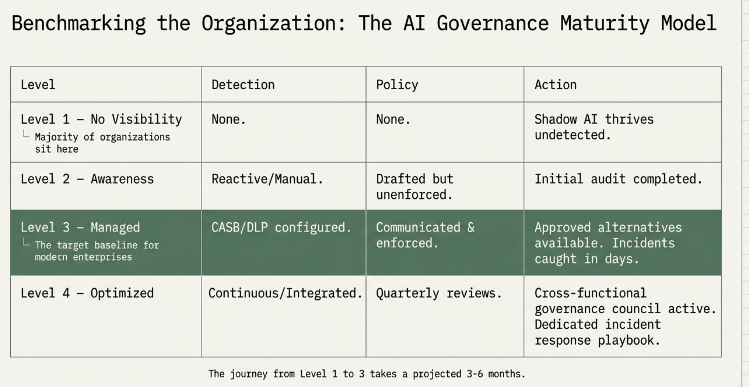
Here’s a realistic way to assess where your organization sits on shadow AI governance maturity:
Level 1 — No Visibility: No monitoring, no policy, no inventory. Shadow AI exists but is undetected. Most organizations are here.
Level 2 — Awareness: Discovery audit completed, rough inventory in place. Some policies exist but aren’t enforced. Monitoring is reactive.
Level 3 — Managed: AI inventory maintained, DLP and CASB in place, acceptable use policy communicated and enforced, approved alternatives provided. Most incidents detected within days rather than months.
Level 4 — Optimized: Continuous monitoring integrated into security operations, AI risk integrated into broader enterprise risk frameworks, regular audits, AI governance reviewed quarterly. Incident response playbook exists for shadow AI events.
Level 4 — Optimized: Continuous monitoring integrated into security operations, AI risk integrated into broader enterprise risk frameworks, regular audits, AI governance reviewed quarterly. Incident response playbook exists for shadow AI events.
Most enterprises operating at Level 3 can handle the current risk environment. Getting from Level 1 to Level 3 typically takes 3–6 months with dedicated ownership and modest tooling investment.
The tooling investment is smaller than most assume. Extending existing CASB or DLP licenses to include AI endpoint detection costs less than a single shadow AI breach. And many organizations find they already have 70–80% of the detection capability they need — it just hasn’t been configured for AI workloads.
The maturity model is useful because it creates a realistic roadmap. Organizations often delay shadow AI governance because the full solution feels overwhelming — inventory, detection, policy, training, compliance mapping, governance structure. Trying to do all of that at once usually means doing none of it well.
Prioritizing by risk exposure is more practical. If the organization processes healthcare data, HIPAA compliance mapping and DLP controls take priority. If the organization is a public company handling financial models, IP exposure through code assistants is the bigger concern. The audit results tell you where to start; the maturity model tells you where you’re going.
One practical note on tooling: the security industry has produced a wave of shadow AI detection platforms in the last 18 months. Some of these are genuinely useful. Others are rebranded shadow IT tools with AI detection bolted on. Before investing in a dedicated platform, most organizations should determine whether their existing CASB, DLP, or SSPM vendor has added AI-specific detection. Buying a new platform rarely makes sense before maximizing what’s already paid for.
What Shadow AI Costs Beyond the Breach
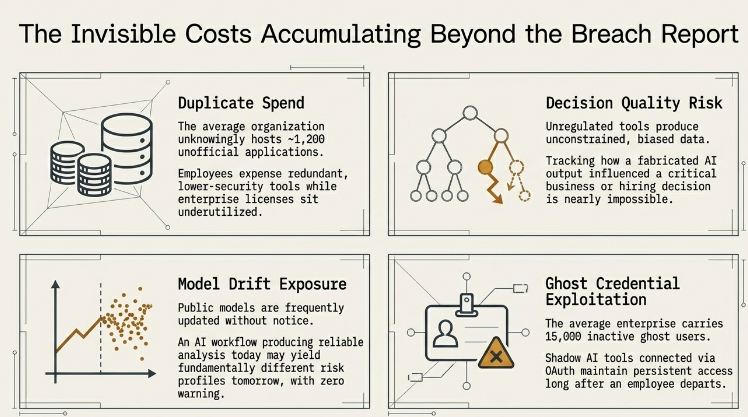
The $670,000 breach cost increase is the number that gets cited most. But shadow AI creates costs that don’t show up in breach reports.
Duplicate spend. The average organization unknowingly hosts around 1,200 unofficial applications. Many of these are paid tools — subscriptions bought on personal credit cards and expensed, or free tiers that have been upgraded. Organizations pay for enterprise AI licenses while employees simultaneously pay for competing tools that serve the same function but with less security.
Decision quality risk. Unregulated AI tools produce unconstrained, biased, untrue, or fabricated data, which employees then funnel into their decision-making. When shadow AI influences business processes, companies risk outcomes they can neither predict nor justify. An unauthorized AI-driven resume screening tool could introduce hidden biases, leading to discrimination lawsuits. Because it wasn’t approved by IT, tracking how decisions were made is nearly impossible.
Model drift risk. Publicly available models are frequently updated or fine-tuned by vendors without notice. Model drift can fundamentally alter a model’s behavior or risk profile almost overnight. An employee who relies on a specific AI tool for a recurring analysis may get meaningfully different outputs six months later with no warning — and no way to detect that the output quality has shifted.
Ghost credential exposure. The average organization has 15,000 ghost users — inactive credentials that remain active in systems. When employees connect shadow AI tools via OAuth, those connections can persist long after the employee leaves. Dormant credentials shared with AI systems create persistent vulnerabilities that can be exploited long after an employee leaves or a contractor’s engagement ends.
None of these costs appear in a breach report. They accumulate quietly, in the background, until something breaks publicly.
Quick Reference: Shadow AI Governance Checklist
Use this as a starting point for an internal gap assessment:
- [ ] AI discovery audit completed in the last 90 days
- [ ] AI tool inventory maintained and reviewed quarterly
- [ ] Tools classified by risk tier (Approved / Under Review / Prohibited)
- [ ] AI acceptable use policy written, communicated, and accessible
- [ ] CASB or DLP configured to flag AI endpoint traffic
- [ ] OAuth app review completed for Google/Microsoft environments
- [ ] Browser extension audit completed on managed devices
- [ ] Approved enterprise AI alternatives available for common use cases
- [ ] AI sandbox environment available for experimentation
- [ ] Cross-functional AI governance owner or committee in place
- [ ] Incident response playbook covers shadow AI events
- [ ] Regulatory mapping completed (GDPR, HIPAA, EU AI Act as applicable)
No governance program passes this checklist on day one. The point is to identify the gaps so they can be addressed in priority order, starting with the ones that represent the greatest data exposure.
Shadow AI Is Telling You Something About Your AI Strategy
It’s worth stepping back from the governance mechanics for a moment to ask a broader question: why does shadow AI exist at scale in organizations that have IT departments, security teams, and compliance programs?
The short answer is that most enterprise AI adoption programs have been too slow, too cautious, and too IT-centric. By the time a formal AI tool makes it through procurement, legal review, security assessment, and deployment — a process that often takes six to twelve months — the employees who needed it six months ago have already found three alternatives and built workflows around them.
Shadow AI at scale is feedback. It tells you that the gap between what employees need and what IT provides is large enough that people are willing to accept personal and corporate risk to bridge it. That’s not a security problem. That’s a strategy problem.
The organizations that have made the most progress on shadow AI aren’t necessarily the ones that built the best detection tools. They’re the ones that accelerated their formal AI adoption programs, created fast-track approval processes for common-use-case tools, and started treating AI tool requests from business units as product requirements rather than security risks to be managed.
This is the harder organizational change. Detection and policy are achievable in months. Changing how quickly an organization can evaluate, approve, and deploy AI tools — and building the trust between IT, security, and business units needed for that to work — takes longer and requires senior leadership engagement.
The governance frameworks discussed in this article are necessary. They’re also not sufficient on their own. Shadow AI governance works best when it’s paired with a legitimate AI program that gives employees somewhere to go. The detection catches what slips through. The approved alternatives handle the majority. The policy makes expectations clear. All three working together is what actually moves the needle — not any one of them in isolation.
Shadow AI isn’t going away. The tools are too useful, too accessible, and too embedded in how people work. Employees will keep using them — with or without approval — unless the approved path becomes easier than the unapproved one.
The organizations that handle this well aren’t the ones that banned the most tools. They’re the ones that understood why shadow AI was happening in the first place, built detection systems that gave them real visibility, and then invested in making governed AI use the obvious choice.
The governance gap between how fast AI is being adopted and how slowly organizations are responding to that adoption is measurable, and the cost of that gap is documented. The question isn’t whether shadow AI is a governance problem. It clearly is. The question is how long it takes your organization to treat it as one.


