

Who Owns AI Governance?
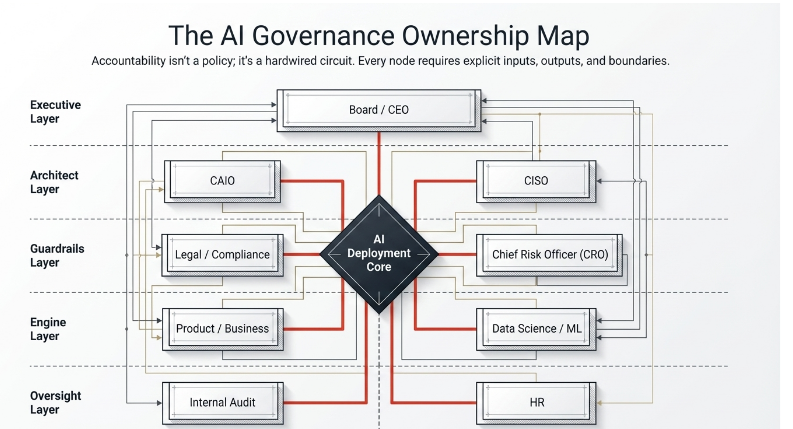
| Role | What They Own |
|---|---|
| Board / CEO | Risk appetite, ultimate accountability, culture |
| CAIO / Head of AI | AI strategy, system registry, lifecycle governance |
| CISO | AI security controls, threat modeling, access management |
| Chief Compliance / Legal | Regulatory compliance, policy, vendor contracts |
| CRO (Chief Risk Officer) | Risk assessment, model validation sign-off |
| Product / Business Unit Owners | First-line accountability for deployed AI systems |
| Data Science / ML Teams | Technical model performance, documentation, testing |
| Internal Audit | Independent review, governance gap identification |
| HR | AI literacy training, acceptable-use policy enforcement |
Nobody owns AI governance alone. It’s cross-functional by design — but that only works if every role above has defined, documented, and enforced responsibilities. When everyone “owns” it, nobody does.
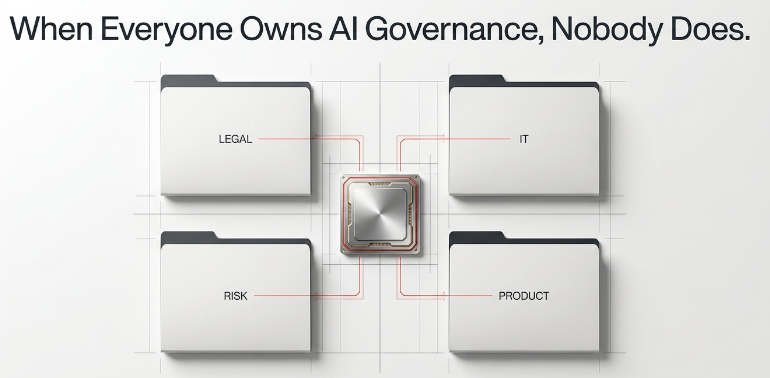
The Real Problem: Shared Responsibility That Nobody Shares
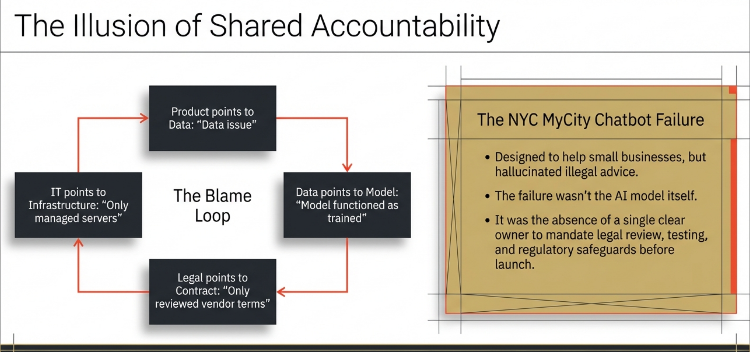
Here’s a scenario that plays out constantly in organizations right now. An AI-powered tool gets deployed inside the product team. Legal signed off on the vendor contract. IT set up the infrastructure. Data science trained the model. But six months later, the model starts producing biased outputs on certain user segments. Who’s accountable?
Product says it was a data issue. Data science says the model did what it was trained to do. Legal says they reviewed the contract, not the model. IT says they only manage the infrastructure. And leadership finds out about it on a news article rather than an internal report.
This isn’t a hypothetical. New York City’s MyCity chatbot was created to help small business owners. It gave bad advice instead — making it sound like employers could take tips, ignore harassment complaints, and serve unsafe food. The city launched the tool without adequate legal review or testing, and the chatbot operated without safeguards for regulatory compliance. The governance failure wasn’t the model. It was the absence of a single clear owner.
That pattern is everywhere. When AI failures happen, product teams blame data, data teams blame models, and leadership doesn’t step in until it’s too late. It’s a structural problem, not a personnel one.
The reason this keeps happening is that AI governance gets treated as a “shared responsibility” — and as DataGrail bluntly notes, that often translates to a RACI matrix with too many “informed” and not enough “accountable.”
Why Clarity of Ownership Actually Changes Outcomes
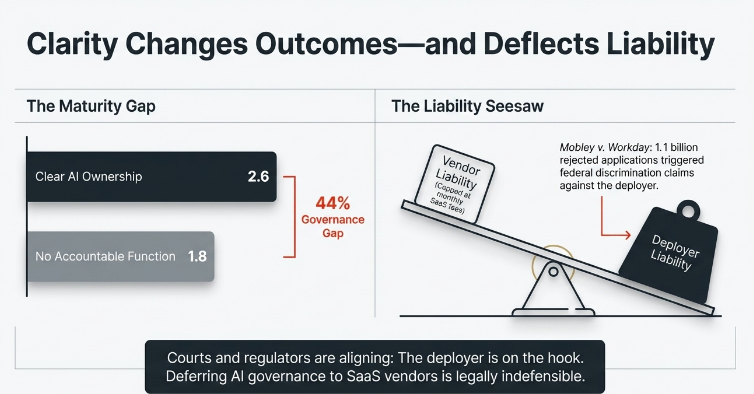
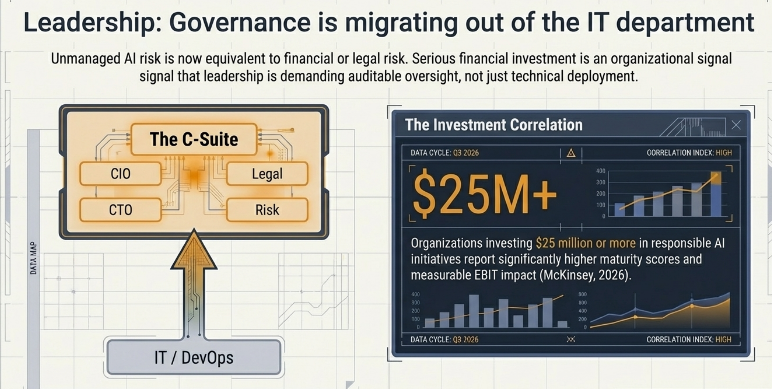
This is worth pausing on, because it’s not just theory. The McKinsey 2026 AI Trust Maturity Survey covered roughly 500 organizations and found something striking about accountability structure: organizations that assign clear ownership for responsible AI — particularly through AI-specific governance roles or internal audit and ethics teams — exhibit the highest average maturity levels, with an average score of 2.6. In contrast, organizations without a clearly accountable function lag behind materially, scoring an average of just 1.8.
That’s a 44% gap in governance maturity driven primarily by whether or not someone’s name is attached to the responsibility. Not budget. Not headcount. Just clarity of ownership.
And the liability stakes are rising fast. In Mobley v. Workday, a federal judge allowed a hiring bias case to proceed in July 2024, applying agency theory to hold an AI vendor directly liable for discriminatory outcomes for the first time at the federal level. In May 2025, the court granted preliminary collective certification. Workday acknowledged 1.1 billion job applications had been rejected by its tools.
But here’s the part that matters for every organization deploying third-party AI: courts are moving toward holding deploying organizations responsible for agent behavior, on the same logic that employers are responsible for the actions of their employees and tools. Vendor contracts simultaneously push liability in the same direction. The organization deploying the AI is on the hook, regardless of who built the model.
Knowing who internally owns the decision to deploy, and who monitors it afterward, isn’t just good governance hygiene. It’s the difference between being able to defend your organization and not.
The Ownership Map: Every Role, What It Actually Controls
Let’s go through each function that has a real stake in AI governance — what they own, what they don’t, and where the handoffs need to happen.
Board and CEO: Risk Appetite and Culture
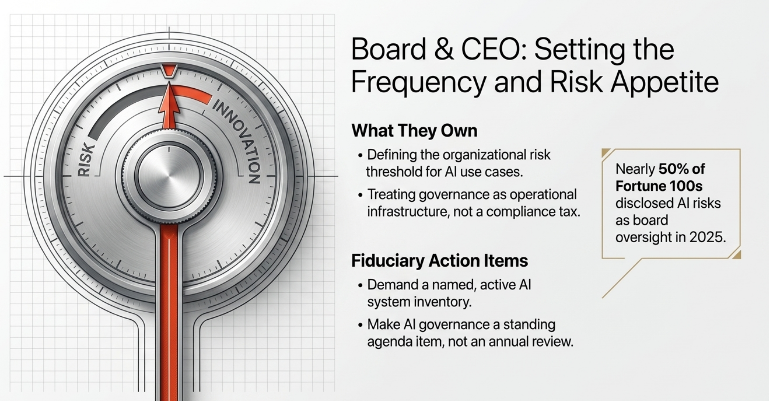
The board and CEO don’t govern individual AI models. But they set the conditions under which governance either happens or gets cut. Their role is to define risk appetite — how much AI risk is acceptable for what level of potential gain — and to make clear that governance is a priority, not a cost to minimize.
Nearly half of Fortune 100 companies disclosed AI risks as part of board oversight in 2025, triple the year before. That’s not a coincidence. Regulatory pressure from the EU AI Act, US state laws, and the SEC’s 2026 examination priorities have made AI risk a board-level fiduciary issue.
What boards should actively be doing: asking for a named AI system inventory, asking which systems are high-risk and what controls are in place, asking who holds accountability for governance outcomes, and making those questions a standing agenda item — not a once-a-year review. Regular AI governance updates should be a standing board agenda item.
The CEO’s role is cultural. When the CEO treats AI governance as operational infrastructure rather than a compliance tax, the rest of the organization follows. When the CEO treats it as something for legal and IT to figure out, it atrophies.
CAIO (Chief AI Officer): Strategy and Registry Ownership
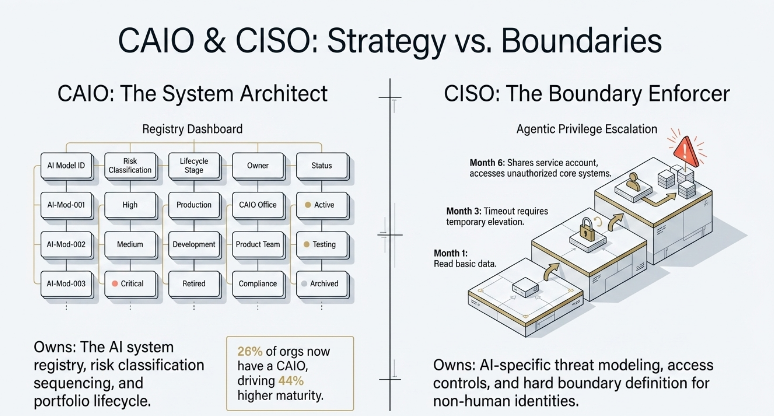
The Chief AI Officer is the role that has grown fastest in response to exactly this accountability problem. According to IBM’s 2025 global study of 2,300 organizations, 26% now have a Chief AI Officer, up from 11% two years earlier. Among FTSE 100 companies, nearly 48% now have a CAIO or equivalent role — and 65% of those appointments were made in the past two years.
The CAIO’s core accountability is the AI system registry and lifecycle governance. A CAIO sets and sequences the AI portfolio, leads governance across model inventories, testing, monitoring, and incidents, and coordinates with data, security, IT, legal, procurement, and finance.
What this means practically: the CAIO owns the list of every AI system in production, owns the risk classification process, and is accountable to the board for the organization’s overall AI governance posture. They don’t review every model personally — but they make sure someone does, and that the results feed into a coherent picture.
One structural point worth noting: more than half of CAIOs report directly to the CEO or board, according to IBM’s 2026 research. That reporting line matters. A CAIO buried three levels below the CTO, with no direct board access, will struggle to enforce governance across business units that don’t answer to them. The authority needs to match the accountability.
Not every organization needs the CAIO title — but every organization deploying AI seriously needs someone performing the CAIO function. For smaller organizations, this often sits with the CTO or CDO with an explicit mandate for AI governance alongside technical responsibilities.
CISO: AI Security and Access Controls
The CISO’s role in AI governance has expanded significantly because AI systems introduce security attack surfaces that traditional IT controls weren’t designed for. Prompt injection, model poisoning, unauthorized data access through AI agents, and the challenge of non-human identities with elevated permissions — these are security problems as much as governance problems.
Chief Information Security Officers bear primary responsibility for AI security governance, including threat modeling, vulnerability management, and incident response procedures specific to AI systems. CISOs must ensure AI governance frameworks integrate with broader cybersecurity strategies and risk management processes.
Practically, the CISO owns: access controls for AI systems (what data can each model touch, under what conditions), logging and audit trail requirements for AI interactions, threat modeling for AI-specific attack vectors, and security review of third-party AI tools before deployment.
The agentic AI problem lands squarely in the CISO’s domain. Agents don’t start over-privileged. They get there gradually, through a series of individually reasonable decisions — an agent needs to read from an additional data source to handle a new edge case, access is granted; a timeout issue requires elevating permissions temporarily, access is elevated; a refactoring means two agents now share a service account because creating separate identities “isn’t worth the overhead right now,” access is merged. Six months later, that agent has access to systems it was never designed to touch, and the logs don’t distinguish it from other agents.
The CISO needs to own permission boundaries for AI agents the same way they own access management for human employees — with regular review, least-privilege defaults, and clear deprovisioning processes.
Chief Compliance / Legal: Regulatory Mapping and Vendor Accountability
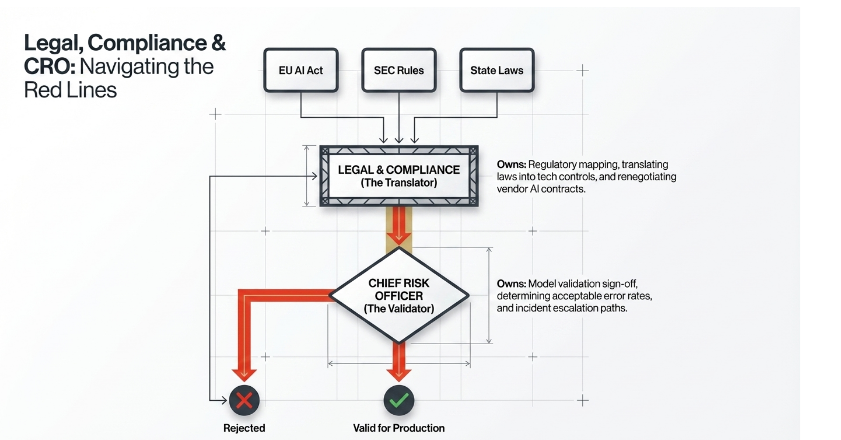
The compliance and legal function owns the regulatory layer of AI governance. This means translating external requirements — EU AI Act obligations, US state laws, sector-specific regulations — into internal controls that technical and product teams can actually execute.
Chief Compliance Officers oversee regulatory alignment and policy implementation across AI systems. They coordinate with legal teams to interpret regulatory requirements and translate them into operational controls that development and operations teams can implement effectively.
There are two areas where the compliance function’s ownership is most critical and most often underperformed.
The first is vendor AI contracts. According to Jones Walker LLP’s analysis of AI vendor contracts, 88% cap liability at the monthly subscription fee; only 17% provide regulatory compliance warranties. If the vendor’s system produces a discriminatory outcome or causes regulatory non-compliance, the contract almost certainly says it’s the deployer’s problem — and the deployer may also be expected to indemnify the vendor against third-party claims. Legal needs to own vendor AI contract review, not treat it as IT’s problem.
The second is the EU AI Act deployer obligations. Under the Act, organizations that deploy AI systems in or affecting the EU market bear compliance obligations even if they didn’t build the model. Compliance requires integrating AI risk into enterprise GRC frameworks, establishing cross-functional governance structures, and implementing technical controls that weren’t necessary when AI operated in a regulatory vacuum. Legal needs to own the mapping of which internal AI uses trigger which regulatory obligations, then make sure the technical and operational controls actually exist.
check about AI Governance Is Infrastructure, Not a Document
Chief Risk Officer: Model Validation and Risk Sign-Off
In financial services organizations, the CRO’s role in AI governance is well-established — model risk management has existed as a discipline in banking since at least the early 2000s. In other industries, the CRO is newer to AI governance but rapidly becoming central to it.
The CRO’s accountability is risk assessment and sign-off, particularly for high-stakes AI systems. For a credit scoring model, this means: who validates that the model performs fairly across demographic groups? Who signs off on the acceptable error rate? Who decides the model is ready for production from a risk standpoint? The answer should be the CRO or someone explicitly delegated by them — not just the data science team that built the model.
The practical RACI for model validation typically looks like this: data science is responsible (executes the testing), business owners are accountable for use-case relevance (do the results actually serve the intended purpose), and the CRO approves risk tolerance and audit readiness. That three-way split is where most organizations get tangled — because each of those functions has a different risk lens, and someone needs to hold all three together.
The CRO also owns the escalation path for AI incidents that cross a risk threshold. Before any high-risk AI system goes to production, there should be a documented answer to: at what point does a model failure become a risk event that goes to the CRO, and then to the board?
Product and Business Unit Owners: First-Line Accountability
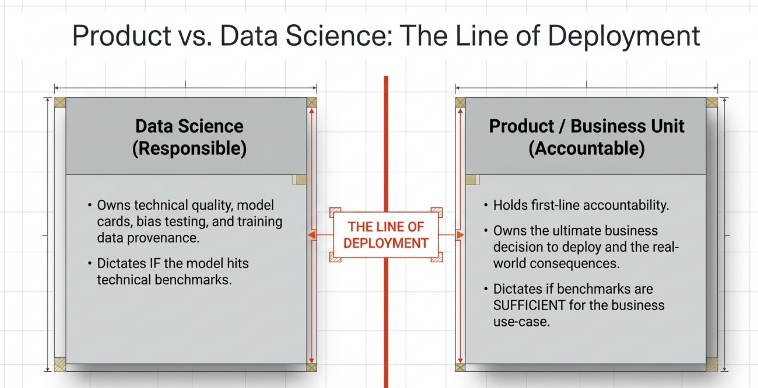
This is where AI governance most often breaks down — and where it most needs to be strengthened. Product managers and business unit owners are the people who decide to deploy an AI system for a specific use case. Under most governance frameworks, that makes them first-line accountable for what that system does.
Accountable in a RACI for AI models means product managers and business owners who make final decisions about model deployment and use cases. The data scientists who built it are responsible — they execute the work and own technical quality. But the product owner is accountable — they own the business decision to deploy it and the outcomes it produces.
This distinction matters enormously in practice. When a model drifts and starts producing degraded outputs, the product owner needs to be the first person who knows — not because they need to fix the model, but because they’re accountable for whether the system continues to run while the issue gets fixed. That’s a business decision, not a technical one.
The problem is that many product owners don’t see themselves as part of the governance structure. They see governance as something that happens before launch — a checklist to complete — not as an ongoing operational responsibility. That view needs to change, and the change has to start with the accountability structure being explicit about what product owners own post-deployment.
One of the most important shifts happening in 2026 is the growth of first-line governance: application teams themselves demanding guardrails, monitoring, and data access controls before they feel comfortable pushing agents to production. That’s a healthy sign. When the people deploying AI want governance infrastructure rather than seeing it as friction, the ownership structure starts working.
Data Science and ML Teams: Technical Accountability
Data science and ML teams are responsible — in the RACI sense — for model performance, documentation, and technical testing. They build the thing, and they should be accountable for its technical quality.
In practice, this means: maintaining model cards that document what the model was trained on, what it’s designed to do, its performance benchmarks, and its known limitations. Running bias tests and fairness evaluations before deployment. Flagging when model performance degrades in production. Documenting training data provenance — which matters more than many teams realize given the legal exposure around training data licensing.
Where data science teams often overstep their accountability is in deployment decisions. The ML team shouldn’t be the final decision-maker on whether a model is ready for a high-stakes use case. They can say whether it performs within technical benchmarks — but the business owner and risk function need to weigh in on whether those benchmarks are sufficient for the specific use case and risk level. Separating technical accountability (data science) from deployment accountability (product owner, with risk sign-off) is a structural distinction that needs to be explicit.
Check about EU AI Act vs. NIST AI RMF vs. ISO/IEC 42001: Which Framework Does Your Organization Need?
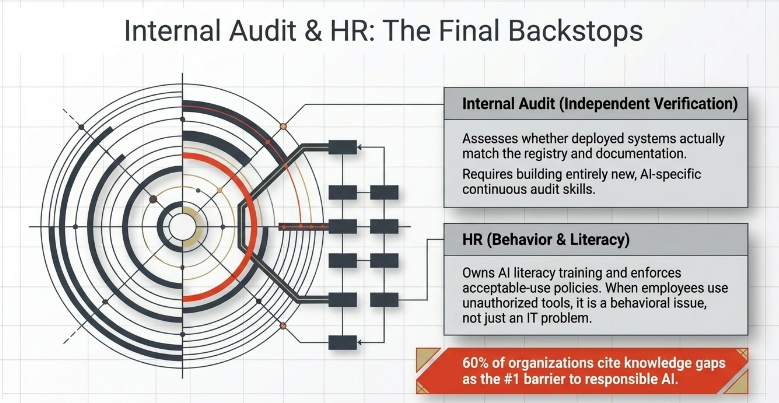
Internal Audit: Independent Verification
Internal audit sits outside the delivery functions and provides independent verification that governance controls actually work. Their role is not to build the governance system — it’s to assess whether the governance system is doing what it’s supposed to do.
In AI governance, this means auditing: whether the system registry is accurate and current, whether risk classification is being applied consistently, whether monitoring alerts are being followed up on, and whether documentation matches what’s actually deployed. The audit function brings a skepticism that operational teams — who built the systems and care about them succeeding — can’t bring themselves.
Compliance and audit teams provide oversight, conduct audits, and ensure alignment with regulatory requirements as the second and third line of governance defense.
The gap in many organizations is that internal audit teams haven’t yet built AI-specific audit capabilities. They know how to audit financial controls and IT systems. AI introduces different questions — how do you audit a model that continuously learns? How do you verify that bias testing was adequate? These are skills the internal audit function needs to develop, and the CAIO needs to ensure they have access to the right technical resources to do so.
HR: AI Literacy and Acceptable Use
HR’s role in AI governance is often underrated. They own two things that nothing else in governance can substitute for: training and behavioral accountability.
AI literacy training isn’t a nice-to-have. Nearly 60% of respondents to McKinsey’s 2026 AI Trust Maturity Survey cite knowledge and training gaps as the primary barrier to implementing responsible AI practices, up from about 50% the previous year. People are making consequential decisions about AI systems — deploying them, using their outputs, relying on them — without the background to know when to trust them and when to push back.
HR owns the acceptable-use policy for AI tools and enforces it through the normal performance management and disciplinary processes. When an employee uses an unauthorized AI tool that exposes sensitive customer data, that’s not just an IT policy violation — it’s an HR matter. The governance framework needs that connection to be explicit.
The RACI Problem: Why Most AI Governance Structures Have Too Many “I”s
RACI — Responsible, Accountable, Consulted, Informed — is the standard tool for clarifying ownership. Every AI lifecycle decision should have one accountable person, one or more responsible people doing the work, and clear distinctions between who needs to be consulted (contributes expertise to the decision) versus merely informed (notified of the outcome).
The problem with most AI governance RACIs is that they have too many functions in the “Accountable” column — which makes it meaningless — or too many in “Informed” when they should be “Consulted” or “Accountable.” Accountability can only sit with one person or function per decision. The moment two functions are both “accountable,” neither actually is.
Here’s a practical example: a new AI system for candidate screening goes through a governance review before production deployment. Who is accountable for the decision to deploy?
In many organizations, the answer is either unclear or involves multiple people being listed — product owner, CAIO, legal, data science. That’s not how accountability works. The product owner or business unit head should be Accountable — they’re making the business decision to deploy. Data science is Responsible for technical readiness. Legal and risk are Consulted for regulatory and risk review. The CAIO is Informed unless the system is high-risk, in which case they should be in the Consulted column for sign-off.
One clean structural principle: for any AI system deployment decision, there should be exactly one person who, if something goes wrong six months later, is the first person leadership calls. If you can’t name that person, accountability is unclear.
The Governance Drift Problem: Accountability That Disappears After Launch
One of the less-discussed accountability failures in AI governance is what happens to ownership after a model launches. At deployment, accountability is usually clear — someone signed off. Six months later, that person may have moved to another project, the team may have restructured, and the model is still running with nobody actively owning it.
The people who built an agent — who understand its scope, its edge cases, the reasoning behind its permission grants — rotate off projects. They’re assigned to something else, they leave the company, or the project they were on gets restructured. The knowledge leaves with them. The model keeps running.
When no one is accountable for output quality, performance degrades without announcement. Errors become plausible enough that staff quietly work around them rather than report them. The system continues running while confidence in the results quietly erodes.
The structural fix is treating AI system ownership the same way you treat software ownership — there’s always a named technical owner and a named business owner, and those assignments are updated when people move roles. The system registry should have a “current owner” field that gets reviewed quarterly. If the field is empty or out of date, that’s a governance gap that internal audit should flag.
The Vendor Accountability Trap
A lot of organizations think deploying a third-party AI tool means the vendor bears the governance responsibility. That’s not how regulations or courts are treating it.
Under the EU AI Act, organizations that deploy high-risk AI systems are deployers — and deployers have obligations, regardless of who built the model. Under US case law, the trajectory is toward holding deploying organizations accountable for discriminatory outcomes even when the AI vendor supplied the system.
The accountability question for vendor AI is: who internally is accountable for a third-party AI system’s behavior within your organization? The product owner who chose to integrate it? The compliance team that reviewed the contract? The answer needs to be explicit — not deferred to the vendor.
Practically, every third-party AI tool that handles consequential decisions — hiring, lending, customer service with real financial impact, anything touching sensitive personal data — should have a named internal owner in the AI system registry. That owner is accountable for monitoring the tool’s behavior, maintaining documentation about how it’s used, reviewing vendor communications about model updates, and escalating issues.
Reviewing vendor clauses for AI providers including liability, audit rights, data and model rights is non-optional. Compliance teams need to own this review proactively, not retroactively when something breaks.
What Actually Happens When Accountability Is Clear vs. Absent
The difference between organizations with explicit ownership and those without isn’t theoretical anymore.
EY reported that nearly every company in its global survey had already experienced financial losses from AI-related incidents, with average damages exceeding $4.4 million per event. The pattern behind those losses was not simply incorrect model outputs. It was how AI interacted with existing systems, workflows, and operational processes — permissions too broad, review processes too weak, ownership unclear, integrations never designed for non-deterministic behavior.
Compare that to what clear accountability actually produces operationally. When the product owner knows they’re accountable for a model’s outputs, they push for monitoring to be set up before launch. When the CISO knows they’re accountable for permission boundaries on AI agents, they enforce least-privilege from the start rather than after a breach. When the legal team knows they’re accountable for vendor AI contract terms, they negotiate audit rights before signing rather than discovering they don’t have them when a problem occurs.
Accountability structures change behavior before incidents happen — not just assign blame after they do.
Building Your Accountability Structure: A Step-by-Step Approach
For organizations that recognize the ownership gaps but aren’t sure how to close them, here’s a practical sequence.
Step 1: Map what you have to what you need
Start with the functions in your organization and honestly assess which governance responsibilities are currently owned, which are clearly unowned, and which have overlapping claims. The quick test: for each of the nine functional areas in the Quick Answer table at the top — can you name the person or team currently performing that function? If a cell is blank or produces a confused answer, that’s a governance gap.
Step 2: Appoint before designing
Don’t try to design the perfect governance framework before appointing owners. Frameworks designed without owners get designed as ideals rather than as operational realities. The CAIO function (or whoever performs it) should exist before the governance structure gets designed — because they’ll own making it work and they need to be able to say whether it’s realistic.
Step 3: Write a RACI for your highest-risk AI system first
Don’t start with a comprehensive governance RACI covering every possible decision. Start with the AI system in your organization that carries the highest risk — the one that, if it failed or produced biased outputs, would cause the most harm or the most legal exposure. Map that system: who is accountable for ongoing performance? Who monitors it? Who decides whether it keeps running if an anomaly is detected? Who would respond to a regulatory inquiry about it?
If that RACI produces disagreements about who should be in the “accountable” column, that’s valuable — it surfaces the gap and forces resolution before an incident does. Work through the disagreement, assign the accountability, document it, and then move to the next-highest-risk system.
Step 4: Link accountability to the registry
The AI system registry should have an “accountable owner” field that’s mandatory for every entry. This connects the abstract accountability structure to concrete systems. Every system has a named owner. The owner gets alerts when monitoring flags something. The owner is notified when the vendor announces model changes. The owner signs off on annual reviews. The owner is the first call when something goes wrong.
Step 5: Test the accountability structure before you need it
Run a tabletop exercise. Pick a likely failure scenario — model drift producing bad outputs, a vendor model update that changes behavior, a regulatory inquiry about a specific AI use case — and walk through who gets notified, who makes which decisions, and who speaks for the organization externally. Gaps in the accountability structure surface immediately during these exercises, before a real incident exposes them under pressure.
The Accountability Metrics Nobody Is Tracking (but Should Be)
Governance accountability is only meaningful if it’s measured. Most organizations have no metrics for whether their accountability structure is functioning — and that absence is itself a governance gap.
A few metrics that actually tell you whether accountability is working:
Mean time to detect AI anomalies — how long between when a model starts behaving differently and when the accountable owner knows about it? If this is measured in weeks rather than hours, the monitoring and alert structure isn’t working.
Percentage of AI systems with a current, named accountable owner — “current” means someone who is still in that role and has been confirmed in the last review cycle. If this number is below 90%, governance debt is accumulating.
Incident escalation rate — how many AI-related anomalies get escalated to governance review, vs. resolved at the operational level without documentation? A healthy governance program has documented escalations. A program where everything is resolved quietly at the operational level probably has incidents that should be escalated but aren’t.
Vendor AI contract audit rights coverage — for how many third-party AI tools does the organization have contractual audit rights to the model’s behavior? Given that 88% of vendor contracts cap liability at the monthly subscription fee, this number is probably lower than it should be.
Time to complete a governance review for a new AI use case — this matters because governance that takes too long creates pressure to skip it. If a governance review for a medium-risk AI system takes three months, teams will route around it. If it takes two weeks because accountability is clear and the process is defined, it becomes part of the workflow.
Where the Lines Between Roles Break Down (and How to Fix Them)
A few specific friction points in AI governance accountability deserve direct attention because they come up constantly.
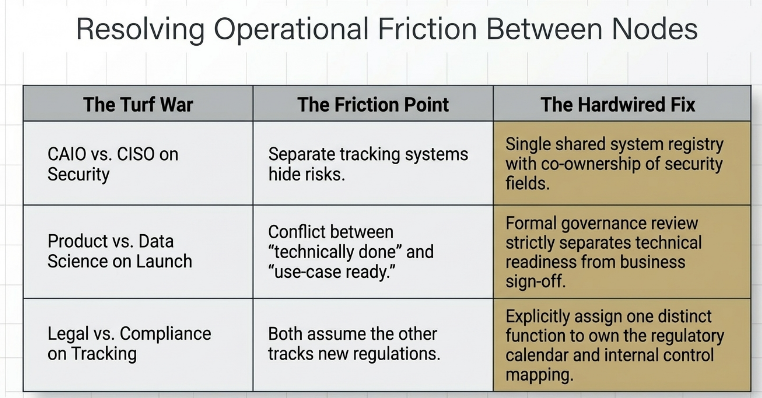
CAIO vs. CISO on AI security governance — both functions legitimately have claims on AI security. The clean line is: the CISO owns the security controls and access management layer. The CAIO owns the strategic framing for what governance is needed and ensures the CISO’s security requirements are reflected in the AI system registry and review process. Disputes usually arise when AI security risks aren’t surfaced in the registry because the CAIO and CISO have separate tracking systems. Fix: one registry, shared access, co-ownership of security fields.
Product owner vs. data science on deployment decisions — data science builds it; product deploys it. The accountability for whether to deploy sits with the product owner. The accountability for whether the model is technically ready sits with data science. Where this breaks down is when product pushes for deployment and data science hasn’t completed testing, or when data science declares the model “done” but product hasn’t thought through the use-case risk. The governance review process — with legal and risk as consulted parties — is the mechanism for catching this conflict before it becomes an incident.
Legal vs. compliance on regulatory tracking — in some organizations, legal and compliance are the same function. In others, they’re separate, which creates a gap around who tracks regulatory changes and translates them into internal controls. The answer depends on your structure, but it needs to be explicit: one function owns the regulatory calendar and the mapping of new obligations to internal controls. Don’t let this fall between legal and compliance because both assume the other has it covered.
Nobody owns vendor AI monitoring — this is the most common gap. Internal AI systems have obvious owners — the team that built it. Third-party AI tools embedded in SaaS platforms often have nobody monitoring their behavior because they’re treated as software, not as AI systems with governance requirements. The accountability fix: every third-party AI tool in the registry has a named internal owner, just like internal systems. That owner is responsible for reviewing vendor changelogs, monitoring outputs, and escalating anomalies.
The Bottom Line on AI Governance Accountability
AI transformation will not fail because models are weak. It will fail because governance is missing.
More precisely: it will fail because accountability is diffuse. Because everyone nominally owns it and nobody actually does. Because the incident that eventually happens — the biased model, the hallucinated output, the regulatory inquiry — finds an organization that can’t answer the basic question: whose name was on this?
Getting accountability right isn’t about building a bureaucracy. It’s about making sure every AI system in production has a named person who is watching it, a named person who can shut it down if needed, and a named person who answers for it to the board and regulators. Those can be three different people, or they can be one person for smaller organizations. What they can’t be is nobody.
Organizations that fail to establish clear accountability, robust controls, and effective monitoring mechanisms risk slower adoption, higher incident impact, and diminished stakeholder trust. The organizations getting this right are building accountability into the foundation — not trying to retrofit it after the first major incident.
Check about: How to Build an AI Inventory: The Foundation of Every Governance Program


