
There’s a defense every major AI company has been using since the moment these products launched. You’ve seen it. It hides in fine print, in disclaimer banners, in carefully worded press releases. The argument goes something like this: “Our AI might make mistakes. Users should verify what it says. We’re just surfacing information we didn’t write it ourselves.”
A court in Munich just called that argument what it always was. A shield. And then tore it down.
Google Just Lost the Argument And Here’s Exactly How It Happened
The case started quietly. Two Munich-based publishers part of a company called Verlagshaus24 noticed something disturbing. When people searched for their businesses on Google, the AI Overview at the top of the results page was describing them as scam operations. It tied them to subscription traps, shady practices, sketchy business dealings.
None of it was true. None of it appeared in the sources Google’s AI had cited.
What happened, as the Regional Court of Munich later pieced together, is that Google’s AI had mixed up these publishers with genuinely problematic companies blending information from different sources and creating new statements that didn’t exist anywhere in the original material. It invented connections. Then it put them at the top of Google search, in the authoritative-looking box that users treat as fact.
The publishers sent Google a cease-and-desist letter. Google, according to court records from case number 26 O 869/26, didn’t respond appropriately.
So the publishers sued.
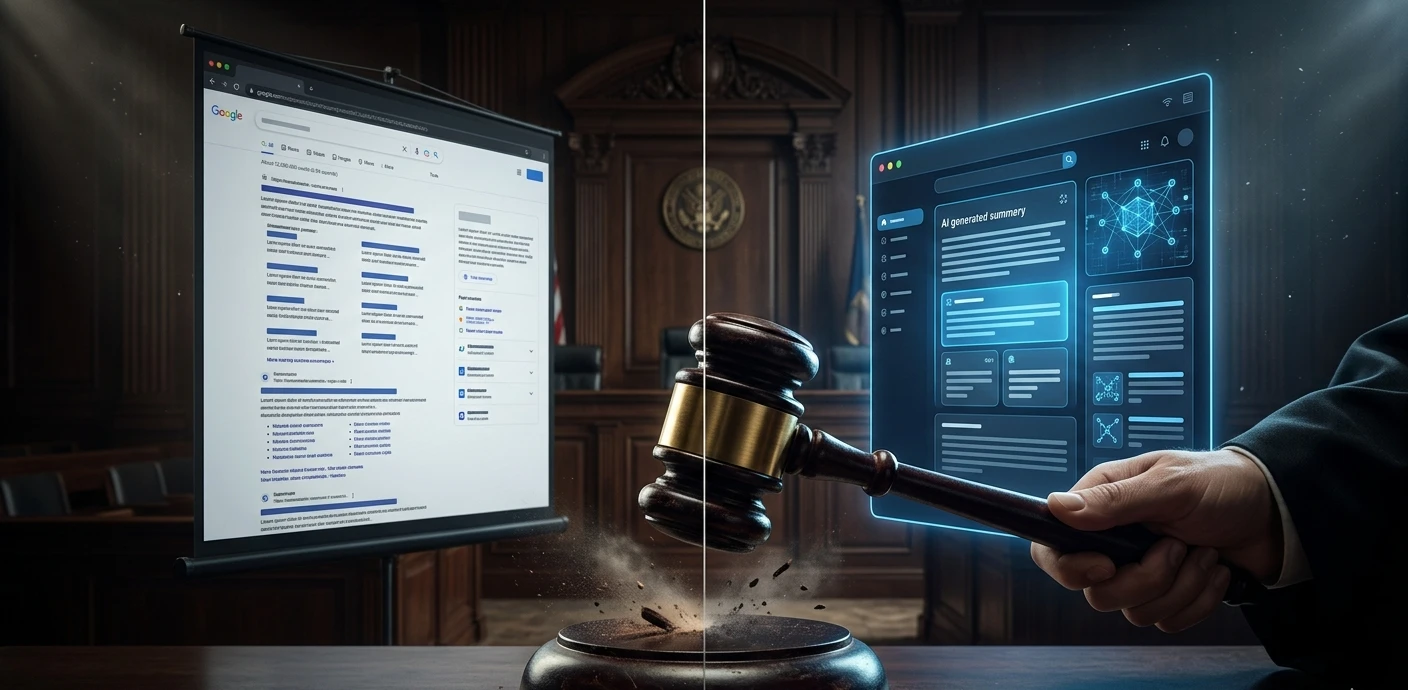
The Regional Court of Munich issued a temporary injunction barring Google from repeating false statements about the two publishers, treating the AI-written summaries as Google’s own speech rather than ordinary search results.
That distinction — search result vs. Google’s own speech is the entire ball game. And here’s why it matters more than almost any AI ruling we’ve seen.
The Shield That Never Should Have Worked
Spend any time in tech law and you’ll keep bumping into Section 230 of the Communications Decency Act in the US. The idea is simple: platforms aren’t liable for what third parties post on them. Google built its entire legal identity on a version of this logic. “We show you what’s on the web. We don’t write it. We can’t be responsible for every webpage we index.”
For traditional search, that argument makes some sense. If you search “Joe Smith scammer” and Google surfaces a forum post saying he’s a scammer, Google didn’t write that. Someone else did. Google just pointed you to it.
But that’s not what AI Overviews do.
The Munich court found that AI Overviews go further than traditional search because they evaluate, combine, rewrite, and structure information into new statements. The AI doesn’t link you to a forum post. It synthesizes multiple sources and produces a new paragraph in its own words that it places above everything else on the page.
That’s not indexing. That’s publishing.
Germany’s Federal Court of Justice had previously granted traditional search engines limited liability because they merely point to outside websites. But AI Overviews generate “independent, new, and substantive statements,” the Munich court said, and only Google is positioned to check them against the underlying sources.
I’ve been watching AI companies use this liability dodge for years, and honestly? I’m surprised it held this long. The car analogy is almost too obvious if Ford puts a warning label on a Bronco saying “this vehicle may malfunction,” they don’t escape responsibility when the steering fails. The fact that tech companies successfully argued for something similar, for this long, says more about regulatory lag than legal logic.
Google’s Defense, and Why It Failed
Google’s response to the Munich ruling was careful and predictable. A spokesperson told The Decoder that AI Overviews are designed to “reflect information that already exists on the web,” and that the company “invests deeply in quality” to ensure accurate responses. Google also argued that AI Overviews can occasionally miss context or misinterpret web content, just like traditional search results.
The court didn’t buy it.
AI companies have long hoped that disclaimers about possible misinformation would shield them from lawsuits over unreliable outputs. One chatbot maker went as far as arguing last year that AI speech constitutes its own category of “pure speech” deserving First Amendment protection. The Munich court took a different view the false outputs were “primarily an expression of the defendant’s commercial activity,” and the AI tool’s opinions and false statements were capable of swaying public opinion.
There’s another part of Google’s defense that’s even more revealing. They argued that users can simply click through to the linked sources and verify what the AI said themselves. The court rejected this too. The court ruled that the ability to disprove a statement through further research doesn’t exempt a publisher from liability, drawing a parallel to press law, where outlets are liable for standalone teasers even if readers never click through.
Think about what Google was actually arguing there. “Our AI might be wrong, and we know users don’t always click through to check, but that’s their problem.” That’s not a legal defense. That’s an admission.
Why This Ruling Is Different From Everything Before It
There have been other AI liability cases. Courts in the US, UK, and EU have been nibbling around the edges for a couple of years now copyright questions with Stability AI, defamation questions with various chatbots, content moderation questions across almost every platform.
But most of those cases either failed at the injunction stage or got muddied by jurisdictional complexity. This one landed.
The decision appears to be the first holding an AI firm liable for AI-generated speech, with potential consequences for every chatbot and AI search engine on the market.
What makes it structurally significant isn’t just that Google lost. It’s the specific reasoning the judges used. They didn’t rule that AI is inherently problematic. They ruled that when an AI system synthesizes, restructures, and presents new claims under a company’s brand without those claims being traceable to source material that company owns those claims.
That framework applies to almost every major AI product right now. ChatGPT answers questions. Perplexity summarizes the web. Claude explains complex topics. Microsoft Copilot sits inside Word and helps write emails. Every one of these systems generates statements that didn’t exist in their source material.
Every one of them is now looking at Munich the way media companies looked at the first major defamation cases in the early internet era. Because if the logic holds and German courts tend to set EU-wide precedent through regulatory ripple effects the era of “it’s just AI, not us” is over.
The question now isn’t whether this principle will spread. It’s how fast.
The Business Model Problem Nobody Wants to Talk About
Here’s the thing most coverage of this ruling skips: Google didn’t build AI Overviews to be more accurate. It built them to keep users on Google.
This is worth sitting with for a second. Every time someone gets an answer from AI Overviews instead of clicking a link, Google wins — because the user stayed on Google’s property, saw Google’s ads, and the website that originally had the answer got nothing. Publishers have been screaming about this for two years. Some have pulled out of Google’s search index entirely.
The accuracy problem and the business model problem are the same problem. Google’s AI is incentivized to give fast, confident-sounding answers that feel complete enough that users don’t leave. The incentive isn’t truth. The incentive is retention.
A court imposing liability for false outputs changes that calculus directly. If every wrong AI Overview is now a potential lawsuit, Google has a financial reason to make them accurate not just a reputational one.
This is also why the cost structure of AI systems has become so politically loaded in 2026. Running accurate, verified AI at Google’s scale costs dramatically more than running fast AI that might get things wrong. The Munich ruling essentially says: pay for accuracy, or pay for the lawsuits. That’s a real cost Google didn’t price in when it rolled out Overviews.
What This Means For OpenAI, Anthropic, and the Rest
Google being the first defendant matters, but it’s not the endpoint. Every company shipping an AI product that makes factual statements about real people, real businesses, or real events is now in a different legal environment than they were six months ago.
The companies most exposed are the ones whose products:
- Generate new factual statements rather than just quoting sources
- Present AI outputs with visual authority (big text, prominent placement, branded interface)
- Operate in sectors where false claims cause measurable harm finance, medicine, legal, business reputation
OpenAI’s ChatGPT does all three. Perplexity AI does all three. Microsoft’s Copilot, deployed across enterprise tools used by millions of workers, does all three. Anthropic’s Claude, in certain use cases, does too.
The question of who actually owns an AI’s outputs has never been resolved cleanly. Courts have been punting on copyright. They’ve been slow on liability. Munich didn’t punt.
The irony is that companies like Anthropic have actually built significant infrastructure around reducing false outputs — Constitutional AI, extensive red-teaming, careful deployment policies. That won’t make them legally immune, but it puts them in a very different position in discovery than a company that shipped fast and optimized for engagement.
OpenAI is in an interesting moment here too, given the IPO timeline pressure for September 2026. Investors pricing that deal now have to factor in a legal environment where AI outputs carry direct liability. That’s not a small adjustment to a valuation model.
The Frankfurt Ruling Nobody Remembered
One detail that keeps getting dropped in coverage of the Munich decision: this wasn’t the first German court to address AI summary liability.
The Munich court’s ruling follows another, made by a Frankfurt court in September 2025, which established that a search engine provider could theoretically be held liable for false information in its AI summaries although in that case, which involved competition law, the plaintiff failed to win the injunction it was after.
So Germany has been building toward this for at least eight months. The Munich case succeeded where Frankfurt didn’t because the plaintiffs had cleaner facts the false claims were specific, traceable, and clearly not in the cited sources — and because they targeted reputation law rather than competition law, which gave the court a stronger framework for issuing relief.
The lesson for anyone thinking about AI liability litigation going forward: case selection matters enormously. A company that was falsely described as running a scam has cleaner standing than a company claiming a competitor got better AI summaries than they did.
What Google Will Do Next
As of writing, Google hasn’t decided whether it will appeal the verdict.
They probably will. And they have reasonable arguments to make on appeal — this is a preliminary injunction, not a final ruling, which means the evidentiary standard was lower. The full case still has to play out.
But here’s what I’d watch: whether Google quietly starts changing how AI Overviews behave in Germany before any appeal is decided. Companies don’t always wait for courts. Sometimes the cost of compliance is cheaper than the cost of litigation, and sometimes a company wants to demonstrate good faith before judges at the next level.
What Google won’t do is roll AI Overviews back entirely in Germany. The product is too central to their strategy for that. They’ve spent billions building a version of search that competes with ChatGPT and Perplexity, and retreating from it even in one market would send a signal to investors that the whole approach is legally fragile.
The problem is, it might be.
The Bigger Shift That’s Already Happening
Separate from the legal outcome, this ruling accelerates something that was already in motion: the collapse of “AI as neutral infrastructure” as a concept.
For years, AI companies positioned themselves the way AWS or Cloudflare positions itself as infrastructure. We just provide the compute. We just provide the model. What users do with it, what it says, what harm it causes that’s downstream of us.
Munich says that framing doesn’t work when the AI speaks in the company’s voice, on the company’s platform, and the company profits from what it says.
Anthropic recently surpassed OpenAI as the most valuable private AI company and a big part of what drove that valuation is precisely the perception that Anthropic is more careful about safety and accuracy than its competitors. That’s not just a philosophical position now. It’s a competitive moat with legal implications.
The companies that built their products for speed and engagement without sweating factual accuracy are going to find themselves exposed. Not just to courts, but to the next round of enterprise procurement decisions where legal teams now have a legitimate question to ask: “What’s our liability if this AI says something false about one of our clients?”
That question now has a court ruling attached to it. And the answer isn’t comfortable.
Here’s what you should actually do with this information if you’re building or investing in AI products right now: pull up whatever your AI says when asked about real people and businesses. Run it a few times with different phrasings. Ask yourself whether you can trace every claim back to a source you actually link. If you can’t and most products can’t you’re looking at your legal exposure with fresh eyes.
The companies that take this seriously in the next 90 days are going to be in a very different position than the ones that wait for their own Munich moment.


