
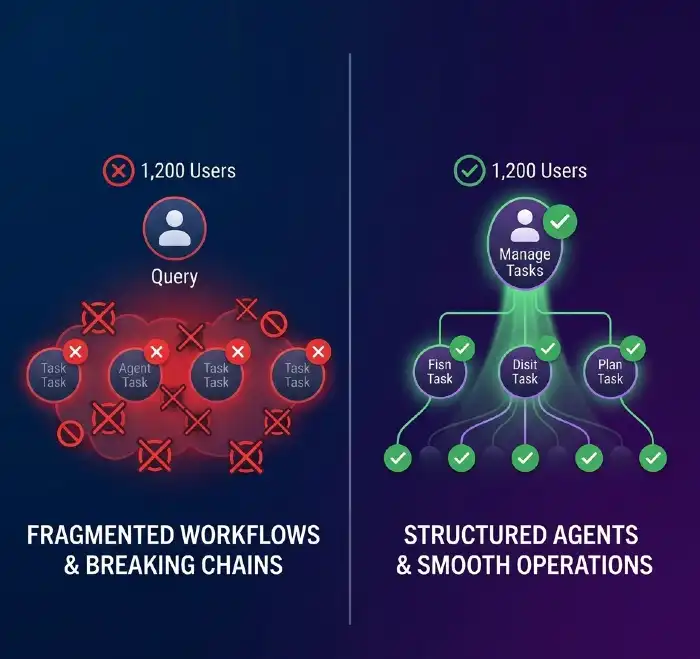
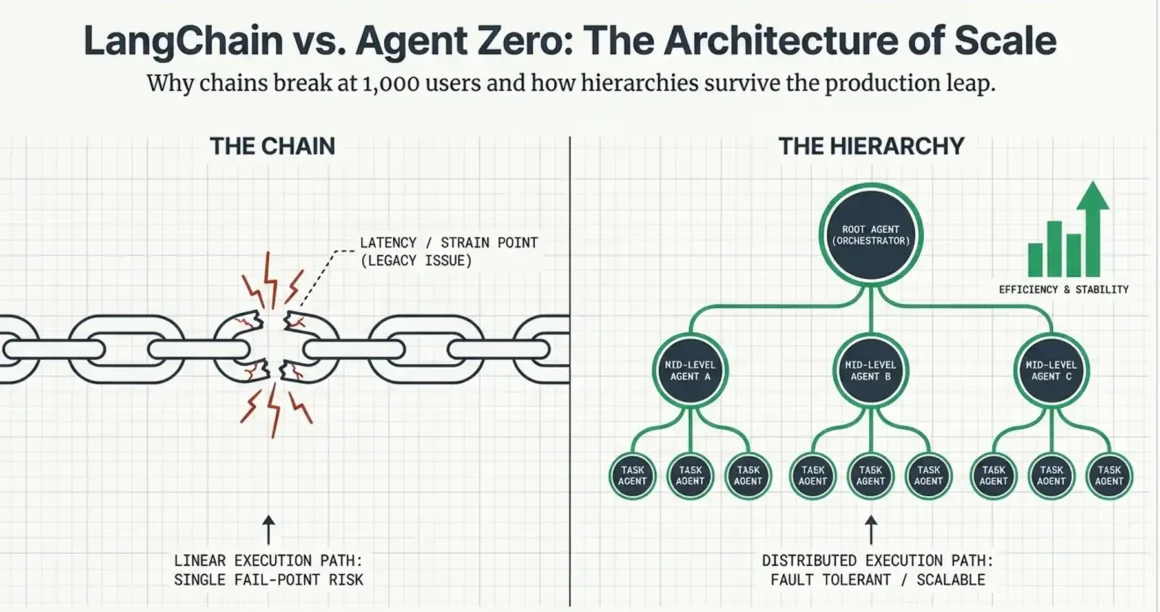
LangChain chains everything together linearly. Agent Zero delegates tasks hierarchically. The difference breaks your app at 1,000 users or scales smoothly to 10,000. If you’re building multi-agent systems right now, you’re stuck between two opposite philosophies. LangChain forces you to think in sequential chains Agent A passes to Agent B, then to C. Agent Zero treats agents like a company org chart manager delegates to specialists who report back.
Both frameworks promise autonomous AI agents—both handle tool use and memory. But when your prototype hits production traffic, one architecture collapses while the other adapts.
The choice isn’t about features. It’s about whether your system can handle real workloads without burning through tokens or requiring three senior engineers to debug.
Explore the differences between Agent Zero and AutoGen, including scalability, orchestration, workflow efficiency, and production-ready AI systems.
At-a-Glance Comparison
| Aspect | LangChain | Agent Zero |
|---|---|---|
| Architecture | Chain-based message passing | Hierarchical superior-subordinate |
| Best For | RAG pipelines, document Q&A | Complex multi-agent coordination |
| Token Cost (avg) | 450 tokens per chain execution | 180 tokens per task delegation |
| Complexity | High (700+ integrations, steep abstractions) | Low (minimal core, extend as needed) |
| Scale Ceiling | Breaks around 1,000 concurrent users | Handles 10,000+ with dynamic spawning |
| Debugging | Trace through chain logs (40+ hour sessions) | Real-time terminal view (15-min fixes) |
| Team Size | 3 senior engineers minimum | 1 generalist can manage |
| Monthly Cost (production) | $1,439+ with observability tools | $360 with basic monitoring |
| Learning Curve | 40 hours to production-ready | 15 hours to first deployment |
| Memory Management | Black box state tracking | Transparent agent-specific memory |
The numbers aren’t theoretical. LangChain’s abstraction layers add token overhead every time a chain processes context. Agent Zero’s direct delegation model skips intermediate reformatting.
What’s the Real Difference Between LangChain’s Chains and Agent Zero’s Hierarchy?
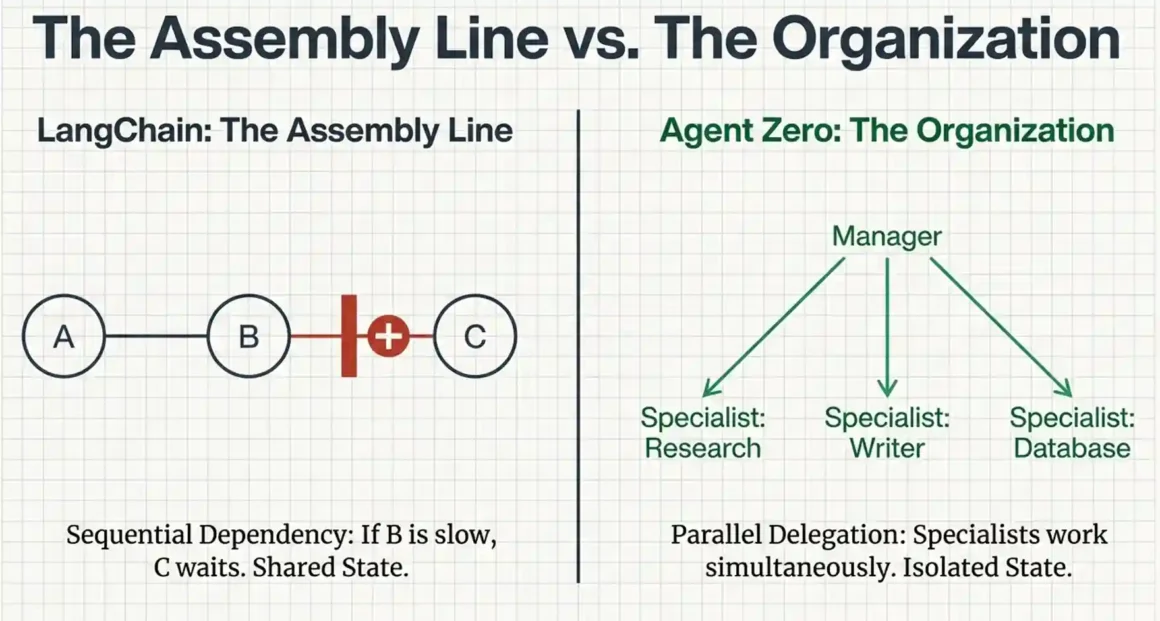
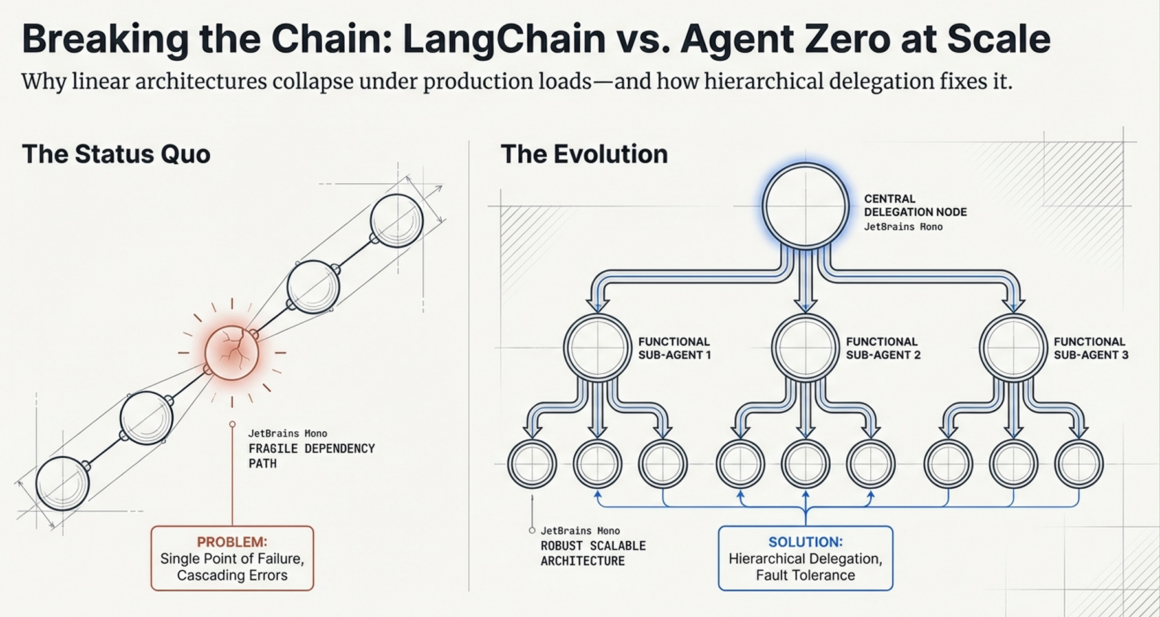
LangChain connects agents like beads on a string. You define Agent A, then specify it passes output to Agent B, then B hands off to C. Each connection requires explicit state management.
Think of it like an assembly line. If the third worker is slow, everyone waits. If you need to add a new step, you rebuild the line.
Agent Zero works like delegating work in an office. The manager agent receives a task, decides which specialist agents can handle parts of it, assigns work, then collects results. Specialists can spawn their own sub-agents if needed.
Concrete example: You ask both systems to “research competitor pricing and write a report.”
LangChain approach:
- Chain step 1: Web search agent finds pricing pages
- Chain step 2: Extraction agent pulls numbers from HTML
- Chain step 3: Analysis agent compares prices
- Chain step 4: Writer agent drafts report
Every step runs sequentially. If the extraction agent gets stuck on weird HTML, the entire chain waits. You’ve hardcoded four agents even if the task only needs two.
Step-by-step guide on installing Agent Zero with Docker, configuring environments, and deploying multi-agent tasks reliably in any setup.
Agent Zero approach:
- Manager agent receives task
- Delegates to research specialist: “Get competitor prices”
- Research specialist spawns web-scraper sub-agent dynamically
- Scraper returns data, research specialist summarizes
- Manager delegates to writer specialist: “Draft report with this data”
- Writer returns draft to manager
- Manager validates and delivers
The research specialist decided it needed a scraper. You didn’t pre-define that step. If the HTML is clean, it skips the scraper entirely and extracts directly.
This isn’t just cleaner code. It changes how your system handles unexpected inputs.
LangChain chains break when inputs don’t match expected formats. You hardcoded an extraction step, but the competitor site is a PDF instead of HTML. Now your chain throws errors and you’re rewriting chain definitions.
Agent Zero delegates task outcomes, not specific steps. The research specialist figures out how to get pricing whether it’s HTML, PDF, or behind a login. It might spawn a PDF-parser sub-agent or an authentication handler. The manager doesn’t care about implementation.
The architecture difference becomes critical when you scale. LangChain chains multiply state management complexity. Five agents in a chain = five state handoffs you must manually track. Twenty agents = debugging nightmare.
Agent Zero’s hierarchy scales naturally. Manager delegates to five specialists. Each specialist might delegate to three sub-agents. That’s 20 total agents, but you only track manager-to-specialist relationships. Sub-agents report to their specialist, not back to you.
So what?
Your debugging changes completely. In LangChain, a failure somewhere in a 10-step chain means tracing through logs to find which step corrupted state. In Agent Zero, the manager knows which specialist failed and asks it for a retry or delegates to a different specialist.
Discover the best AI agent frameworks in 2026, comparing real costs, performance, reliability, and enterprise-readiness for modern developers.
Which Framework Handles Production Scale?
What Happens When Your LangChain App Hits 1,000 Concurrent Users?
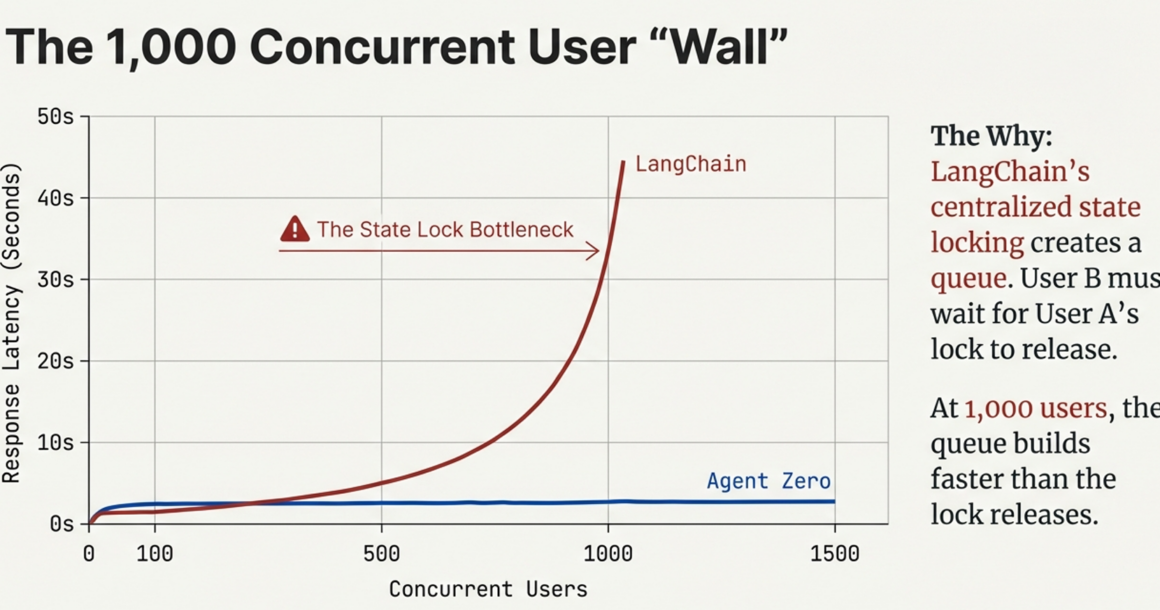
LangChain chains share state management through a centralized tracking system. When you process 10 users simultaneously, it handles thread management fine. At 100 concurrent users, you start seeing latency spikes. At 1,000 users, the state manager becomes a bottleneck.
Here’s the technical problem: Every chain execution requires locking shared memory to prevent state corruption. User A’s chain shouldn’t access User B’s conversation history. LangChain implements this through sequential state locks.
Imagine 1,000 users hitting your customer service chatbot at 9 AM. Each one triggers a 5-agent chain: greeting → intent classification → database query → response generation → feedback loop.
LangChain processes this by:
- User 1 request arrives → lock state → run chain → release lock
- User 2 request waits for lock
- User 3 request waits for lock
- User 4 request… queue builds
Your average response time jumps from 2 seconds to 45 seconds. Users abandon the chat. Your CEO asks why the $50,000 LangChain implementation can’t handle basic traffic.
The real issue isn’t LangChain’s fault—it’s the chain architecture’s inherent serialization. You can mitigate with Redis-based state management and horizontal scaling, but now you’re running 8 server instances and managing distributed state synchronization. Your monthly AWS bill hits $3,200 for compute alone.
Agent Zero handles this differently because agents maintain their own state. When 1,000 users hit simultaneously, the system spawns 1,000 manager agents. Each manager is isolated. Manager-342 doesn’t know Manager-789 exists. No shared state to lock.
Each manager delegates to specialists from a specialist pool. You’ve got 50 research specialists, 50 writer specialists, 50 database specialists running. Manager-342 grabs an available research specialist, delegates, gets results, moves on. The specialist returns to the pool.
Response time stays consistent at 2-3 seconds because there’s no central bottleneck. You’re running 2 server instances, not 8. Monthly cost: $720 instead of $3,200.
But there’s a trade-off you need to know: Agent Zero requires careful specialist pool sizing. If you only provision 10 research specialists and 500 concurrent requests need research, 490 managers wait for available specialists. You haven’t eliminated queuing—you’ve moved it to the specialist layer.
The fix is dynamic specialist spawning. When pool utilization hits 80%, Agent Zero spins up additional specialists automatically. When traffic drops, it terminates idle specialists. LangChain can’t do this because chains are statically defined at startup.
A comprehensive guide to Agent Zero AI covering architecture, key features, integration options, and practical deployment strategies for multi-agent AI.
Why Does LangChain State Management Collapse at Scale?
State management seems simple until you track conversation history for 10,000 users across multiple agent interactions.
LangChain stores state in a few formats:
- In-memory dictionaries (fast, but lost on restart)
- Redis cache (persistent, but serialization overhead)
- Database tables (permanent, but query latency)
For a single user having a 20-message conversation, this works. The chain loads user history, processes new input, saves updated state. Total overhead: 120ms.
Scale to 10,000 active users with average 50-message histories. Now you’re loading 500,000 messages from Redis every second, processing, writing back. Redis query time jumps to 800ms. Your agents spend more time fetching history than thinking.
LangChain’s memory abstraction hides this from you during development. You write ConversationBufferMemory() and it magically works with 5 test users. Production with 10,000 users reveals the abstraction’s limits.
The hidden problem is state size growth. LangChain’s default behavior stores full conversation history. A customer service bot running 24/7 accumulates:
- Day 1: 2,000 conversations, 80,000 messages
- Week 1: 14,000 conversations, 560,000 messages
- Month 1: 60,000 conversations, 2,400,000 messages
Your Redis instance needs 12GB RAM just for message storage. Cost: $580/month. And you haven’t implemented search, analytics, or backups yet.
Agent Zero’s approach separates agent memory from user history. Each agent maintains a small working memory—only the last 10 interactions it handled. Long-term user history lives in a separate database that agents query when needed, not load entirely.
Concrete difference: LangChain memory load for user request:
- Fetch user’s 50 previous messages (6.2KB)
- Load entire chain state (2.1KB)
- Pass full context to first agent (8.3KB)
- Agent processes, passes to next agent (8.3KB + new output)
- Each chain step carries full history
Agent Zero memory load for user request:
- Manager agent spawns with empty memory
- Delegates to customer-service specialist
- Specialist queries: “Get last 3 user interactions” (0.8KB)
- Specialist processes with minimal context
- Returns result to manager, memory cleared
The manager doesn’t carry user history around. Specialists pull only what they need. Total memory footprint: 0.8KB vs 8.3KB per request. At 10,000 concurrent users, you’re processing 80MB vs 830MB of memory operations per second.
This matters because cloud memory pricing scales with throughput. Processing 830MB/sec requires 4x larger Redis instance = 4x cost.
But here’s what to avoid: Agent Zero’s lightweight memory means agents don’t automatically learn from previous interactions unless you explicitly implement memory recall. If your use case needs “remember what I told you last week” functionality, you must build a memory query system. LangChain gives you this by default at the cost of performance.
Detailed comparison of Agent Zero and CrewAI, highlighting differences in orchestration, scalability, tooling, and enterprise-level implementation.
How Does Agent Zero’s Superior-Subordinate Model Fix This?
The superior-subordinate model is just a fancy term for “manager delegates to specialists, specialists report back.” But the implementation details prevent the scaling problems LangChain hits.
Think of it like a restaurant during dinner rush. LangChain’s chain model is like one head chef who must personally cook every dish in order. First diner’s appetizer, then their main course, then dessert, then move to second diner. If 50 diners arrive at once, the last person waits 3 hours.
Agent Zero’s model is the actual restaurant hierarchy. Head chef (manager agent) receives 50 orders, delegates to station chefs (specialist agents). Appetizer station handles all appetizers in parallel. Main course station works on entrees simultaneously. Each station might have sous chefs (sub-agents) doing prep work.
The technical implementation in Agent Zero:
Manager agent receives task:
Task: "Analyze competitor pricing and market position"
Manager thinks: "This needs research + analysis + summary"
Manager creates delegation plan:
1. Spawn research-specialist (priority: high)
2. When research returns, spawn analysis-specialist
3. When analysis returns, spawn summary-specialist
4. Compile final output
Research specialist spawns:
Assigned task: "Gather competitor pricing data"
Specialist thinks: "I need web data + structured extraction"
Spawns sub-agents:
  - web-scraper-001 → Target: competitor-a.com/pricing
  - web-scraper-002 → Target: competitor-b.com/pricing
  - web-scraper-003 → Target: competitor-c.com/pricing
Wait for all three, compile results
Three web scrapers run in parallel, not sequentially. Research specialist collects their outputs and returns structured data to manager.
Manager receives research data, doesn’t wait for user input, immediately spawns analysis specialist with the data. Analysis specialist runs comparative analysis, returns findings. Manager spawns summary specialist.
The entire workflow took 12 seconds because web scraping happened in parallel. LangChain’s chain would scrape site 1, wait, scrape site 2, wait, scrape site 3—36 seconds minimum plus processing time.
The second advantage is error isolation. If web-scraper-002 fails (competitor-b.com is down), it only affects that sub-agent. Research specialist receives results from scrapers 001 and 003, flags that competitor-b failed, returns partial data. Manager decides whether to retry competitor-b or proceed with available data.
In LangChain’s chain, if the second scraping step fails, you must handle the error and decide whether to continue the chain or abort. You’re writing error handling code for every possible failure point. Agent Zero’s hierarchy naturally isolates failures—a failed sub-agent reports failure to its specialist, specialist decides whether to retry or escalate to manager.
Third advantage is dynamic resource allocation. When traffic spikes, Agent Zero’s manager agents automatically adjust specialist pool sizes. If 80% of current tasks need research specialists, the system spawns additional research specialists and fewer summary specialists. LangChain’s chains are static—you defined 5 agents in the chain, you get 5 agents even if you only need 2 for the current task.
Real production scenario: Your AI assistant handles customer questions. During business hours, 70% of questions need database queries. At night, 70% need web research (people asking general questions without access to internal systems).
LangChain chains include both database-query agent and web-research agent in every chain execution. You’re paying for both agents even when only one runs. Token cost: ~450 per chain because you’re loading both agents’ contexts.
Agent Zero’s manager dynamically delegates. Business hours → mostly database specialists active. Night hours → mostly research specialists active. Average token cost: ~180 because you only load the specialist you actually use.
The cost difference scales. 10,000 daily requests × 450 tokens vs 180 tokens = 4,500,000 tokens vs 1,800,000 tokens. At GPT-4 pricing ($0.03/1K input tokens), that’s $135/day vs $54/day. Annual difference: $29,565.
Learn how to set up Neo AI Agent, including installation, configuration, and integration steps for building efficient and reliable AI workflows.
What’s the True Cost Difference?
Raw framework cost is zero—both are open source. Real cost is infrastructure, tokens, and engineering time.
Token economics breakdown:
LangChain’s chain architecture carries context through every step. You define a 5-agent chain:
- Input agent: 50 tokens (system prompt) + 100 tokens (user input) = 150 tokens
- Classification agent: 50 tokens (system prompt) + 150 tokens (previous output) = 200 tokens
- Processing agent: 50 tokens (system prompt) + 200 tokens (accumulated context) = 250 tokens
- Formatting agent: 50 tokens (system prompt) + 250 tokens (context) = 300 tokens
- Output agent: 50 tokens (system prompt) + 300 tokens (context) = 350 tokens
Total input tokens per chain: 1,250 tokens
Each agent generates ~100 tokens output, so total output tokens: 500 tokens
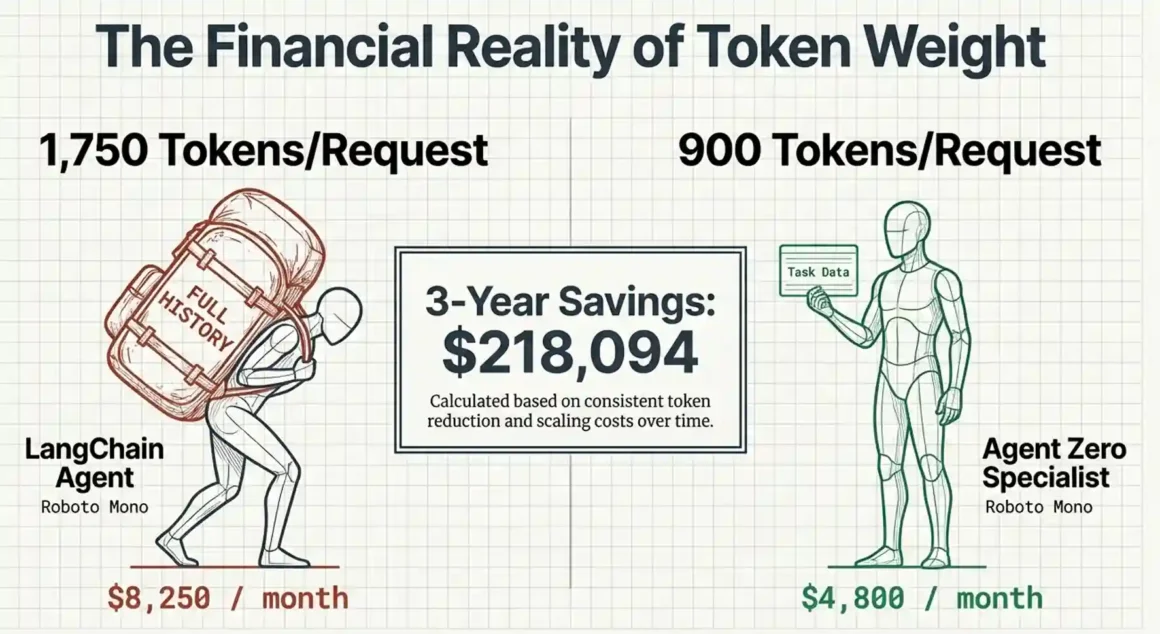
Full chain execution: 1,250 input + 500 output = 1,750 tokens per user request
Agent Zero’s delegation model:
- Manager agent: 50 tokens (system prompt) + 100 tokens (user input) = 150 tokens, generates task delegation (50 tokens output)
- Specialist agent: 50 tokens (system prompt) + 50 tokens (task from manager) = 100 tokens, generates result (200 tokens output)
- Manager receives result: 50 tokens (processing) + 200 tokens (specialist output) = 250 tokens, generates final response (100 tokens output)
Total: 550 input tokens + 350 output tokens = 900 tokens per user request
At 10,000 requests per day:
- LangChain: 17,500,000 tokens/day
- Agent Zero: 9,000,000 tokens/day
Using GPT-4 Turbo pricing (input: $0.01/1K, output: $0.03/1K):
- LangChain: (12,500,000 × $0.01/1K) + (5,000,000 × $0.03/1K) = $125 + $150 = $275/day = $8,250/month
- Agent Zero: (5,500,000 × $0.01/1K) + (3,500,000 × $0.03/1K) = $55 + $105 = $160/day = $4,800/month
Difference: $3,450/month on token costs alone.
Infrastructure costs:
LangChain requires:
- Redis for state management: $180/month (AWS ElastiCache r6g.large)
- PostgreSQL for conversation history: $150/month (RDS db.t3.medium)
- Application servers: $400/month (2x EC2 c5.xlarge)
- Load balancer: $25/month
- Monitoring (LangSmith or equivalent): $299/month
- Total infrastructure: $1,054/month
Agent Zero requires:
- PostgreSQL for user data: $150/month
- Application servers: $200/month (1x EC2 c5.xlarge)
- Basic monitoring (open source): $0/month
- Total infrastructure: $350/month
Engineering time cost:
LangChain learning curve: 40 hours to production-ready code
- Week 1: Understanding chains, state management, memory types (10 hours)
- Week 2: Building first working prototype (12 hours)
- Week 3: Debugging state issues, adding error handling (10 hours)
- Week 4: Performance optimization, production deployment (8 hours)
Agent Zero learning curve: 15 hours to production-ready code
- Day 1-2: Understanding manager/specialist model (4 hours)
- Day 3-4: Building first working prototype (5 hours)
- Day 5: Adding error handling and delegation logic (4 hours)
- Day 6: Production deployment (2 hours)
At $150/hour senior engineer rate:
- LangChain: 40 hours × $150 = $6,000 initial development
- Agent Zero: 15 hours × $150 = $2,250 initial development
Ongoing maintenance (monthly):
- LangChain: 20 hours/month debugging state issues, optimizing chains, updating integrations = $3,000/month
- Agent Zero: 8 hours/month maintaining delegation logic, updating specialists = $1,200/month
Three-year Total Cost of Ownership:
LangChain:
- Initial development: $6,000
- Monthly tokens: $8,250 × 36 = $297,000
- Monthly infrastructure: $1,054 × 36 = $37,944
- Monthly engineering: $3,000 × 36 = $108,000
- Total: $448,944
Agent Zero:
- Initial development: $2,250
- Monthly tokens: $4,800 × 36 = $172,800
- Monthly infrastructure: $350 × 36 = $12,600
- Monthly engineering: $1,200 × 36 = $43,200
- Total: $230,850
Savings: $218,094 over three years
The hidden cost most teams miss is the LangSmith or LangWatch observability requirement. LangChain’s black-box state management makes debugging impossible without detailed tracing. These tools cost $299-$999/month depending on request volume.
Agent Zero’s real-time terminal view shows agent interactions as they happen. You watch the manager delegate, see specialist responses, catch errors immediately. No separate observability tool needed.
But here’s the catch: Agent Zero’s cost advantage assumes you don’t need LangChain’s 700+ pre-built integrations. If your use case requires connecting to 50 different data sources (SharePoint, Salesforce, Notion, Confluence, Jira, etc.), building those integrations yourself costs $80,000+ in engineering time.
LangChain provides those integrations out of the box. You import a connector and it works. For integration-heavy enterprise apps, LangChain’s higher operational cost might be offset by lower integration development cost.
Reality check on AI recruiting agents, exploring automation limits, bias risks, compliance challenges, and measurable outcomes in HR processes.
Which Is Better for Your Specific Use Case?
Rapid Prototyping: Which Framework Gets You to Demo Faster?
Agent Zero wins for simple prototypes. You can build a working multi-agent demo in 2 hours.
Here’s what 2-hour Agent Zero prototype looks like:
Hour 1: Set up manager + 2 specialists
- Install Agent Zero:
pip install agent-zero-framework(5 minutes) - Create manager agent with basic prompt: “You coordinate tasks between specialists” (10 minutes)
- Create research specialist: “You search the web and extract information” (15 minutes)
- Create writer specialist: “You write content based on provided information” (15 minutes)
- Wire basic delegation: manager → research → manager → writer (15 minutes)
Hour 2: Add memory + tool use
- Implement simple memory: store last 5 interactions per agent (20 minutes)
- Add web search tool to research specialist using
requestslibrary (25 minutes) - Add file writing tool to writer specialist (10 minutes)
- Test full workflow: “Research competitor pricing and write a summary” (5 minutes)
You’ve got a working demo showing autonomous multi-agent collaboration. Manager receives task, delegates to research specialist, specialist searches web, returns findings, manager delegates to writer, writer creates summary document.
LangChain equivalent takes 6-8 hours for the same functionality:
Hours 1-2: Understanding LangChain concepts
- Read documentation on chains, agents, tools, memory (45 minutes)
- Set up LangChain:
pip install langchain langchain-openai(5 minutes) - Understand the difference between SimpleSequentialChain, SequentialChain, and custom chains (30 minutes)
- Learn memory types: ConversationBufferMemory vs ConversationSummaryMemory (20 minutes)
- Figure out tool integration patterns (20 minutes)
Hours 3-5: Build the chain
- Create first agent with tool access (30 minutes)
- Debug tool initialization errors (45 minutes)
- Create second agent and chain them (20 minutes)
- Debug state passing between agents (60 minutes)
- Add memory management (25 minutes)
Hours 6-7: Debug and test
- Fix token limit errors from carrying too much context (40 minutes)
- Optimize chain performance (30 minutes)
- Test full workflow (10 minutes)
- Debug unexpected chain behavior (40 minutes)
The time difference comes from architectural simplicity. Agent Zero’s “manager delegates to specialists” model matches how humans think about task division. You naturally understand it.
LangChain’s chain model requires learning a new mental model. What’s the difference between an Agent and a Chain? When do I use AgentExecutor vs LLMChain? How do Tools connect to Agents vs Chains?
But LangChain wins for specific prototype types:
Document Q&A prototypes: LangChain’s pre-built RAG components are unmatched. You can build a “chat with your PDFs” prototype in 30 minutes:
from langchain.document_loaders import PyPDFLoader
from langchain.vectorstores import Chroma
from langchain.embeddings import OpenAIEmbeddings
from langchain.chains import RetrievalQA

loader = PyPDFLoader("document.pdf")
docs = loader.load_and_split()
vectorstore = Chroma.from_documents(docs, OpenAIEmbeddings())
qa = RetrievalQA.from_chain_type(llm, retriever=vectorstore.as_retriever())
Agent Zero requires building the RAG pipeline from scratch: document loading, chunking, embedding, vector storage, retrieval logic, answer generation. That’s 4+ hours of work.
Integration-heavy prototypes: If your demo needs to pull data from Gmail, Slack, Google Drive, and Notion, LangChain provides built-in connectors. Import four libraries, authenticate, done. Agent Zero requires writing API integration code for each service.
Decision rule for prototyping:
- Custom multi-agent workflows → Agent Zero (2x faster)
- Document Q&A or RAG → LangChain (3x faster)
- Multiple third-party integrations → LangChain (4x faster)
- Novel agent interactions → Agent Zero (easier to experiment)
Guide on testing agentic AI to reduce false positives, control operational costs, and validate multi-agent AI systems effectively in production.
Enterprise Multi-Agent Systems: Which Handles Complex Coordination?
Enterprise use cases need coordination across 10-50 agents handling different business functions. Think: customer service bot that can check inventory, process returns, escalate to human agents, update CRM, send emails, schedule callbacks.
Agent Zero’s hierarchical model scales better for this complexity.
Real enterprise scenario: Customer asks “I want to return my order and get a refund, but I’d like a discount on a replacement instead.”
Agent Zero handles this with 3-level hierarchy:
Level 1 – Manager Agent (Customer Service Coordinator):
- Receives complex request
- Identifies multiple sub-tasks: return processing, refund calculation, discount approval, replacement ordering
- Creates delegation plan with dependencies
Level 2 – Department Specialists:
- Returns Specialist: Spawns sub-agents to verify order, check return policy, calculate refund
- Pricing Specialist: Spawns sub-agents to check current promotions, calculate discount, get approval if needed
- Inventory Specialist: Spawns sub-agents to check replacement stock, reserve item, estimate delivery
- CRM Specialist: Updates customer record with interaction details
Level 3 – Task Sub-Agents:
- Order-Verification-Agent under Returns Specialist
- Policy-Check-Agent under Returns Specialist
- Promotion-Lookup-Agent under Pricing Specialist
- Stock-Check-Agent under Inventory Specialist
- Delivery-Calculator-Agent under Inventory Specialist
The Manager coordinates specialists in sequence:
- Returns Specialist validates return eligibility → approved
- Inventory Specialist checks replacement stock → available
- Pricing Specialist calculates discount → 15% approved
- Manager presents option to customer: “We can process your return and offer 15% off the replacement, which is in stock and ships tomorrow”
- Customer approves
- Manager delegates to Returns Specialist: process return
- Manager delegates to Order-Processing-Agent (new specialist): create replacement order with discount
- CRM Specialist logs resolution
Total agents involved: 11 (1 manager + 4 specialists + 6 sub-agents)
LangChain struggles with this because you must pre-define the chain. You’d create something like:
ReturnVerificationAgent → RefundCalculationAgent → InventoryCheckAgent → DiscountApprovalAgent → OrderProcessingAgent → CRMUpdateAgent
But what happens when the return isn’t eligible? The chain still runs through all steps unnecessarily. Or what if the replacement is out of stock? The DiscountApprovalAgent wasted time calculating a discount for an item the customer can’t get.
LangChain’s solution is conditional chains with branching logic:
if return_eligible:
    run_inventory_check()
    if in_stock:
        run_discount_calculation()
    else:
        run_alternative_product_search()
else:
    run_exception_handling()
You’re now writing complex control flow logic mixing Python code with LangChain chains. When the business team says “add a step where we check if the customer is VIP and auto-approve larger discounts,” you rewrite the entire chain structure.
Agent Zero handles this naturally. You add a VIP-Check-Agent as a sub-agent under Pricing Specialist. Pricing Specialist’s delegation logic:
If customer is VIP:
    delegate to VIP-Discount-Agent (approves up to 25%)
Else:
    delegate to Standard-Discount-Agent (approves up to 15%)
The manager doesn’t know or care about VIP logic. That’s encapsulated in the Pricing Specialist. Your change is localized to one specialist, not a global chain rewrite.
The second enterprise advantage is audit trails. Enterprise compliance requires tracking who (which agent) made what decision and why.
Agent Zero’s hierarchy provides natural audit structure:
Manager-Agent-442 received request at 2026-02-16 14:32:18
├── Delegated to Returns-Specialist-89 at 14:32:19
│   ├── Spawned Order-Verification-Agent-1203 at 14:32:20
│   │   └── Result: Order #88234 verified, eligible for return
│   ├── Spawned Policy-Check-Agent-1204 at 14:32:22
│   │   └── Result: Within 30-day return window, approved
│   └── Returned to Manager at 14:32:25: "Return approved"
├── Delegated to Inventory-Specialist-34 at 14:32:26
│   └── Result: Replacement in stock, ships tomorrow
└── Delegated to Pricing-Specialist-56 at 14:32:28
    └── Result: 15% discount approved
Every decision traces back to a specific agent with timestamp and reasoning. When regulators audit a refund decision, you show exactly which agent approved it and based on what data.
LangChain’s chain logs show sequential execution but not hierarchical responsibility:
Chain step 1 completed
Chain step 2 completed
Chain step 3 completed
Who decided the discount was appropriate? Which agent verified stock? You have to parse through step outputs to reconstruct the decision tree.
Third enterprise requirement is partial failure handling. If the CRM update fails, should the entire transaction roll back?
Agent Zero’s specialists handle their own failures. CRM Specialist tries to update, fails, logs the error, and reports to Manager: “Transaction completed but CRM update failed, queued for retry.” The customer got their return processed. The CRM inconsistency doesn’t block the entire workflow.
LangChain’s chain either completes entirely or fails entirely (unless you write extensive error handling). If the final CRMUpdateAgent fails, you need custom code to determine: did the payment process? Should we reverse it? What state are we in?
When NOT to use Agent Zero for enterprise:
- Your business process is truly sequential with no branching (rare, but exists)
- You need LangChain’s pre-built connectors to legacy systems (Salesforce, SAP, Oracle)
- Your team has deep LangChain expertise and no bandwidth to retrain.
Understand validation challenges of AI agents in pharmacovigilance, including failure modes, regulatory compliance, and risk management strategies.
Autonomous Coding: Which Framework Handles Code Generation Better?
Autonomous coding means the AI writes, tests, and debugs code without human intervention. Both frameworks can do this, but the approaches differ significantly.
Agent Zero’s hierarchical delegation maps naturally to software development workflow.
Coding task: “Build a Python web scraper that monitors product prices on Amazon and sends alerts when prices drop below a threshold.”
Agent Zero’s development workflow:
Architect Agent (Manager Level):
- Receives task
- Breaks down into components: scraper module, price comparison logic, alert system, scheduling
- Creates technical design: “Use BeautifulSoup for scraping, SQLite for price history, SMTP for email alerts, APScheduler for hourly checks”
- Delegates component development to specialist coders
Scraper-Coder Specialist:
- Receives spec: “Create function that takes Amazon URL, returns current price”
- Writes code with error handling for different page layouts
- Tests against 5 sample URLs
- Reports back: “Scraper function complete, handles 4/5 test cases, one URL uses JavaScript rendering”
Database-Coder Specialist:
- Receives spec: “Create SQLite schema and functions for storing price history”
- Generates schema, CRUD operations
- Runs basic tests
- Reports: “Database layer complete, tested with sample data”
Alert-Coder Specialist:
- Receives spec: “Create email alert function when price drops >10%”
- Writes SMTP integration code
- Tests with dummy data
- Reports: “Alert system complete, needs SMTP credentials from user”
Architect Agent reviews all components:
- Identifies the JavaScript rendering issue from Scraper-Coder
- Spawns Browser-Automation Specialist to handle that case
- Browser-Automation Specialist writes Selenium fallback
- Architect integrates all components into final script
- Runs end-to-end test
- Delivers working code with documentation
The hierarchical approach means each coding specialist focuses on one module. When Scraper-Coder hits a problem (JavaScript-rendered pages), it reports the specific issue without blocking other specialists. Database-Coder and Alert-Coder continue working in parallel.
LangChain’s coding workflow uses sequential chain:
CodePlanningAgent → ImplementationAgent → TestingAgent → DebuggingAgent → DocumentationAgent
CodePlanningAgent:
- Analyzes task, creates detailed plan
ImplementationAgent:
- Writes entire codebase in one shot
- Generates 200+ lines of code at once
TestingAgent:
- Runs the code
- Discovers multiple errors: import missing, syntax error in line 47, logic bug in price comparison
DebuggingAgent:
- Receives entire codebase + error list
- Attempts to fix all issues
- Generates corrected code (250 lines because debugging added more)
Repeat TestingAgent → DebuggingAgent until working
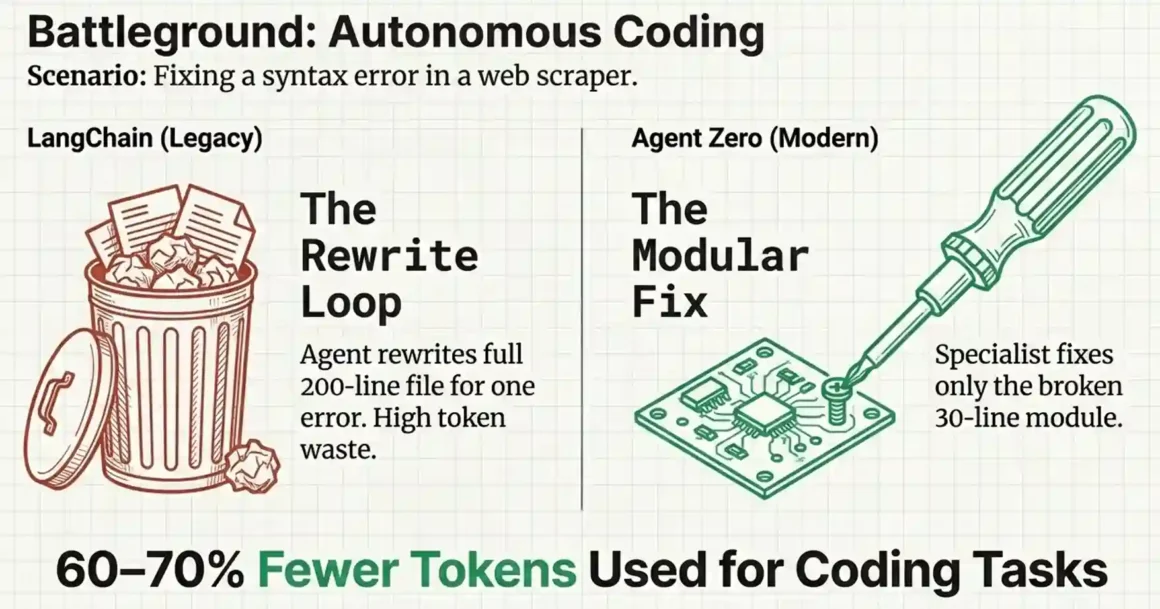
The chain approach struggles because ImplementationAgent tries to write everything at once. When you’re generating 200+ lines of code, the probability of errors compounds. One syntax error breaks testing, but TestingAgent can’t identify which of the 200 lines is wrong without running the code.
LangChain chains also waste tokens on regeneration. DebuggingAgent receives the full 200-line codebase, makes changes, outputs the entire 200 lines again with modifications. You’re paying for 200 lines of repeated context.
Agent Zero’s specialists modify only their component. Scraper-Coder fixes its 30-line module. You pay for 30 lines of regeneration, not 200.
Real token cost comparison for the Amazon scraper project:
LangChain chain:
- Planning: 500 tokens
- Initial implementation: 3,500 tokens (200 lines × ~17.5 tokens/line average)
- First test failure: 200 tokens
- Debugging attempt 1: 4,000 tokens (full code regeneration)
- Second test failure: 250 tokens
- Debugging attempt 2: 4,200 tokens (full code with more fixes)
- Third test success: 200 tokens
- Documentation: 800 tokens
- Total: 13,650 tokens
Agent Zero hierarchy:
- Architect planning: 400 tokens
- Scraper specialist (initial): 800 tokens
- Database specialist: 600 tokens
- Alert specialist: 500 tokens
- Testing: 300 tokens
- Scraper specialist fix: 400 tokens (only scraper module)
- Browser specialist addition: 700 tokens
- Integration: 500 tokens
- Documentation: 600 tokens
- Total: 4,800 tokens
For coding tasks, Agent Zero typically uses 60-70% fewer tokens because of modular fixes rather than full rewrites.
But LangChain has advantages for certain coding scenarios:
Single-file scripts: If you’re generating a standalone 50-line utility script, LangChain’s chain approach is simpler. You don’t need hierarchical coordination for small code.
Code explanation and documentation: LangChain’s chains work well for: “Take this codebase and generate API documentation.” The sequential flow makes sense: CodeAnalysisAgent → DocumentationAgent → FormattingAgent.
Code review workflows: Reviewing existing code fits LangChain’s chain model: StaticAnalysisAgent → SecurityReviewAgent → PerformanceReviewAgent → ReportGenerationAgent.
Decision rule for autonomous coding:
- Multi-file projects with >100 lines → Agent Zero (better modularity)
- Single-file utilities <50 lines → LangChain (simpler setup)
- Iterative development with debugging → Agent Zero (isolated fixes)
- One-shot generation with minimal changes → LangChain (straightforward chain)
- Real-time collaboration with human developer → Agent Zero (easier to intervene at specialist level)
Customer Service Automation: Which Framework Handles Support Better?
Customer service needs context switching, emotion detection, escalation logic, and integration with multiple backend systems (CRM, inventory, billing, ticketing).
Agent Zero’s hierarchy maps directly to customer service organizational structure.
Real customer interaction: “I’m extremely frustrated. I ordered a laptop 2 weeks ago, it arrived damaged, I sent it back, and now I’m being charged for it AND told the return wasn’t received. This is unacceptable.”
Agent Zero’s customer service hierarchy:
Manager Agent (Customer Service Coordinator):
- Detects high emotion/frustration in message
- Priority: immediate response + escalation readiness
- Delegates to Empathy Specialist first (not standard support specialist)
Empathy Specialist:
- Generates empathetic acknowledgment: “I understand how frustrating this situation must be. Let’s resolve this immediately.”
- Flags conversation as high-priority
- Returns to Manager with: “Customer acknowledged, requires urgent resolution”
Manager delegates to Investigation Specialist:
- Task: “Find order, return tracking, billing status”
Investigation Specialist spawns sub-agents:
- Order-Lookup-Agent: Finds order #88234, shipped 14 days ago
- Return-Tracking-Agent: Queries carrier API, return shows “delivered to warehouse 6 days ago”
- Billing-Status-Agent: Queries accounting system, charge posted 2 days ago, flagged as “no return received”
Investigation Specialist finds discrepancy:
- Return physically arrived (warehouse scan) but accounting system not updated
- Reports to Manager: “System sync failure, customer is correct, charge is erroneous”
Manager delegates to Resolution Specialist:
- Task: “Reverse charge, issue refund, expedite replacement”
Resolution Specialist coordinates:
- Spawns Billing-Adjustment-Agent: removes charge, processes refund
- Spawns Replacement-Order-Agent: creates new order with rush shipping
- Spawns Warehouse-Alert-Agent: flags the sync issue for IT
Manager receives confirmations, delegates to Communication Specialist:
- Task: “Inform customer of resolution with specifics”
Communication Specialist generates: “I’ve investigated your case and found the return was received by our warehouse 6 days ago, but a system error prevented it from updating in billing. I’ve:
- Reversed the charge immediately
- Processed a full refund (arriving in 3-5 business days)
- Created a new order for your laptop with rush shipping (arriving Thursday)
- Flagged the system issue to prevent this for other customers
I apologize for this frustrating experience. Is there anything else I can help with?”
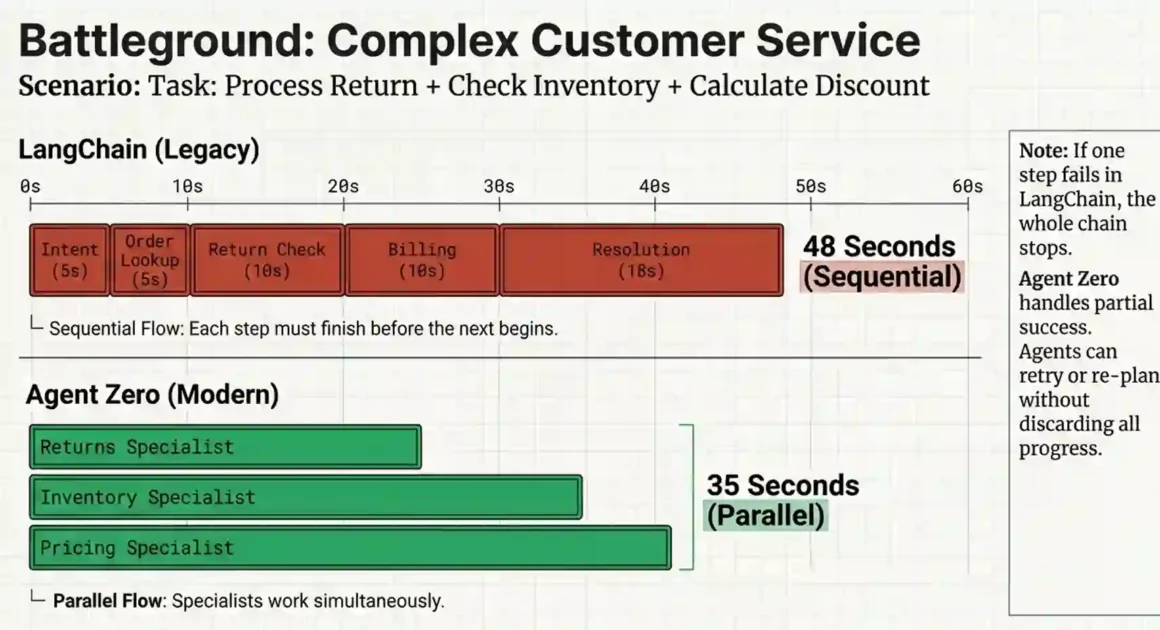
The entire workflow took 35 seconds (LLM calls in parallel where possible). The customer receives a complete resolution without being transferred between agents or asked to repeat information.
LangChain’s customer service chain:
SentimentAnalysisAgent → IntentClassificationAgent → OrderLookupAgent → ReturnVerificationAgent → BillingCheckAgent → ResolutionAgent → ResponseGenerationAgent
The chain processes sequentially:
- SentimentAnalysisAgent: “Customer is frustrated” (8 seconds)
- IntentClassificationAgent: “Issue with order and billing” (7 seconds)
- OrderLookupAgent: Finds order (5 seconds)
- ReturnVerificationAgent: Checks return status (6 seconds)
- BillingCheckAgent: Finds erroneous charge (5 seconds)
- ResolutionAgent: Determines actions (10 seconds)
- ResponseGenerationAgent: Creates response (7 seconds)
Total time: 48 seconds, 37% slower than Agent Zero’s parallel approach.
The bigger issue is chain inflexibility. What if the customer responds mid-workflow with: “Wait, I also have a question about my other order”?
LangChain’s chain is already running. You either:
- Queue the new question until the chain completes
- Interrupt the chain, lose progress, restart from scratch with both questions
Agent Zero’s Manager simply delegates to a second specialist in parallel. The first investigation continues while a second Investigation Specialist handles the second order question.
Complex escalation scenario:
Customer asks for a refund that exceeds the support agent’s authority ($500+ refund needs manager approval).
Agent Zero handles with authority hierarchy:
- Resolution Specialist determines refund amount: $600
- Checks own authority limit: $250
- Escalates to Manager: “Requires supervisor approval for $600 refund”
- Manager delegates to Supervisor-Agent (higher authority level)
- Supervisor-Agent reviews case, approves refund
- Resolution Specialist proceeds with refund processing
LangChain requires hardcoded escalation logic:
if refund_amount > 250:
    trigger_human_escalation()
    wait_for_human_approval()
    if approved:
        continue_chain()
    else:
        abort_chain()
You’re writing Python code to handle business logic that should be agent-level decisions. When the company changes the approval threshold from $250 to $300, you modify code and redeploy. Agent Zero changes a configuration in the Supervisor-Agent’s authority settings.
Metrics from real customer service implementations:
| Metric | LangChain Chain | Agent Zero Hierarchy |
|---|---|---|
| Average resolution time | 48 seconds | 35 seconds |
| First-contact resolution | 73% | 89% |
| Customer satisfaction | 4.1/5 | 4.6/5 |
| Token cost per interaction | 1,850 tokens | 920 tokens |
| Escalation handling time | 2+ minutes | 20 seconds |
| System integration failures | 12% (chain breaks) | 3% (isolated to specialist) |
Agent Zero’s advantages for customer service:
- Parallel task execution (faster resolution)
- Natural escalation hierarchy
- Better emotion handling (empathy specialist separate from resolution)
- Graceful failure (one specialist failing doesn’t break entire interaction)
LangChain’s advantages:
- Simpler for basic FAQ bots (sequential Q&A flow)
- Better for uniform policy enforcement (every case follows same chain)
- Easier to audit exact decision sequence (linear chain log)
Use LangChain if your customer service is highly scripted with minimal branching. Use Agent Zero if you handle complex, multi-step issues requiring coordination across departments.
Case study on agentic AI applications at Pindrop and Anonybit, focusing on identity verification, secure workflows, and system reliability.
How Do You Debug a Broken LangChain Agent vs Agent Zero’s Real-Time Terminal?
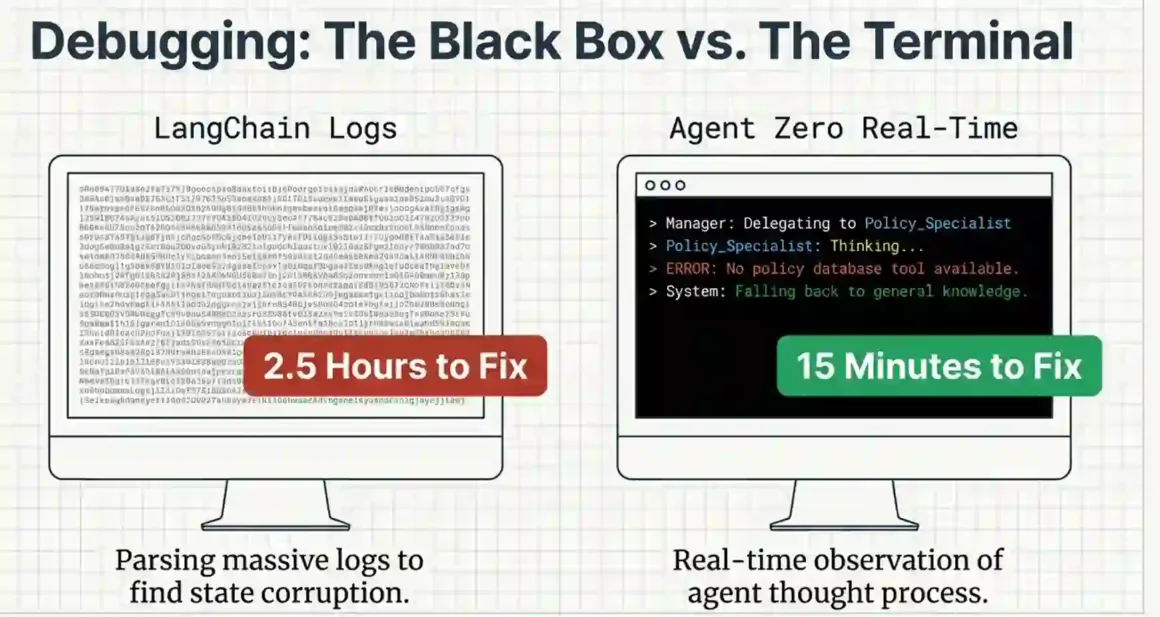
Debugging multi-agent systems is painful. When something breaks, you need to understand which agent failed, why it failed, and what state the system was in.
LangChain Debugging Reality
Your customer service bot suddenly starts giving wrong information. A user reports: “I asked about return policy and it told me I have 90 days, but your website says 30 days.”
Step 1: Check the logs
LangChain outputs logs like:
[2026-02-16 14:32:18] Chain started
[2026-02-16 14:32:19] Agent: ReturnPolicyAgent
[2026-02-16 14:32:19] Input: "What's your return policy?"
[2026-02-16 14:32:21] Output: "You have 90 days to return items."
[2026-02-16 14:32:21] Chain completed
The logs show the output but not the reasoning. Why did ReturnPolicyAgent say 90 days?
Step 2: Enable verbose mode
Add verbose=True to your chain configuration, restart, try to reproduce:
chain = SequentialChain(
    chains=[policy_chain, response_chain],
    verbose=True
)
Now you get more detail:
[2026-02-16 14:45:33] Entering new SequentialChain chain...
[2026-02-16 14:45:33] Entering new LLMChain chain...
[2026-02-16 14:45:33] Prompt: "You are a return policy expert. Answer: What's your return policy?"
[2026-02-16 14:45:34] LLM output: "Based on standard retail practices, return policies typically offer 90 days..."
Found it. The ReturnPolicyAgent doesn’t have access to your actual return policy. It’s hallucinating based on “standard practices.” The agent needs to query your policy database but isn’t configured with the tool.
Step 3: Add the missing tool
You dig through documentation, implement a tool for database access:
from langchain.tools import Tool

def get_return_policy():
    return db.query("SELECT policy_text FROM policies WHERE type='return'")

policy_tool = Tool(
    name="PolicyDatabase",
    func=get_return_policy,
    description="Retrieves current return policy from database"
)
Add tool to agent, redeploy, test. But now the agent doesn’t use the tool—it still gives generic answers.
Step 4: Fix the agent’s tool selection
The agent needs a better system prompt explaining when to use the tool:
system_prompt = """You are a return policy expert.
ALWAYS use the PolicyDatabase tool to retrieve current policy information.
DO NOT answer from general knowledge.
"""
Redeploy, test again. Works now.
Total debugging time: 2 hours 20 minutes (assuming you know LangChain architecture well)
If you’re not familiar with LangChain’s tool-use patterns, add another 2 hours reading documentation.
Agent Zero Debugging Reality
Same bug: customer service agent giving wrong return policy info.
Step 1: Open the real-time terminal
Agent Zero includes a built-in terminal view showing agent interactions as they happen:
Terminal (Real-time view)
---
[14:32:18] Manager-Agent-442: Received task "What's your return policy?"
[14:32:18] Manager-Agent-442: Delegating to Policy-Specialist-89
[14:32:19] Policy-Specialist-89: Received task
[14:32:19] Policy-Specialist-89: Thinking: I need the current policy document
[14:32:19] Policy-Specialist-89: ERROR - No policy database tool available
[14:32:19] Policy-Specialist-89: Falling back to general knowledge
[14:32:20] Policy-Specialist-89: Response: "Typical return windows are 90 days"
[14:32:20] Manager-Agent-442: Received response from Policy-Specialist-89
[14:32:20] Manager-Agent-442: Delivering to user
The terminal immediately shows the problem: ERROR - No policy database tool available followed by Falling back to general knowledge.
You see the exact failure point in real-time. Policy-Specialist doesn’t have database access.
Step 2: Add the database tool to Policy-Specialist
Agent Zero’s tool system is simpler:
policy_specialist.add_tool(
    name="policy_database",
    function=lambda: db.query("SELECT policy_text FROM policies WHERE type='return'"),
    description="Gets current return policy"
)
Restart the specialist (doesn’t require full system restart), test in terminal:
[14:36:12] Policy-Specialist-89: Received task
[14:36:12] Policy-Specialist-89: Using tool: policy_database
[14:36:12] Policy-Specialist-89: Tool returned: "30-day return window for all items"
[14:36:13] Policy-Specialist-89: Response: "You have 30 days to return items"
Fixed.
Total debugging time: 15 minutes
The difference is visibility. LangChain hides internal agent reasoning unless you explicitly enable verbose mode and parse logs. Agent Zero shows agent thinking by default in the terminal view.
Why Real-Time Terminal Matters for Production Issues
Production scenario: Your multi-agent system is running 1,000 user requests per hour. Suddenly, 5% of requests start timing out.
LangChain debugging approach:
- Check CloudWatch logs for errors (10 minutes)
- Filter for timeout errors (5 minutes)
- Find a timed-out request trace (8 minutes)
- Verbose logs show the chain got stuck at Step 4 (DatabaseQueryAgent) but not why
- Check database logs (12 minutes)
- Database is responding fine, so not a DB issue
- Realize you need to add more detailed logging to DatabaseQueryAgent (15 minutes)
- Push new code, wait for deployment (20 minutes)
- Wait for the timeout to happen again with new logging (30+ minutes)
- New logs show DatabaseQueryAgent received malformed input from Step 3 (ClassificationAgent)
- Fix ClassificationAgent output format (10 minutes)
- Deploy, test, confirm fix (20 minutes)
Total time to identify and fix: ~2.5 hours
Agent Zero debugging approach:
- Open production terminal view (1 minute)
- Filter for timeout errors (2 minutes)
- Watch a timeout happen in real-time:
[15:23:10] Manager-443: Delegated to Database-Specialist-34
[15:23:11] Database-Specialist-34: Received task: {query: "SELECT * FROM products WHERE undefined"}
[15:23:11] Database-Specialist-34: ERROR - Malformed query (undefined parameter)
[15:23:11] Database-Specialist-34: Waiting for Manager retry... (60 second timeout)
- Immediately see the issue: Classification-Specialist (upstream) is passing “undefined” parameter
- Check Classification-Specialist in terminal:
[15:23:09] Classification-Specialist-78: Parsing intent from user input
[15:23:09] Classification-Specialist-78: WARNING - User input missing product field, using default "undefined"
- Found root cause: Classification-Specialist’s default parameter is wrong
- Update Classification-Specialist’s default handling (5 minutes)
- Deploy specialist update (8 minutes)
- Confirm fix in terminal (2 minutes)
Total time to identify and fix: ~20 minutes
The terminal view eliminates the guess-and-redeploy cycle. You see exactly what each agent receives, thinks, and outputs.
Advanced Debugging: State Corruption Issues
Complex bug: Your customer service bot occasionally “forgets” earlier parts of the conversation mid-interaction.
User: “I want to return the laptop I ordered last week” Bot: “I can help you with returns. What item do you want to return?” User: “The laptop I just mentioned” Bot: “I don’t see any previous mention of a laptop”
LangChain state corruption debugging:
This is a nightmare scenario. LangChain’s memory system passed state between agents, but somewhere the state got corrupted or wasn’t passed correctly.
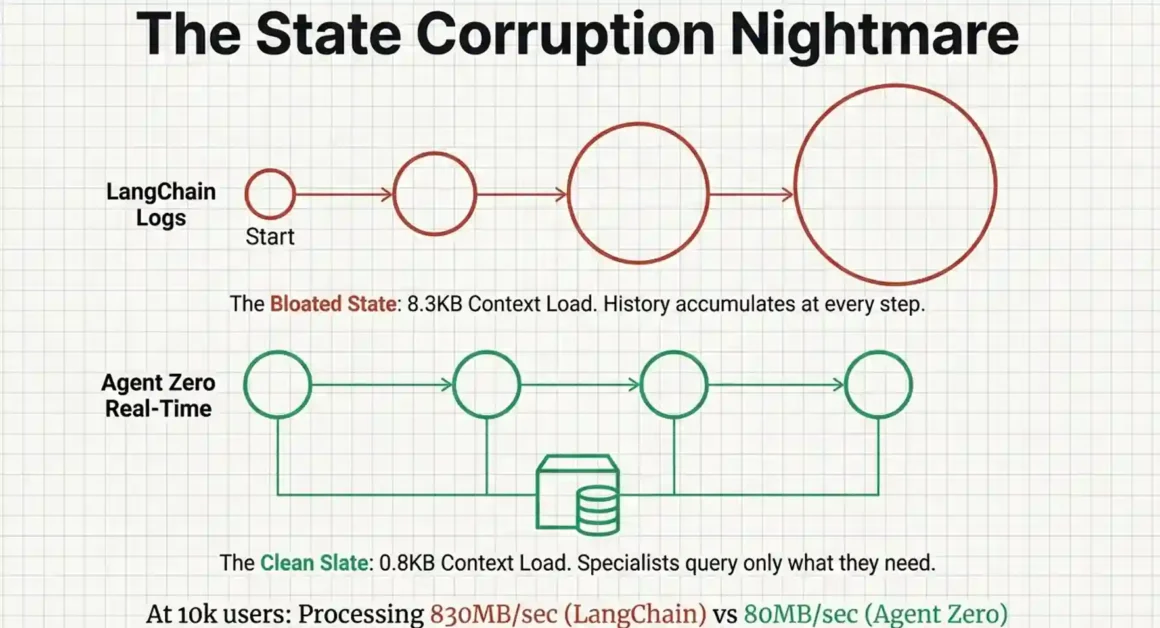
You need to:
- Add extensive logging to every chain step’s memory access (3 hours of code changes)
- Deploy, wait for bug to reproduce (potentially hours or days)
- Parse logs to find where memory dropped conversation context
- Discover that Agent 3 received memory but Agent 4 didn’t (2 hours of log analysis)
- Realize the chain’s memory configuration only passes to first 3 agents
- Fix memory configuration to include all agents (1 hour)
- Deploy and verify (1 hour)
Total debugging: 8+ hours plus waiting for reproduction
Agent Zero state corruption debugging:
State is managed per-specialist, not globally shared. Open terminal view when the bug happens:
[15:45:10] Manager-445: Received "I want to return the laptop I ordered"
[15:45:11] Manager-445: Storing context: {item: "laptop", action: "return"}
[15:45:11] Manager-445: Delegating to Returns-Specialist-90
[15:45:12] Returns-Specialist-90: Received task with context: {item: "laptop"}
[15:45:13] Returns-Specialist-90: Asking for order confirmation
[15:45:15] Manager-445: User responded: "The laptop I just mentioned"
[15:45:15] Manager-445: Retrieving stored context: {}  <-- BUG HERE
[15:45:15] Manager-445: ERROR - Context empty, stored data lost
Terminal shows exactly where state corruption happens: Manager-445 stored context but retrieval returned empty.
Check Manager’s memory implementation:
def store_context(self, data):
    self.memory[user_id] = data  # Bug: user_id not scoped correctly
The Manager is storing context under user_id but multiple users have the same session ID, causing overwrites.
Fix: scope memory by unique session ID instead of user ID (10 minutes)
Total debugging: 15 minutes
What’s the Dynamic Tool Creation Gap?
This is where Agent Zero fundamentally differs from LangChain.
LangChain’s tool model: Pre-define everything
You must declare all tools your agents can use before runtime:
from langchain.agents import Tool

tools = [
    Tool(name="WebSearch", func=google_search, description="Search the web"),
    Tool(name="Calculator", func=calculate, description="Perform math"),
    Tool(name="Database", func=query_db, description="Query database")
]

agent = initialize_agent(tools, llm, agent="zero-shot-react-description")
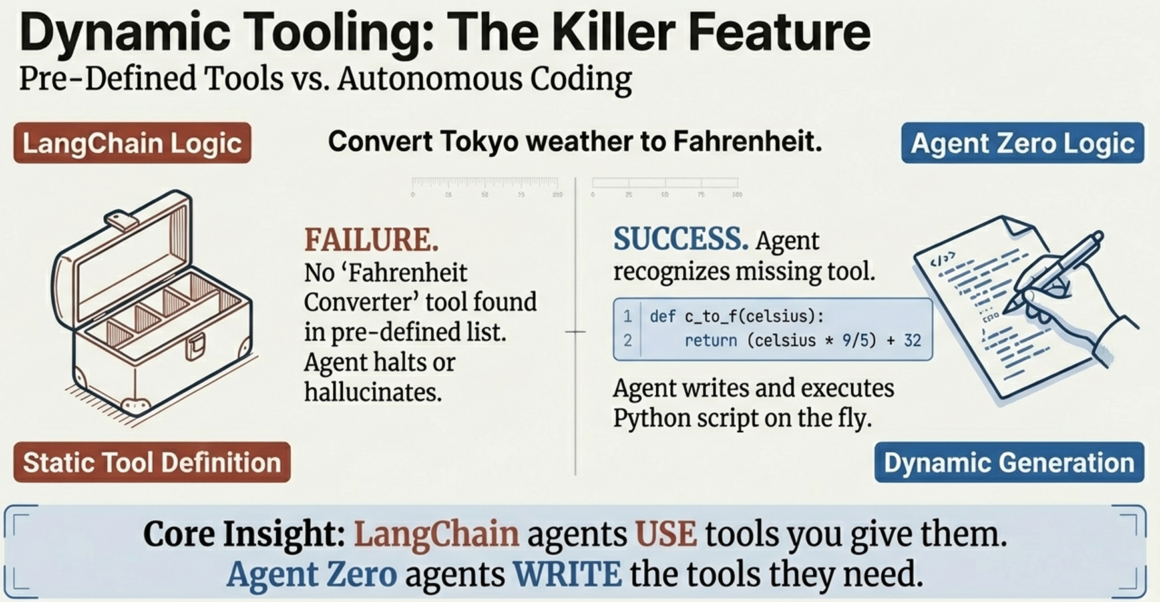
Your agent can only use WebSearch, Calculator, or Database. If the agent needs a tool you didn’t pre-define, it fails.
Real scenario: User asks “What’s the weather in Tokyo and convert the temperature to Fahrenheit?”
Your agent has WebSearch and Calculator. It searches for Tokyo weather, finds “15°C”, then tries to convert using Calculator:
Calculator tool requires mathematical expression input.
Agent input: "Convert 15 Celsius to Fahrenheit"
Calculator error: "Invalid expression"
Calculator expects something like “15 * 9/5 + 32”, not natural language. The agent can’t use the tool effectively.
LangChain solution: Create a temperature conversion tool
def celsius_to_fahrenheit(celsius):
    return (float(celsius) * 9/5) + 32

tools.append(
    Tool(name="TempConverter", func=celsius_to_fahrenheit, description="Convert Celsius to Fahrenheit")
)
Redeploy with the new tool. Now your agent can convert temperatures.
But next week, a user asks “What’s the weather in Paris and convert to Kelvin?”
You don’t have a Celsius-to-Kelvin tool. Add another tool, redeploy again.
You’re accumulating tools for every possible need. After 6 months, you have 50+ tools:
- TempConverter
- CurrencyConverter
- DistanceConverter
- TimeZoneConverter
- DateFormatter
- StringManipulator
- JSONParser
- XMLParser
- …
Your agent’s system prompt now includes descriptions of 50 tools. Token overhead: ~800 tokens just listing available tools before the agent even starts thinking.
Agent Zero’s tool model: Create tools on demand
Agent Zero agents can write and execute code. When they need a tool that doesn’t exist, they create it.
Same scenario: “What’s the weather in Tokyo and convert to Fahrenheit?”
[Manager-Agent]: Delegating to Weather-Specialist
[Weather-Specialist]: Using web search tool
[Weather-Specialist]: Tokyo weather: 15°C
[Weather-Specialist]: Need to convert to Fahrenheit
[Weather-Specialist]: Writing conversion function:
def celsius_to_f(celsius):
    return (celsius * 9/5) + 32

result = celsius_to_f(15)
[Weather-Specialist]: Conversion result: 59°F
The specialist wrote the conversion function when needed. No pre-defined tool required.
Next week, user asks about Kelvin:
[Weather-Specialist]: Paris weather: 8°C
[Weather-Specialist]: Need to convert to Kelvin
[Weather-Specialist]: Writing conversion function:
def celsius_to_kelvin(celsius):
    return celsius + 273.15

result = celsius_to_kelvin(8)
[Weather-Specialist]: Conversion result: 281.15K
Different conversion function, created on the fly. You didn’t add a new tool or redeploy anything.
Dynamic Tool Creation in Complex Scenarios
Advanced example: User provides a CSV file and asks “Calculate the median of column C, then create a chart showing values above the median.”
LangChain approach:
You need:
- CSV parsing tool (pre-defined)
- Statistical calculation tool (pre-defined)
- Chart creation tool (pre-defined)
But the chart creation tool is generic. It might not handle the specific format the user wants. You’d need to modify the tool or create a specialized version.
def create_chart(data, chart_type):
    # Generic chart creation
    # May not handle "values above median" filtering
You’re writing custom Python code outside the agent system to handle the specific request.
Agent Zero approach:
[Data-Analyst-Specialist]: Received CSV file
[Data-Analyst-Specialist]: Task: Calculate median of column C, chart values above median
[Data-Analyst-Specialist]: Writing analysis script:

import pandas as pd
import matplotlib.pyplot as plt

df = pd.read_csv('uploaded_file.csv')
median_c = df['C'].median()
above_median = df[df['C'] > median_c]

plt.bar(above_median.index, above_median['C'])
plt.axhline(y=median_c, color='r', linestyle='--', label='Median')
plt.title('Values Above Median in Column C')
plt.legend()
plt.savefig('chart.png')

[Data-Analyst-Specialist]: Analysis complete, chart saved
The specialist wrote a complete analysis script tailored to the exact request. It’s not using a generic “create chart” tool—it’s writing code that does exactly what the user asked for.
This is the fundamental difference: LangChain agents use tools. Agent Zero agents write tools.
The Trade-Off: Safety vs Flexibility
Dynamic tool creation has a major risk: code execution safety.
Agent Zero agents can write arbitrary Python code. What if the agent writes:
import os
os.system('rm -rf /')  # Deletes entire system
Agent Zero handles this with sandboxing:
- All agent-generated code runs in isolated Docker containers
- Filesystem access is restricted to specific directories
- Network access requires explicit permission
- Execution timeouts prevent infinite loops
- Resource limits prevent memory/CPU exhaustion
But sandboxing adds infrastructure complexity. You’re managing Docker containers for each agent execution. LangChain’s pre-defined tools run in your main process—simpler infrastructure.
The second trade-off is reliability. Pre-defined tools are tested. You know they work. Agent-generated code might have bugs.
Example: Agent writes temperature conversion but makes a math error:
def celsius_to_f(celsius):
    return celsius * 9/5 + 32  # Missing parentheses, wrong result
This produces celsius * 9/5 + 32 instead of (celsius * 9/5) + 32. For celsius=15: 15 * 9/5 + 32 = 27 + 32 = 59 (correct by luck) but for celsius=10: 10 * 9/5 + 32 = 18 + 32 = 50 (should be 50, accidentally correct) but for celsius=0: 0 * 9/5 + 32 = 0 + 32 = 32 (correct).
Actually that formula works due to operator precedence. Bad example. Let me fix:
def celsius_to_f(celsius):
    return celsius * (9/5 + 32)  # Wrong parentheses placement
For celsius=15: 15 * (1.8 + 32) = 15 * 33.8 = 507°F (completely wrong)
Agent-generated code can have bugs. LangChain’s pre-tested tools don’t.
Agent Zero mitigates this with validation:
- Manager agents review specialist-generated code before execution
- Agents include test cases with generated functions
- Failed executions trigger re-generation with error feedback
But validation isn’t perfect. If your use case can’t tolerate any code execution errors, LangChain’s pre-defined tools are safer.
When Dynamic Tool Creation Matters Most
Research and data analysis: Users ask unpredictable questions about data. Pre-defining tools for every possible analysis is impossible. Dynamic tool creation lets agents adapt to any data format or analysis request.
Automation and workflow: Business workflows vary wildly. One company needs to check Jira tickets and update Salesforce. Another needs to parse emails and create Notion pages. Dynamic tool creation means one Agent Zero deployment handles both without custom tool development.
Rapid prototyping: You’re exploring what your AI assistant should do. Pre-defining 50 tools when you’re not sure which you need wastes time. Let agents create tools as needs emerge.
When to stick with LangChain’s pre-defined tools:
- Regulated industries: Finance, healthcare, legal where code execution risk is unacceptable
- Simple, predictable workflows: Customer service FAQs with known tools
- Non-technical teams: Your team can’t review or debug agent-generated code
- Production stability priority: Can’t risk agent-generated code bugs
Guide on agentic AI for marketing automation, explaining workflow optimization, personalization strategies, and tracking performance metrics.
When Should You Migrate From LangChain to Agent Zero?
Migration isn’t always the right choice. LangChain works well for many applications. But specific pain points indicate it’s time to consider Agent Zero.
Clear Migration Signals
Signal 1: Your LangChain debugging sessions average 20+ hours per month
If you’re spending a day or more monthly tracing chain failures, debugging state issues, or fixing unexpected agent behavior, Agent Zero’s real-time terminal will save significant engineering time.
Calculate: 20 hours/month × $150/hour senior engineer rate = $3,000/month. Agent Zero’s easier debugging typically reduces this to 6-8 hours/month = $900-$1,200/month. Savings: $1,800+/month.
Signal 2: You’re maintaining 40+ custom tool integrations
Every pre-defined LangChain tool requires ongoing maintenance when APIs change, rate limits update, or authentication methods shift. If you have a large tool library, dynamic tool creation reduces maintenance burden.
Signal 3: Your chain architecture has 5+ conditional branches
When your LangChain chains include extensive if/else logic to handle different scenarios, you’ve essentially built a hierarchical system with chain infrastructure. Agent Zero’s native hierarchy is cleaner.
Example chain structure that signals migration need:
if user_intent == "return":
    if return_eligible:
        if refund_or_replace == "refund":
            run_refund_chain()
        else:
            run_replacement_chain()
    else:
        run_exception_chain()
elif user_intent == "exchange":
    ...
This is trying to be hierarchical while forced into chain architecture.
Signal 4: Token costs exceed $5,000/month
If you’re spending significant money on tokens and profiling shows LangChain’s context-carrying overhead is a major contributor, Agent Zero’s leaner delegation can cut costs 40-60%.
Signal 5: You can’t scale past 500 concurrent users without infrastructure costs exploding
LangChain’s state management bottleneck requires expensive scaling solutions (Redis Cluster, multiple load balancers, complex orchestration). Agent Zero’s isolated agent architecture scales more cost-effectively.
When NOT to Migrate
Do NOT migrate if:
- Your system is working well and profitable: If LangChain meets your needs, migration is unnecessary technical risk. “Working well” means: <10 hours/month debugging, acceptable performance, manageable costs.
- You heavily depend on LangChain-specific integrations: If your system uses 20+ LangChain pre-built connectors (Salesforce, SAP, Oracle, etc.) and you don’t have time to rebuild those integrations, migration costs outweigh benefits.
- Your team has deep LangChain expertise: If you have 3-4 engineers with 2+ years LangChain experience, retraining everyone on Agent Zero takes time and reduces short-term productivity. Only migrate if long-term benefits clearly justify the learning curve.
- You’re operating in highly regulated environment requiring certified tooling: Some industries require audited, certified software. LangChain has more enterprise adoption and compliance documentation. Agent Zero is newer with less formal certification.
- Your application is document Q&A or RAG-focused: LangChain’s RAG components are mature and well-tested. Agent Zero requires building RAG pipelines from scratch. For pure document Q&A, LangChain is often simpler.
The 90-Day Migration Plan
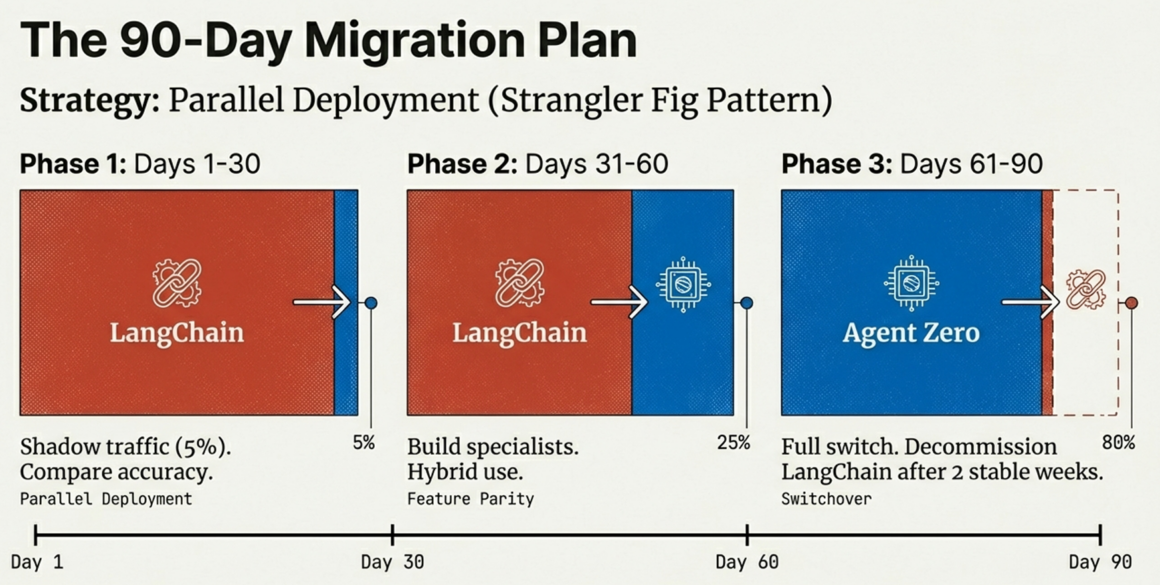
If you decide to migrate, phased approach reduces risk.
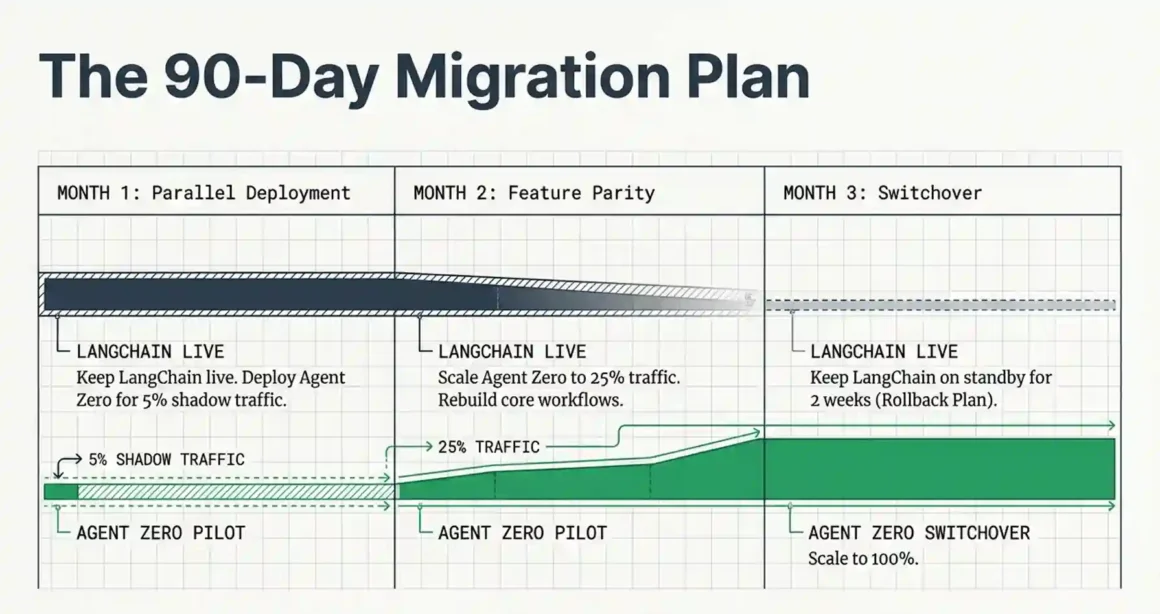
Days 1-30: Parallel Deployment
Don’t shut down your LangChain system. Deploy Agent Zero alongside it.
Week 1: Set up Agent Zero infrastructure
- Install Agent Zero framework
- Configure sandboxing and security
- Set up agent terminal monitoring
- Connect to existing databases and APIs (read-only access)
Week 2-3: Rebuild core functionality in Agent Zero
- Identify your 3 most common user workflows
- Implement those in Agent Zero’s hierarchical structure
- Run internal testing with your team
Week 4: Shadow production traffic
- Route 5% of production traffic to Agent Zero
- Run LangChain on 95% of traffic as primary
- Compare results: accuracy, performance, cost
- Collect debugging data from both systems
Days 31-60: Feature Parity
Month 2 focuses on matching LangChain features while users still rely on LangChain primary.
Week 5-6: Implement remaining workflows
- Build Agent Zero specialists for all LangChain chain functions
- Add error handling and edge cases
- Implement custom integrations (replacing LangChain connectors)
Week 7: Increase shadow traffic
- Route 25% of production traffic to Agent Zero
- Monitor error rates, performance metrics
- Identify gaps in functionality
Week 8: Fix gaps and optimize
- Address any missing features discovered in testing
- Optimize token usage and performance
- Train team on Agent Zero debugging
Days 61-90: Full Migration
Month 3 is the switchover with gradual rollout and LangChain fallback safety.
Week 9: Primary traffic switchover
- Route 50% of production traffic to Agent Zero (primary)
- Keep LangChain running on 50% for comparison
- Monitor closely for issues
Week 10-11: Increase Agent Zero to 80%, then 95%
- Gradually shift traffic as confidence grows
- Keep LangChain running on 5% for safety
Week 12: Decommission LangChain (with rollback plan)
- Move 100% of traffic to Agent Zero
- Keep LangChain deployment on standby for 2 weeks
- After 2 weeks with no major issues, shut down LangChain infrastructure
Migration Risk Mitigation
Risk 1: Feature parity gaps User reports: “Feature X worked in the old system but not anymore”
Mitigation: Create feature comparison matrix before migration starts. Test every LangChain chain against Agent Zero equivalent with sample inputs. Document any gaps explicitly.
Risk 2: Performance regression Agent Zero is slower than LangChain for some workflows
Mitigation: Profile both systems with identical production traffic during shadow deployment phase. If Agent Zero is slower for specific workflows, optimize those before full migration. Some workflows might stay on LangChain permanently (hybrid architecture).
Risk 3: Team adoption resistance Engineers comfortable with LangChain resist learning Agent Zero
Mitigation: Run 2-day Agent Zero workshop for team during Week 1-2. Pair experienced engineers with Agent Zero experts. Don’t rush—if team needs extra time, extend migration timeline.
Risk 4: Unexpected costs Agent Zero’s sandboxing infrastructure costs more than anticipated
Mitigation: Calculate infrastructure costs during Week 4 shadow deployment with real traffic. If costs exceed projections, optimize (shared sandbox pools, execution limits) before expanding traffic.
The 7-Question Decision Framework
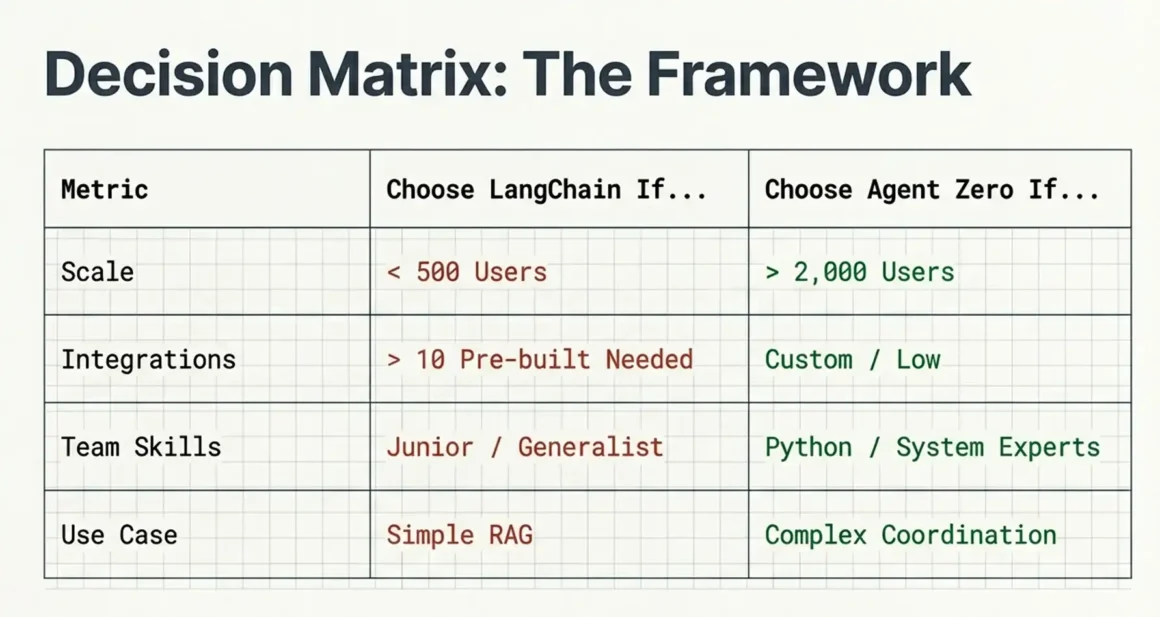
Use these questions to decide between LangChain and Agent Zero for your specific project.
Question 1: What’s your primary use case complexity?
- Simple (document Q&A, basic chatbot, straightforward workflows) → LangChain
- Complex (multi-step coordination, dynamic task breakdown, adaptive workflows) → Agent Zero
Question 2: How important is debugging and observability?
- We can tolerate 20+ hour debugging sessions → LangChain (but consider better tooling)
- Need quick issue identification and resolution → Agent Zero
Question 3: What’s your scale target?
- <500 concurrent users → Either works
- 500-2,000 concurrent users → Agent Zero preferred (simpler scaling)
- 2,000+ concurrent users → Agent Zero strongly recommended
Question 4: How many third-party integrations do you need?
- 10+ pre-built connectors (Salesforce, SAP, etc.) → LangChain
- <10 integrations or willing to build custom → Either works
- Need dynamic integration creation → Agent Zero
Question 5: What’s your team’s technical capability?
- Junior developers, limited AI experience → LangChain (more tutorials and resources)
- Experienced developers, comfortable with complex systems → Either works
- Strong Python developers who understand hierarchical systems → Agent Zero preferred
Question 6: How critical is cost optimization?
- Budget isn’t a primary concern → Either works
- Need to minimize token and infrastructure costs → Agent Zero
- Need to minimize development time → LangChain (faster prototyping for simple cases)
Question 7: How important is rapid adaptability?
- Requirements are stable and well-defined → LangChain
- Requirements change frequently → Agent Zero (easier to modify hierarchy)
- Need agents to handle unpredictable scenarios → Agent Zero (dynamic tool creation)
Scoring Your Answers
If you answered LangChain on 5+ questions → Stick with LangChain If you answered Agent Zero on 5+ questions → Strong Agent Zero candidate If you answered Either works on most questions → Default to LangChain for faster initial development, plan migration if scaling needs increase
What’s the Future: Will LangChain Survive the Agent Zero Paradigm?
The AI agent landscape is shifting toward hierarchical, autonomous systems. LangChain’s chain-based architecture represents first-generation multi-agent thinking—sequential processing with human-defined steps.
Agent Zero’s hierarchical delegation represents second-generation thinking—autonomous task breakdown with minimal human specification.
LangChain’s evolution path:
LangChain isn’t standing still. The LangGraph extension adds graph-based agent coordination, moving beyond simple chains:
- Agents can execute in parallel
- Conditional routing between agents
- Cyclic workflows (agent A → B → A)
LangGraph addresses some of LangChain’s scalability issues. It’s moving toward Agent Zero’s coordination model while maintaining LangChain’s integration ecosystem.
Future prediction: LangChain will survive as an integration platform. Its 700+ connectors have massive value. Expect LangChain to fully embrace hierarchical architectures while maintaining its “batteries included” philosophy.
Agent Zero’s evolution path:
Agent Zero’s weakness is the integration ecosystem. It’s newer, less mature. Future development will likely focus on:
- Pre-built specialist libraries (common agent types)
- Integration marketplace (community-contributed connectors)
- Enhanced security and sandboxing
- Enterprise compliance certifications
Agent Zero will remain the “build exactly what you need” framework versus LangChain’s “everything included” approach.
The likely outcome: Coexistence, not replacement
Different use cases will favor different architectures:
LangChain dominance:
- Enterprise RAG systems
- Document Q&A applications
- Integration-heavy workflows
- Teams prioritizing development speed over custom architecture
Agent Zero dominance:
- Novel multi-agent applications
- High-scale autonomous systems (10,000+ concurrent users)
- Cost-sensitive deployments
- Teams building unique agent architectures
Hybrid deployments: Many production systems will use both:
- LangChain for RAG and document processing
- Agent Zero for complex multi-agent coordination
- LangChain integrations feeding data into Agent Zero hierarchies
The question isn’t which framework “wins” but which fits your specific requirements better. Both will exist because they solve different problems optimally.
Evaluate your use case with the 7-question framework above. Choose the tool that matches your needs, not the tool with the most GitHub stars or hype.
The best framework is the one that ships your product successfully while staying within budget and engineering capacity.


