
You hit a wall fast with a single AI agent. Ask it to research a competitor, summarize the findings, cross-check them against internal docs, and produce a report — it starts losing thread around step three. Context fills up. It forgets what it found earlier. It starts making things up to fill the gaps.
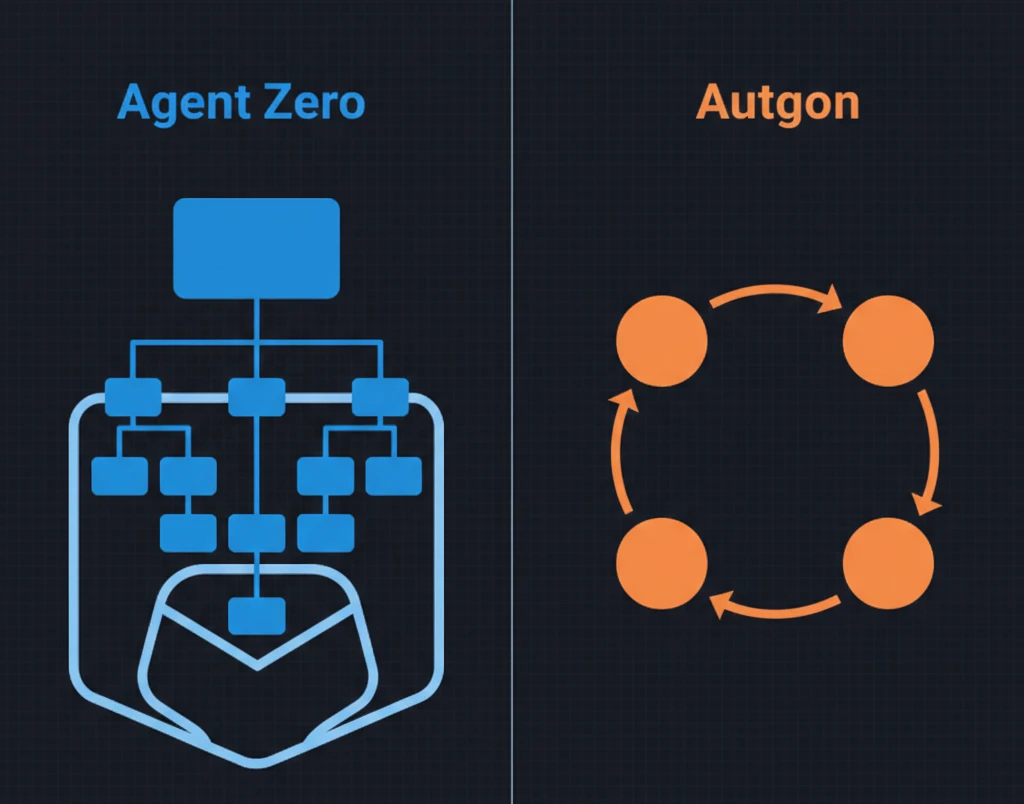
That is the problem multi-agent frameworks solve. They split the work across specialized agents so each one handles a focused piece. Both Agent Zero and AutoGen do this — but the way they do it is architecturally opposite. That difference determines what your system can actually do in production, how much it costs to run, and how much control you have when something breaks.
| Agent Zero | AutoGen | |
|---|---|---|
| How agents coordinate | Superior delegates to subordinates | Agents talk in a conversation loop |
| Memory between sessions | Persistent by default (FAISS) | Session-based, needs extra setup |
| Tools | Agents create their own dynamically | Tools must be pre-defined |
| Prompt visibility | Full — plaintext files you edit directly | Partially abstracted by the framework |
| Execution environment | Real OS terminal inside Docker | Sandboxed code execution |
| Search | SearXNG (self-hosted, private) | Bing API (cloud) |
| Local model support | Strong — built for small models | Works, but better with GPT-4 class |
| Best for | Long autonomous tasks, privacy-critical work | Collaborative reasoning, Azure enterprise |
How AutoGen Coordinates Agents — and Where That Creates Problems
AutoGen, built by Microsoft Research and first released in September 2023, treats multi-agent work as a group conversation. You set up an AssistantAgent (the one doing the thinking) and a UserProxyAgent (acting as coordinator). In GroupChat setups, multiple agents join the same conversation thread, each replying in turn, all sharing the same growing message history.
This works well for a specific type of task. When you want one agent to write a draft and another to critique it, the back-and-forth naturally produces better output. The agents challenge each other. Gaps get caught. AutoGen’s own research showed this approach hit 69.48% accuracy on advanced math problems using GPT-4, outperforming single-agent setups by a significant margin. That is a real result. The collaborative reasoning model is genuinely effective for exploratory, iterative work.
The problem shows up in production.
Every reply in a GroupChat appends to the shared message history. By turn 10, every agent receives that full growing history with each message. By turn 25, you are pushing a massive context payload to every agent just to process a single reply. Token consumption grows with each turn, and it grows for every agent simultaneously. AutoGen does have a max_turns parameter to cap conversations — but the default can be set as high as 50, and if you do not tune it deliberately for your specific workflow, costs spike fast. This is consistently one of the first surprises teams hit when they scale AutoGen beyond a demo.
The second issue is debugging. Because agent decisions emerge from the accumulated conversation context, the same input can produce different outputs across runs. Without external tracing — AutoGen integrates with OpenTelemetry and AgentOps for this, but it is separate setup — you are watching agents exchange messages without being able to reliably reproduce or isolate what caused an unexpected response.
AutoGen v0.4, released in January 2025, was a full rewrite that addressed many of these complaints. The architecture moved from synchronous to asynchronous and event-driven. The team explicitly acknowledged the original release had “architectural limitations, an inefficient API, and restricted debugging tools.” The rewrite improved observability and added mid-execution control through AutoGen Studio. But the fundamental model — agents coordinating through message exchange — did not change.
One specific vulnerability is worth knowing. A February 2025 security study called CORBA (Contagious Recursive Blocking Attack) demonstrated that under adversarial input conditions, between 79% and 100% of AutoGen agents could be forced into a completely blocked, non-functional state within 1.6 to 1.9 dialogue turns. The attack works by injecting messages that propagate the blocking state across the agent network. This is an adversarial scenario rather than an everyday failure, but it reveals something real about conversation-loop architectures: a bad message cascades. The recommended fix is agent isolation and prompt sanitization — additional engineering on top of the framework’s baseline.
There is also the fork problem. AutoGen’s development went through a major split. Microsoft rewrote the framework in v0.4, which broke backward compatibility with v0.2 apps. A community fork called AG2 was created to preserve the v0.2 API line independently. Production teams evaluating AutoGen now have to decide which codebase to bet on. The official migration guide flags breaking changes when moving from v0.2 to v0.4. This has pushed some teams to switch frameworks entirely rather than migrate.
How Agent Zero Coordinates Agents — and Why the Architecture Is Different
Agent Zero uses a superior-subordinate hierarchy. There is no group chat. There are no peers exchanging messages.
The main agent — called Agent 0 — receives a task. If that task is complex, Agent 0 spins up a subordinate agent and delegates a specific subtask to it. That subordinate works on its piece, reports the result back, and Agent 0 continues. If the subtask is itself complex, the subordinate can create its own sub-agent further down the chain. The framework documentation says it clearly: “Every agent has a superior agent giving it tasks and instructions. Every agent then reports back to its superior.”
The practical effect of this is each agent holds only the context for its own piece of work. Agent 0 does not accumulate a growing history of every sub-agent’s internal dialogue. It receives results and summaries. Context stays focused and bounded. This is why Agent Zero handles long multi-step workflows without the same context overflow pattern that affects AutoGen’s GroupChat.
Beyond the coordination model, Agent Zero runs inside a real Docker container with a real Linux environment. It has an actual terminal. When it installs a package, the package is installed. When it writes and runs a script, that script executes. When it modifies a file, the file is modified. AutoGen also supports code execution, but through a sandboxed environment with controlled file system and network access. The practical difference appears when you need your agent to do anything at the operating system level — manage running processes, install dependencies across sessions, interact with local data persistently.
The trade-off here is real and worth stating plainly. Agent Zero with real OS access inside a container is genuinely powerful. The official documentation warns directly: “Agent Zero Can Be Dangerous! With proper instruction, Agent Zero is capable of many things, even potentially dangerous actions concerning your computer, data, or accounts.” The Docker container is the safety layer. Vague instructions on a task that involves real files and real execution can produce real consequences. Prompt clarity matters more here than in AutoGen.
Memory: The Difference That Matters Most for Repeated Work
Most multi-agent comparisons skip this, which is a mistake. If you are running the same type of workflow regularly, memory behavior determines whether your agent improves over time or starts from scratch every single run.
AutoGen starts fresh by default. Agents remember the conversation within a session. When that session ends, the context is gone. You can add persistent memory through a vector database integration — Chroma, Pinecone, or similar — but that is separate infrastructure you have to build, configure, and maintain. A community-maintained extension autogen-contextplus adds token-based context management, but it is experimental and not part of the main framework.
Agent Zero stores memory persistently and automatically. It uses FAISS (Facebook AI Similarity Search) for vector-based retrieval and organizes what it stores into four distinct categories:
Main memories — facts the agent has learned, like user preferences or API key formats for specific services. Conversation fragments — pieces of context from previous sessions that are still relevant. Proven solutions — code and approaches the agent verified actually worked. Custom instruments (now being replaced by the Skills system) — reusable scripts the agent created and saved for future use without consuming extra tokens to regenerate them.
The proven solutions category is the one that changes actual workflow economics. If an agent successfully pulls stock data from Yahoo Finance one Tuesday, it stores the working approach. Next time a similar task comes in, it retrieves that approach instead of reasoning through it again from scratch. Token use drops. Reliability increases. The agent gets better at recurring tasks over time without any manual cataloguing.
Tool Creation: What Happens When Your Agent Needs a Capability That Does Not Exist Yet
AutoGen requires tools to be defined before agents run. You register functions in your configuration — a calculator, a database query function, a web search call. Agents call those registered tools during execution. If a task needs a capability you did not anticipate and pre-build, the agent works around it with what it has, or fails.
Agent Zero creates tools dynamically. The only tools it ships with by default are web search, memory access, inter-agent communication, and terminal execution. Everything else, an agent can write itself. If Agent Zero determines it needs a function to parse a specific JSON structure from an API it has not seen before, it writes the code, tests it in the terminal, debugs errors autonomously, and saves the working result. Future tasks that need the same operation retrieve and reuse it.
The documentation is explicit: “Everything else is created by the agent itself or can be extended by the user.” This is also why Agent Zero’s tool usage implementation was built from scratch rather than inherited from existing frameworks — the goal was reliability even with small models, where instruction following is less reliable.
Dynamic tool creation is impressive but requires careful system prompt design. An agent with real execution access and the ability to write arbitrary code will do exactly what you instruct it to do. Precise instructions produce useful tools. Vague instructions produce tools that technically run but miss the point.
Prompt Transparency: What You See When Something Breaks
When an agent behaves unexpectedly — and in long-running autonomous workflows, it will eventually — the speed of your diagnosis depends on how visible the agent’s instructions are.
AutoGen’s default prompts are embedded in the framework code. The AssistantAgent and UserProxyAgent have predefined system prompts set by the AutoGen library. You can override them, but the defaults involve logic that lives in Python source files. Diagnosing unusual behavior sometimes means reading AutoGen’s internals to understand what baseline instructions are running underneath your custom configuration.
Agent Zero’s entire behavior is defined in plaintext prompt files. The system prompt lives at prompts/default/agent.system.md. If an agent behaves unexpectedly, you open that file, read it, change what needs changing, and reload. No framework internals to navigate. The documentation frames this as a core design principle: “The whole framework is guided by the prompts/ folder. Agent guidelines, tool instructions, messages, utility AI functions, it’s all there.”
For teams building specialized agents — security auditing, legal research, domain-specific automation — the ability to read and audit the exact instructions your agent is running on is an operational advantage that becomes more valuable the more specific the use case.
New to Agent Zero? Before diving into Docker installation, understand what makes this framework unique. Our comprehensive Agent Zero guide covers its architecture, key capabilities, and why it’s becoming the preferred choice for autonomous AI agents. Master the fundamentals first to maximize your Docker deployment success.
Where AutoGen Is the Correct Choice
Collaborative reasoning where agents need to challenge each other. A Writer and a Critic running in AutoGen’s GroupChat produce better-polished outputs than either agent working alone. The conversation model creates natural revision cycles. This is not a theoretical claim — IBM’s multi-agent RAG system used a 6-agent AutoGen setup for document analysis, with agents playing planner, researcher, and report generator roles in sequence. The iterative challenge-and-revise pattern is genuinely what AutoGen is built for.
AutoGen Studio for non-developers. AutoGen ships with a visual GUI where you assemble agent teams, define their roles, and test workflows without writing Python. A non-developer can have a working prototype in under an hour. Agent Zero has a web UI, but it is for giving tasks to an already-running agent — not a visual agent builder.
Azure enterprise deployments. In October 2025, Microsoft merged AutoGen and Semantic Kernel into a unified Microsoft Agent Framework. This brings native Azure Active Directory identity, role-based access control, SOC 2 and HIPAA compliance, production SLAs, and multi-language support (Python, C#, Java). If your infrastructure is on Azure and your compliance team needs documented guarantees, AutoGen through the Microsoft Agent Framework is the only option that provides them. General availability is targeted for Q1 2026.
Human approval gates. AutoGen’s human_input_mode parameter builds approval checkpoints directly into the agent workflow — require human sign-off at every action, only at specific steps, or not at all. This is a formal, documented framework feature, not something you bolt on. For workflows where human oversight is a compliance requirement, AutoGen handles this cleanly.
Deciding between Agent Zero and CrewAI for your project? This detailed Agent Zero vs CrewAI comparison breaks down performance, ease of deployment, and Docker compatibility. See why many developers choose Agent Zero’s containerized approach before you begin your installation.
Where Agent Zero Is the Correct Choice
Long autonomous tasks without supervision. Agent Zero running in a persistent Docker container can execute a workflow for hours without intervention. The hierarchy keeps each agent’s context clean, persistent memory stores intermediate results across the session, and the agent recovers from errors by trying alternatives autonomously. For overnight research, batch processing, or infrastructure monitoring, this architecture is purpose-built for unsupervised execution.
Privacy and data residency. Agent Zero uses SearXNG — a self-hosted, open-source metasearch engine. Search queries never leave your infrastructure. AutoGen’s default web search uses the Bing API, which routes queries through Microsoft’s cloud. For regulated industries, legal work, or any situation where search behavior must not be logged by a third party, Agent Zero’s search model is architecturally private in a way AutoGen’s default is not.
Local and small models. Agent Zero was built from the start to be reliable with small models. The tool use system was written specifically to work with models as small as 1 billion parameters via Ollama. AutoGen works with local models through Ollama or LM Studio integrations, but complex GroupChat setups with multiple agents become unpredictable with smaller models — they tend to work better with GPT-4 class reasoning. If your deployment has no cloud API budget or has hardware constraints, Agent Zero’s architecture accommodates that more gracefully.
No vendor dependency. Docker runs anywhere — a laptop, a VPS, an on-premise server, any private cloud. Agent Zero has no dependency on any specific cloud provider. AutoGen’s deepest enterprise features are Azure-native. If vendor independence matters to your architecture decisions, Agent Zero’s deployment model is simpler and more portable.
Agent Zero ranks among the top AI agent frameworks of 2026. Explore how it compares to AutoGPT, LangChain, and alternatives in terms of deployment flexibility. Understanding the landscape helps you appreciate why Docker installation offers the best balance of power and simplicity.
Setup: What the First Hour Actually Looks Like
Getting AutoGen running requires Python 3.10 or later. Install with:
pip install -U "autogen-agentchat" "autogen-ext[openai]"
Set your OpenAI API key as an environment variable. Write a basic two-agent script and it runs in about 15 minutes. For AutoGen Studio, add pip install -U "autogenstudio" and launch the visual interface. The initial experience is smooth. Friction increases when you move to GroupChat with multiple agents, add persistent memory, or try to debug inconsistent agent behavior — expect several hours of learning before production-ready configurations.
Getting Agent Zero running is Docker-based:
docker pull agent0ai/agent-zero
docker run -p 50001:80 agent0ai/agent-zero
Go to localhost:50001, add API keys through the web interface or a .env file, and the agent is live. The container handles all dependencies. No Python environment conflicts. Many developers find this initial experience faster than AutoGen’s pip setup.
Important caveat on Docker persistence: by default, Agent Zero containers are ephemeral. Data is lost if you delete the container. To make memory and settings persist across restarts, mount a volume to /a0/usr:
docker run -d -p 50080:80 -v /path/to/local/folder:/a0/usr agent0ai/agent-zero
The learning curve for Agent Zero is different from AutoGen — it is less about understanding the framework’s Python API and more about writing effective system prompts. Because you control agent behavior entirely through prompt files, the quality of your instructions directly determines the quality of the output.
One honest gap: Agent Zero’s documentation has less coverage on advanced features like custom embeddings and extension development. AutoGen’s documentation is more comprehensive, and its community is substantially larger. More existing tutorials, more answered Stack Overflow questions. When you hit an edge case with AutoGen, the answer is more likely to already exist somewhere. With Agent Zero, you may need to read source code or ask in the Discord.
Agent Zero ranks among the top AI agent frameworks of 2026. Explore how it compares to AutoGPT, LangChain, and alternatives in terms of deployment flexibility. Understanding the landscape helps you appreciate why Docker installation offers the best balance of power and simplicity.
How to Choose Between Them
Work through these questions in order. Stop at the first clear answer.
Do you need agents to remember what they learned across sessions without setting up a separate vector database? Agent Zero — its FAISS-based persistent memory handles this by default.
Are you deploying on Azure with enterprise compliance requirements? AutoGen through the Microsoft Agent Framework — identity, SLAs, and compliance integrations are pre-built.
Does your task need real OS access — running scripts, managing files, installing packages? Agent Zero — Docker gives agents a real Linux environment. AutoGen sandboxes execution.
Must all data, including search queries, stay on your own infrastructure? Agent Zero with SearXNG — search queries never leave your server.
Do you want agents to iterate on each other’s work through structured back-and-forth reasoning? AutoGen — the conversation model is what makes Writer-Critic and multi-perspective research patterns work.
Are you prototyping quickly without writing Python? AutoGen Studio — visual agent assembly, faster to get a working prototype than any comparable framework.
Are you working with small local models and limited hardware? Agent Zero with Ollama — built from scratch to be reliable with small models.
Once your Agent Zero Docker setup is complete, put it to work automating marketing workflows. This agentic AI marketing automation guide shows practical applications for campaign management and content generation—perfect projects to test your new containerized deployment.
The Bottom Line
AutoGen solves the problem of collaborative multi-agent reasoning — agents that challenge, review, and improve each other’s outputs through structured conversation. It has the enterprise infrastructure (Azure, compliance, SLAs), the visual tooling (AutoGen Studio), and the community size (45,000+ GitHub stars) to back that up.
Agent Zero solves the problem of autonomous multi-agent execution — agents that work on a real computer, learn from past sessions, build their own tools, and run independently for extended periods without supervision. It does this with more transparency and less vendor dependency than any framework that abstracts its internals away.
They are not competing for the same use case. If your workflow looks like “agents debating and improving an output together,” AutoGen is right. If your workflow looks like “an agent executing complex tasks autonomously on a real system over time,” Agent Zero is right. The wrong answer is picking one based on GitHub stars or company backing alone — the architecture mismatch will cost you more time than the initial setup ever saved.
Interested in alternative AI agent setups? Our NEO AI Agent setup guide offers another approach to autonomous agent deployment. Compare installation methods and architectural differences to deepen your understanding of containerized AI systems beyond Agent Zero’s Docker implementation.


