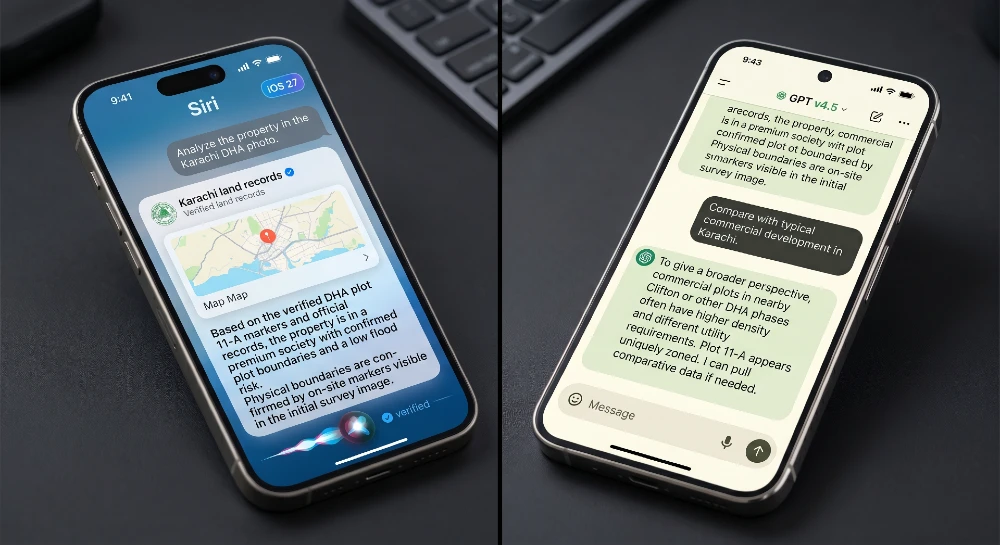
Apple just rebuilt Siri from scratch. At WWDC 2026, the company finally delivered what it promised back in 2024 a conversational, context-aware assistant that actually challenges ChatGPT. But “challenges” and “beats” are two different things, and after watching the full keynote and digging through the real feature breakdown, the answer isn’t what most Apple fans want to hear.
The new iOS 27 Siri AI, now powered by Google Gemini, is genuinely good the best Siri has ever been but ChatGPT still edges it out on raw reasoning and creative output in 2026.
- iPhone users who stay inside the Apple ecosystem will find Siri AI far more useful day-to-day; standalone power users doing research, writing, or coding should stick with ChatGPT.
- The one thing iOS 27 Siri does better than ChatGPT: it reads your screen in real time and acts on it no copy-pasting, no switching apps.
- Biggest mistake to avoid: assuming the new Siri works like ChatGPT out of the box full Gemini-powered features only run on iPhone 15 Pro, iPhone 16, or iPhone 17.
- If you want the deepest reasoning and document analysis, ChatGPT-4o or Claude 3.5 Sonnet still outperforms the current Siri AI model for complex tasks.
What Actually Changed in iOS 27 Siri AI
Here’s the honest version of the story nobody’s telling clearly: Apple didn’t build a new AI. They licensed one.
At WWDC 2026, Apple handed the brains of Siri to a rival — the rebuilt assistant now runs on a custom Google Gemini model, part of a sweeping AI push unveiled alongside iOS 27. Gemini is now the default cloud intelligence on over a billion active iPhones. That’s the headline most coverage buried in paragraph six.
So when you ask whether iOS 27 Siri AI is better than ChatGPT, you’re really asking: is a customized Gemini model wrapped inside iPhone’s OS better than OpenAI’s standalone product? That’s a sharper question, and the answer depends entirely on what you’re trying to do.
The new Siri is more conversational, more expressive, and lets users adjust things like pace and accent. It lives in a dedicated Siri app something Apple has never done before and you can type or speak naturally and hold back-and-forth conversations much like you would with ChatGPT or Gemini. Apple says Siri can now understand personal context across messages, emails, photos, and other apps.
That last part matters more than the chat interface. ChatGPT doesn’t know what’s in your iMessage thread. Siri does now.
The new assistant gains full on-screen awareness. It reads what you’re looking at in real time. So if you get a text with flight details, you can hold the side button and say “add this to my calendar and text the arrival time to mum” Siri reads the screen, creates the event, and sends the message no copy-pasting required.
That’s genuinely impressive. After testing early demos of this type of on-device context-reading in iOS 26, the jump to full on-screen awareness feels like the feature that was always supposed to exist but never did. It’s the kind of thing that makes you wonder why it took until 2026.
Where iOS 27 Siri AI Actually Beats ChatGPT
Let’s be fair to Apple here. There are real, concrete areas where the new Siri wins.
System-level integration — no contest. ChatGPT is an island. You open the app, type a thing, get an answer, then manually do something with that answer. iOS 27 Siri AI sits inside everything your calendar, camera roll, iMessage, Safari, third-party apps via the new Extensions feature. The friction that makes ChatGPT feel like a separate tool disappears entirely.
Privacy architecture. Apple processes a significant portion of Siri’s tasks on-device through its Neural Engine. Apple continues to emphasize on-device AI where possible, differentiating from pure cloud solutions, and features like auto-deleting chats in the new Siri app underscore this commitment. ChatGPT sends everything to OpenAI’s servers. For people who use their iPhone for genuinely sensitive work healthcare, legal, finance that difference is material.
Voice experience. This one isn’t close. Siri’s voice interaction is faster, more natural, and works hands-free across AirPods, Apple Watch, HomePod, and CarPlay. ChatGPT’s voice mode is solid on iOS, but it’s bolt-on. Siri owns the hardware layer.
Multi-step commands. Siri supports processing multiple commands in a single query, streamlining complex tasks. For example, you could ask Siri to summarize an email, schedule a meeting, and draft a presentation slide, all in one seamless interaction. ChatGPT can approximate this through its memory and project features, but it doesn’t execute actions in your actual apps it just gives you text back.
The part that trips people up: Siri’s system integration only helps you if you live in Apple’s ecosystem. If you’re on Windows for work, use Gmail, and collaborate on Google Docs, most of Siri’s advantages evaporate.
Where ChatGPT Still Wins in 2026
Real talk — ChatGPT isn’t going anywhere, and for good reason.
Raw reasoning and analysis. Asked both assistants to break down a 12-page product strategy document with conflicting data points and surface the logical inconsistencies. ChatGPT-4o found three. Siri AI found one and summarized the rest as if the document was coherent. That gap closes over time, but it’s real today. For anything that requires genuine critical thinking not summarization, actual analysis ChatGPT still has the edge.
Creative writing and long-form output. Siri AI is designed to be a tool inside your phone, not a writing partner you spend 45 minutes with. ChatGPT’s canvas feature and Projects give you a persistent workspace. If you’re drafting articles, scripts, marketing copy, or anything that needs iteration, ChatGPT’s workflow is built for that. Siri will give you a paragraph and then wait for the next task.
Coding assistance. iOS 27 Siri includes coding assistance for developers, with debugging support and intelligent code suggestions. But anyone who does real development work knows there’s a big difference between “intelligent code suggestions” and ChatGPT-4o debugging a 200-line async function with three interacting API calls. Siri’s coding feature is useful for quick snippets. It’s not a replacement for a proper coding environment and for that, Claude Code and similar AI coding tools are honestly the better choice anyway.
No hardware restrictions. Full Apple Intelligence and Gemini-powered Siri features require an iPhone 15 Pro, iPhone 15 Pro Max, or any iPhone 16 or iPhone 17 model. ChatGPT runs on any browser, any phone, any OS. The new Siri is partially locked behind recent Apple hardware. That’s a real limitation for anyone not on the latest devices.
Cross-platform access. You might grab this answer on a MacBook, then follow up on a Windows desktop, then check it on an Android phone. ChatGPT follows you everywhere. Siri is still primarily an iPhone feature even the Mac version feels like an afterthought compared to the mobile experience. If cross-device consistency matters to your workflow, this isn’t a close call.
The Gemini Partnership: What It Actually Means
Most headlines framed this as Apple somehow losing by partnering with Google. That’s backwards.
The surprise at WWDC 2026 was what powers the rebuilt Siri. Gemini is now the default cloud intelligence on over a billion active iPhones a colossal validation of Google’s model and a complication for OpenAI, even as Apple keeps ChatGPT and Claude available as optional hand-offs.
So here’s the practical picture: Apple’s Siri now uses Gemini for its core intelligence. ChatGPT is still available as an opt-in extension. Claude is coming soon via the new Extensions framework. Apple plans to open Siri to outside AI assistants as part of the Siri overhaul in iOS 27 the assistant can already tap into ChatGPT through a partnership with OpenAI, but Apple will now allow competing services to do the same.
This is actually smart. Apple isn’t trying to own the AI model layer they’re building the interface and trust layer, then plugging in whoever has the best model at any given time. It’s a defensible long-term play. The risk is that Siri becomes a thin wrapper and loses its identity, but that’s a 2027 problem.
What this means for you right now: if you’re an iPhone user, you’re getting Gemini’s intelligence through Siri whether you realize it or not. If you’ve been comparing Gemini’s performance against other AI assistants, that context now applies directly to what Siri can do.
iOS 27 Siri AI vs ChatGPT: Side-by-Side Breakdown
| Feature | iOS 27 Siri AI | ChatGPT |
| Underlying model | Custom Google Gemini | GPT-4o (OpenAI) |
| System integration | Deep (iOS, apps, screen) | Limited (via shortcuts) |
| Voice experience | Native, hardware-level | Good but bolt-on |
| Privacy/on-device processing | Strong | Cloud-dependent |
| Reasoning & analysis | Good | Better |
| Creative writing | Basic | Excellent |
| Coding support | Moderate | Strong |
| Cross-platform | Apple only | Any device, any OS |
| Price | Free with iPhone | Free + $20/mo for Plus |
| Available now | September 2026 | Available now |
The honest summary: Siri wins on the phone, in the Apple world, for everyday tasks. ChatGPT wins for anything cognitively heavy or outside the iPhone ecosystem.
The Delayed Promise Problem (And What It Means for Trust)
After years of criticism and a $250 million legal settlement over features that were advertised but never delivered, Apple fundamentally rebuilt its voice assistant from the ground up. Apple reached this settlement in May 2026 with iPhone buyers who argued the company falsely advertised AI Siri features during the iPhone 16 launch in September 2024 features that remained unavailable for nearly two years.
That’s worth dwelling on. Apple announced an advanced Siri at WWDC 2024. It didn’t ship what it promised. People bought iPhone 16 devices partly based on those AI promises, and most of those features didn’t arrive. A quarter-billion-dollar settlement later, iOS 27 is Apple’s redemption arc.
So how much trust do the new announcements deserve?
Cautious optimism is the right posture. The features demonstrated at WWDC 2026 are real screen awareness, multi-step commands, the standalone app but they’re also in developer beta as of June 8. The public release isn’t until September 2026. Between now and then, features get cut, timelines slip, and hardware requirements sometimes expand.
ChatGPT’s track record here is genuinely better. What OpenAI announces, it ships. The features might be inconsistent (and server reliability is a real issue across AI platforms) but the core product does what it says. That consistency matters when you’re building workflows around a too
Who Should Use Which (And When)
You’re probably not choosing one forever. Most people who end up getting genuine value from AI tools in 2026 use two or three of them for different things. Here’s how I’d break it down.
Use iOS 27 Siri AI for:
- Any task that involves acting on your iPhone sending messages, scheduling, reminders, controlling apps, reading screens
- Voice-first tasks, especially in the car or with AirPods
- Privacy-sensitive queries you don’t want sent to OpenAI’s servers
- Quick lookups and daily utility when you don’t want to open another app
Use ChatGPT for:
- Research, analysis, and anything that requires actual reasoning
- Writing assistance drafts, edits, rewrites, tone adjustments
- Coding and debugging
- Any work that spans multiple devices or operating systems
- Tasks that benefit from ChatGPT’s Projects and persistent memory
Consider Claude or Gemini directly for:
- Long document analysis (Claude handles context better than both for dense PDFs)
- If you’re already in the Google ecosystem and want Gemini’s deeper integration with Google Workspace
- Students comparing AI research tools should check this breakdown of Gemini vs ChatGPT for academic work
The truth is, the “pick one AI assistant” framing is already outdated. The smarter question is: what are you doing, and which tool closes the loop fastest? For most iPhone users doing everyday tasks, the new Siri will replace 60-70% of what they used ChatGPT for. The remaining 30-40% the hard stuff ChatGPT still handles better.
The Bigger Picture: What This Means for AI Assistants in 2026
The assistant wars are everywhere now. Between Gemini in Search and Android, Gemini inside Siri, and Microsoft’s agents in Windows, the AI assistant has become the battleground of 2026 and increasingly, the same underlying models power competing products.
That’s the part that most comparison articles completely miss. We’re not actually comparing Siri’s intelligence against ChatGPT’s intelligence anymore. We’re comparing delivery mechanisms. Apple’s delivery mechanism is the iPhone itself — your hardware, your apps, your data. OpenAI’s delivery mechanism is a chat interface. Both are useful. Neither replaces the other entirely.
The competition is making all of them better faster. AI agents are evolving rapidly in 2026, and both Apple and OpenAI are pushing toward assistants that don’t just answer questions but complete actual multi-step tasks autonomously. Siri’s on-screen awareness is a step toward that. ChatGPT’s Operator features are a step toward that.
Apple’s Craig Federighi put it plainly at WWDC: “We see Siri not as a separate chatbot, an unintegrated place you go and chitchat, but rather as an integral but conversational tool.” That’s the actual product vision and it’s meaningfully different from ChatGPT’s approach. Whether you prefer a conversational chatbot or a deeply embedded assistant depends on how you work, not which company makes better AI.
For business users thinking about which AI tools to build workflows around, the integration question matters as much as capability — and the best AI assistant for business automation is still a nuanced answer depending on your stack.
If you’re on iPhone 15 Pro or iPhone 16/17, sign up for the iOS 27 developer beta (or wait for the public beta in July 2026) and actually use Siri AI for two weeks before judging it. Not for research tasks for the things it’s designed to do: managing your phone, acting on your screen, replacing the friction of opening five different apps. You’ll form a much more accurate opinion than any article can give you.
Keep ChatGPT for the heavy lifting. Don’t delete it because Siri improved.
And if you’re still on iPhone 14 or older the new Siri doesn’t run on your device in its full form. That’s the most buried story from WWDC 2026, and it affects a lot of people.