
SEO & PUBLISHING DETAILS
Here is a fact worth sitting with: according to McKinsey and Gartner research, roughly 70% of enterprise AI initiatives stall or fail before reaching production scale — and the leading cause is not bad technology. It is broken governance. No clear ownership. No risk controls. No compliance path. Just a collection of pilots that never crossed the finish line.
If that pattern sounds familiar, this guide is built for you. Not as a theory exercise, but as a working roadmap used across real AI rollout situations — from global financial services firms deploying credit-scoring models to healthcare systems navigating EU AI Act obligations. The problems are consistent. So are the fixes.
What follows is a structured, decision-ready framework covering the five governance pillars that determine whether your AI transformation scales or stalls: ownership, risk, ethics, data quality, and compliance. Every section includes a practical template, a scoring method, or a decision trigger — not abstractions.
Key stat: 70% of AI pilots fail at the pilot-to-production gate. The failure mode is almost never the model. It is the governance scaffolding around it.
Before spending another dollar on model tuning or infrastructure, run the governance diagnostic in the next section. Most organizations are surprised by how early in the chain the real problem sits.
→ Related: What Is an AI Governance Framework?
AI Strategy Failing at Scale? Governance Is Your Missing Gate
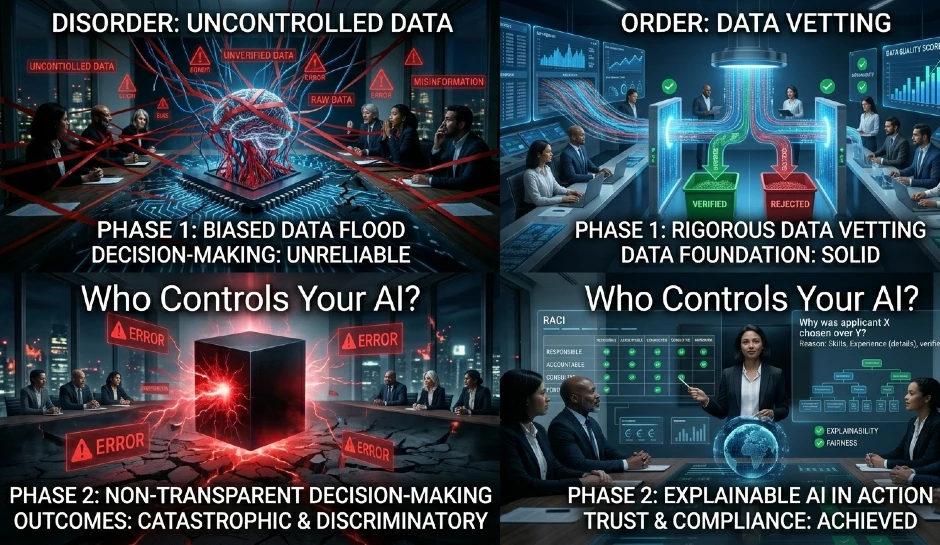
The single most consistent observation from working on AI scaling problems is this: organizations that succeed at AI transformation treat governance as infrastructure, not paperwork. The ones that fail treat it as a checkbox exercise after the model is already built.
Five governance pillars determine your outcome:
• Ownership: Who is accountable when a model misbehaves?
• Risk: Is there a documented risk register for every deployed model?
• Ethics: Does your ethics review happen before launch, or after an incident?
• Data quality: Is there a measurable threshold at which bad data blocks deployment?
• Compliance: Do you have a timeline for EU AI Act obligations mapped to your current model inventory?
Diagnose Your AI Strategy Governance Score in 2 Minutes
Run this quick 10-question assessment and score your organization honestly. Score 1 (No) to 5 (Fully documented and enforced):
| # | Governance Question | Score (1-5) |
| 1 | Is there a named owner for every deployed AI model? | |
| 2 | Does a risk register exist with mitigation owners? | |
| 3 | Is bias tested before every production deployment? | |
| 4 | Do you track all AI models in a central inventory? | |
| 5 | Is data quality measured at each pipeline stage? | |
| 6 | Is there a formal ethics review cadence? | |
| 7 | Have EU AI Act risk categories been assigned to your models? | |
| 8 | Is there a documented pilot-to-production handoff checklist? | |
| 9 | Is a Chief AI Officer or equivalent role in place? | |
| 10 | Does the board receive quarterly AI risk reports? |
Score interpretation: 40-50: Governance-mature. 25-39: Partial — priority gaps exist. Below 25: High risk of transformation failure. Treat this as your starting baseline before investing in new AI capabilities.
Governance vs Technology Priority — What the Data Shows
| Factor | Contribution to AI Scale Success | Where Most Budget Goes |
| Governance (ownership, risk, compliance) | ~60% | ~15% of AI budgets |
| Technology (models, infrastructure) | ~20% | ~65% of AI budgets |
| Talent and upskilling | ~15% | ~15% of AI budgets |
| External vendors | ~5% | ~5% of AI budgets |
This mismatch is the root problem. Most organizations massively over-invest in the layer that contributes the least to scaling success, while under-investing in the governance layer that determines whether the technology investment pays off at all.
→ Related: AI Governance Infrastructure 2026
No Clear AI Ownership? Build Your Strategy RACI Matrix Now
When an AI model causes harm — a biased credit decision, a flawed medical recommendation, a discriminatory hiring filter — the first question regulators and boards ask is: who owned this? In the majority of real incidents reviewed, the answer is either ‘no one specifically’ or ‘unclear.’ That ambiguity is not just an operational problem. Under the EU AI Act, it is a legal liability.
The solution is a formal RACI matrix for AI governance that assigns each role one of four positions: Responsible, Accountable, Consulted, or Informed. Here is the governance-first ownership model that works at enterprise scale:
| Role | R | A | C | I | Primary Governance Function |
| Chief AI Officer | ✓ | ✓ | Strategy, ethics, cross-functional governance | ||
| Chief Risk Officer | ✓ | ✓ | Enterprise risk register, risk gate approvals | ||
| Chief Technology Officer | ✓ | ✓ | Model infrastructure, deployment controls | ||
| Chief Data Officer | ✓ | ✓ | Data quality gates, lineage enforcement | ||
| General Counsel | ✓ | ✓ | EU AI Act compliance, contract review | ||
| Business Unit Owner | ✓ | ✓ | Use-case approval, ROI accountability | ||
| AI Ethics Lead | ✓ | ✓ | Bias testing, ethics review cadence |
The single most common ownership failure is assuming the CTO owns everything. Technology ownership and governance accountability are different. The CTO owns the stack. The CAO owns the strategy. The CRO owns the risk. Without separating these, accountability diffuses — and diffused accountability is the same as no accountability.
Practical note: In organizations that have not yet hired a Chief AI Officer, the CRO typically holds the governance accountability role temporarily. This works as a bridge, but it is not a long-term solution — the risk and strategy functions need separation within 12-18 months of AI scaling.
Chief AI Officer Job Specification: Governance Over Machine Learning
When hiring or appointing a Chief AI Officer, the most important clarification to make internally is this: you do not need the best ML engineer in the room. You need the best governance architect with AI literacy. The 12 core responsibilities, in priority order:
1. Define and own the enterprise AI governance framework
2. Chair the AI Steering Committee with monthly cadence
3. Maintain the full AI model inventory and risk register
4. Lead EU AI Act compliance mapping for all high-risk models
5. Approve or block model deployments at key risk gates
6. Oversee bias testing protocols and production monitoring
7. Report quarterly to the board on AI risk and performance
8. Set vendor AI procurement standards and scorecard criteria
9. Drive AI literacy and upskilling programs across business units
10. Manage shadow AI discovery and remediation programs
11. Coordinate with legal on incident response protocols
12. Own the ethics review board agenda and escalation process
Strategy Steering Committee: 7-Member Template
The AI Steering Committee is the operational backbone of governance. It should meet monthly (minimum) with a quorum of 5 of 7 members required for model deployment approvals. Recommended composition: Chief AI Officer (chair), CRO, CTO, CDO, General Counsel, one Business Unit Head (rotating), and one external AI ethics advisor (non-voting). This structure ensures that no single function can approve a high-risk deployment without cross-functional review.
→ Related: AI Governance Accountability Frameworks
Risk Blind Spots Killing ROI? Use Strategy Risk Gates Across Every Phase
The most expensive AI governance mistake made consistently is deploying models without formal risk gate reviews at each transformation phase. A risk gate is a mandatory checkpoint where a model must clear defined criteria before advancing to the next stage. Without gates, problems that are cheap to fix at the ideation stage become catastrophically expensive at scale.
The risk scoring formula to use is straightforward: Risk Score = Impact x Likelihood x Velocity. Velocity refers to how quickly the risk can cause damage once triggered. A model processing 100,000 decisions per day has a high velocity multiplier even if likelihood is low.
| Gate # | Phase | Key Checks | Block Condition |
| 1 | Ideation | Use-case ethics screen, data availability, regulatory scan | High-risk use case, no legal review |
| 2 | Data Assessment | Data quality score, bias audit, lineage mapping | DQ score below 90%, PII exposure |
| 3 | Model Development | Risk register created, owner assigned, bias baseline set | No documented owner, no risk register |
| 4 | Internal Testing | Bias testing (all protected classes), performance benchmarks | Bias delta >10% across groups |
| 5 | Pilot Launch | SLA defined, monitoring active, rollback plan documented | No rollback procedure |
| 6 | Pilot Evaluation | ROI vs baseline, drift check, user feedback review | ROI <1.5x, drift >10% |
| 7 | Pre-Production | Legal sign-off, EU AI Act classification confirmed | Missing regulatory classification |
| 8 | Production Handoff | SRE handover complete, incident response active | No on-call owner assigned |
| 9 | First 30 Days | Performance vs SLA, bias re-audit, support ticket review | Bias delta >15%, SLA breach |
| 10 | 90-Day Review | Full ROI audit, data drift, model retraining trigger check | Drift >15% without mitigation |
| 11 | Annual Review | Full compliance re-assessment, ethics review, vendor audit | Missing audit documentation |
| 12 | Sunset Decision | Decommission checklist or renewal approval | No sunset plan for deprecated models |
Gate 3 Failure: No Risk Register? Build This Template
Gate 3 is where the majority of organizations fail. A risk register is not a spreadsheet exercise — it is the legal paper trail that proves due diligence under the EU AI Act. Every model in production should have a risk register entry with at minimum these 15 fields:
• Model name and version
• Business owner (named individual, not a team)
• Use case description and decision type
• EU AI Act risk classification (prohibited / high / limited / minimal)
• Affected user populations
• Data sources and lineage references
• Primary risk description
• Risk score (Impact x Likelihood x Velocity)
• Current mitigation in place
• Residual risk score post-mitigation
• Review cadence (weekly / monthly / quarterly)
• Last reviewed date
• Escalation trigger conditions
• Incident history (linked)
• Decommission or renewal date
→ Related: AI Risk Classification for Organizations
High-Risk AI Strategy Pivot: 3 Hard Triggers
Three conditions should immediately trigger a strategy review and potential model suspension regardless of business impact:
• Bias disparity exceeds 20% across any protected demographic group
• Model performance drift exceeds 15% from baseline over a rolling 30-day window
• ROI falls below 2x governance cost within the first 90 days of production
These are not suggestions. They are hard stops. Organizations that treat them as guidelines rather than triggers consistently end up with both the reputational damage and the regulatory exposure.
→ Related: Silent Behavioral Drift in AI Systems
Fragmented AI Inventory? Build a Strategy-Wide Registry That Actually Works
Most enterprises with more than 50 employees running any form of AI-assisted tooling are dealing with the same hidden problem: shadow AI. Employees are using AI tools — from commercial LLM platforms to department-procured automation software — without any central awareness, security review, or governance oversight. The cost is not just security exposure. It is budget waste, duplicated capability, and regulatory blind spots.
A governance-grade AI inventory is not a spreadsheet. It is a live registry, integrated with procurement and IT systems, that surfaces every model and AI-enabled tool in use across the organization. Working with organizations that have implemented central AI inventories, the consistent finding is that roughly 30% of AI spend was redundant or ungoverned before the registry was built.
AI Inventory Template: 18 Mandatory Columns
| Column | Description | Data Type |
| Model ID | Unique identifier | Auto-generated |
| Model Name | Human-readable name | Text |
| Version | Current production version | Semantic version |
| Business Owner | Named accountable individual | Person |
| Technical Owner | Engineering point of contact | Person |
| Department | Business unit using the model | Text |
| Use Case | Brief decision description | Text |
| Risk Tier | EU AI Act classification | Prohibited/High/Limited/Minimal |
| Data Sources | Primary input data streams | List |
| Deployment Environment | Prod / staging / pilot | Enum |
| Launch Date | First production deployment | Date |
| Last Reviewed | Most recent governance review | Date |
| Next Review Due | Scheduled review date | Date |
| Vendor / Source | Internal or external provider | Text |
| Business Impact Score | Revenue, risk, or compliance impact (1-10) | Integer |
| Monitoring Status | Active / degraded / inactive | Enum |
| Incident Count | Total incidents in last 12 months | Integer |
| Decommission Date | Planned sunset or renewal date | Date |
Shadow AI Hunt: 5-Day Discovery Process
Day 1: Deploy an anonymous employee survey asking which AI tools are used in daily work. Guarantee no punitive action — the goal is visibility, not compliance enforcement. Day 2-3: Run network traffic analysis to identify AI API calls not routed through approved channels. Day 4: Cross-reference procurement records against the approved AI vendor list. Day 5: Consolidate findings, classify each tool by risk tier, and assign provisional owners. Expect to surface 15-40 ungoverned tools in a typical 500-person organization.
→ Related: Shadow AI — The Governance Warning Sign You Are Missing
→ Related: How to Build an AI Inventory
EU AI Act Strategy Block? The Compliance Roadmap for 2026
The EU AI Act is no longer a future concern. The prohibited AI provisions took effect in February 2025. The high-risk system obligations — which affect the majority of enterprise AI deployments in HR, credit, healthcare, education, and public services — are enforceable from August 2026 onward. If your organization has not started the compliance mapping process, the window for comfortable preparation is closing.
The strategic error most organizations make is treating EU AI Act compliance as a legal department project. It is a strategy project. The compliance obligations directly determine which models you can deploy, how you must document them, and what governance infrastructure you must have in place before you scale.
Annex III High-Risk Alignment: 14 Controls Checklist
| # | Required Control | Owner | Status |
| 1 | Risk management system established for each high-risk system | CRO | |
| 2 | Data governance and training data documentation | CDO | |
| 3 | Technical documentation maintained and up to date | CTO | |
| 4 | Record-keeping / logging enabled in production | CTO | |
| 5 | Transparency obligations met (users notified of AI interaction) | Legal | |
| 6 | Human oversight mechanism documented and operational | Business Owner | |
| 7 | Accuracy, robustness, and cybersecurity standards met | CTO | |
| 8 | Conformity assessment completed before deployment | CAO | |
| 9 | EU declaration of conformity signed | Legal | |
| 10 | Registration in EU database completed (where required) | Legal | |
| 11 | Post-market monitoring plan in place | CAO | |
| 12 | Incident reporting procedure to national authority defined | CRO | |
| 13 | Fundamental rights impact assessment conducted | Ethics Lead | |
| 14 | Bias testing across all protected characteristics documented | Ethics Lead |
Prohibited AI Use Cases: 7 Safe Pivot Alternatives
| Prohibited Use (EU AI Act) | Governance-Safe Alternative |
| Real-time biometric surveillance in public spaces | Stored-data forensic analysis with judicial authorization |
| Emotion recognition in workplace / education | Behavioral engagement analytics (anonymized, voluntary) |
| Social scoring systems by public authorities | Voluntary customer loyalty scoring with full transparency |
| Subliminal manipulation techniques | Transparent A/B personalization with user consent controls |
| Exploitation of vulnerabilities (age, disability) | Accessibility-first design with independent audit |
| Predictive policing based solely on profiling | Evidence-based risk flagging with mandatory human review |
| Real-time facial recognition for law enforcement | Time-delayed forensic identification with warrant requirement |
→ Related: EU AI Act, NIST AI RMF, and ISO 42001 Compared
Data Governance Gaps? Use These Strategy Quality Gates to Block Bad Data
The phrase ‘garbage in, garbage out’ is older than machine learning, but it remains the most consistently violated principle in enterprise AI deployment. Data quality problems are the invisible destroyer of AI ROI. A model with technically excellent architecture will produce unreliable, biased, or harmful outputs if the training and inference data does not meet defined quality standards.
The governance-grade approach is to set a hard data quality threshold — 95% is the standard used in regulated industries — and build automated gates that block pipeline advancement when data falls below that threshold. This is not an aspirational target. It is an operational control.
Data Quality Gate Automation: 5 Tests to Run at Source
These five tests should run automatically at data ingestion and block pipeline advancement on failure:
13. Null value rate: Flag any field with >5% null values. Block on >10%.
14. Freshness check: Flag data older than 24 hours for real-time decisions. Block on data older than 72 hours.
15. Schema validation: Reject any incoming data that does not match the expected schema.
16. Distribution drift: Flag when feature distributions shift >10% from the training baseline. Block on >20%.
17. Bias proxy audit: Test whether protected-class proxies (zip code, name patterns) are embedded in features. Block on confirmed proxy presence.
Data Lineage Strategy: 7 Mandatory Path Stages
Every production model should be able to answer the question ‘where did this prediction come from?’ in seven documented steps: Raw Source → Data Ingestion → Feature Engineering → Training Dataset → Model Input → Prediction Output → Business Decision. Without this chain documented, you cannot audit errors, diagnose bias, or satisfy EU AI Act documentation requirements.
→ Related: AI Governance Infrastructure Deep Dive
Ethics Strategy Vacuum? Apply These 8 Principles With Real Enforcement
Ethics frameworks without enforcement mechanisms are decorative. The gap between ‘we have AI ethics principles’ and ‘our ethics principles actually block harmful deployments’ is where most organizations live. Closing that gap requires three things: documented principles tied to specific review checkpoints, a functioning Ethics Review Board with actual authority to block launches, and weekly monitoring of production bias metrics.
The OECD AI Principles provide the internationally recognized foundation: transparency, accountability, robustness, safety, fairness, privacy, human oversight, inclusive growth. The practical implementation question is how each principle maps to a specific governance control that has teeth.
| Principle | Governance Control | Review Frequency | Block Condition |
| Transparency | User notification of AI decision + explanation available | Per deployment | No explanation mechanism |
| Accountability | Named owner in risk register | Monthly | No owner assigned |
| Robustness | Performance benchmark + drift monitoring | Weekly | Drift >15% |
| Safety | Incident response plan + rollback procedure | Per deployment | No rollback documented |
| Fairness | Bias audit across all protected groups | Pre-launch + weekly | Bias delta >10% |
| Privacy | PII scan + data minimization check | Per data update | Unapproved PII present |
| Human oversight | Override mechanism + human review for high-stakes decisions | Per deployment | No override capability |
| Inclusive growth | Accessibility audit + impact assessment on vulnerable groups | Quarterly | No impact assessment |
Ethics Review Board: Strategy-Aligned Meeting Agenda
The Ethics Review Board should process a maximum of 5 model reviews per weekly meeting to maintain quality. Standard agenda: (1) New model pre-launch reviews — 20 minutes each. (2) Production bias metric review from previous week’s dashboard — 15 minutes. (3) Escalation handling — up to 3 escalations per session, 10 minutes each. (4) Policy update review when regulation changes — as needed. A quorum of 4 required for launch approvals.
→ Related: AI Ethics Principles That Actually Work in Practice
Pilot-to-Production Stuck? The 12-Gate Scaling Strategy That Fixes 90% of Failures
The graveyard of enterprise AI is filled with pilots that worked. Technically sound, well-received by users, promising ROI projections — and then nothing. The pilot-to-production gap is the single most documented failure point in enterprise AI transformation, and the fix is almost always structural rather than technical.
The core problem is that pilots are typically owned by data science or innovation teams, while production is owned by engineering and operations. Without a formal handoff process that transfers accountability, documentation, monitoring, and on-call responsibility, models die on the transfer table.
Production Handoff Template: 18 Checkpoints
• Model documentation complete and version-controlled
• Risk register entry active and reviewed
• EU AI Act classification confirmed and logged
• Data lineage documented end-to-end
• Bias audit completed, results filed
• SLA defined (latency, availability, accuracy floor)
• Monitoring dashboard live and alerting configured
• Rollback procedure tested and documented
• SRE handover meeting completed
• On-call rotation assigned with escalation path
• Incident response playbook written
• Business owner sign-off received
• Legal sign-off received
• User-facing documentation or notice published
• First 30-day review scheduled in calendar
• Model added to central AI inventory
• Budget code assigned for ongoing operations
• Sunset or renewal date confirmed
$100M Retail Scale Case Study: What Governed Personalization Actually Delivers
A major European retailer with over 400 stores deployed a personalization engine for its e-commerce platform. The first attempt — governance-light, fast deployment — delivered a 12% conversion lift but generated three bias complaints within 60 days regarding product recommendation disparities across demographic groups, plus two regulatory inquiries. Deployment was suspended for 4 months.
The second deployment used the full 12-gate framework, completed an EU AI Act conformity assessment, implemented weekly bias monitoring, and assigned a named business owner with explicit accountability. Result: 23% conversion lift, zero regulatory incidents in the first year, and a measurable 3x revenue multiplier on the governed segment versus the ungoverned baseline. The governance cost was approximately 8% of the total project budget. The avoided regulatory and reputational cost was estimated at 40x that investment.
Vendor Strategy Chaos? Build AI Procurement Governance That Cuts Approval Time
Vendor AI procurement is one of the most ungoverned areas in enterprise AI strategy. Business units sign SaaS contracts with embedded AI features without any security review, ethics assessment, or exit-plan documentation. The result is vendor lock-in, security exposure, and compliance gaps that surface at the worst possible time.
A governance-grade vendor approval process should complete within 30 days maximum. Longer than that, and business units route around it. The key is a standardized 15-point scorecard that pre-qualifies vendors before detailed contract negotiation:
Vendor Risk Strategy Matrix
| Assessment Area | Green (Approved) | Yellow (Conditional) | Red (Rejected) |
| Data residency | EU/approved jurisdiction | Contractual guarantee required | Non-compliant jurisdiction |
| Security certifications | SOC 2 Type II + ISO 27001 | SOC 2 Type I only | No certifications |
| AI ethics policy | Published, auditable commitments | Internal policy, not public | No policy exists |
| EU AI Act compliance | Documented conformity process | In progress with timeline | No plan |
| Bias audit availability | Third-party audited annually | Internal audit only | No audit capability |
| Exit / data portability | Full export in 90 days, documented | Partial export, needs negotiation | No exit plan |
| Incident notification SLA | Within 24 hours | Within 72 hours | No defined SLA |
Talent Strategy Gap? Build Internal AI Governance Capability Before Hiring Consultants
One of the most consistent and expensive mistakes in AI transformation is outsourcing governance to consultants while building no internal capability. Consultants deliver frameworks. They do not run daily governance operations. When the engagement ends, so does the governance — unless internal expertise has been built to sustain it.
The internal-first approach requires a 4-level AI maturity training program:
| Level | Target Audience | Core Content | Certification Goal |
| 1 – AI Awareness | All employees | What AI is, ethical use, reporting concerns | Internal completion badge |
| 2 – AI User | Business users + managers | Prompt governance, decision accountability, bias recognition | Internal certification |
| 3 – AI Practitioner | Data teams, product managers | Risk assessment, bias testing, documentation standards | ISO 42001 Foundation |
| 4 – AI Governance Lead | CAO, compliance, senior engineers | Full governance framework, EU AI Act, audit readiness | ISO 42001 Lead Auditor |
Strategy ROI Dashboard: 9 CFO-Approved Metrics Every AI Leader Needs
Governance investment only survives board scrutiny if it can demonstrate measurable return. The challenge is that most governance ROI is expressed as avoided cost — a category that finance teams view skeptically. The solution is to lead with operational efficiency metrics and pair them with a validated risk-reduction formula.
| Metric | Baseline (Pre-Governance) | Target | Measurement Method |
| Model deployment speed | Average 6 months pilot-to-prod | 2 months with gate process | Deployment log tracking |
| Compliance incidents | 3-5 per quarter | 0-1 per quarter | Incident register |
| Risk-adjusted ROI | 1.2x average | 3x+ with governance | Finance formula |
| Bias incident rate | Unmeasured | <2 per 100K decisions | Bias monitoring dashboard |
| Audit readiness score | 30% (estimated) | 85%+ | Quarterly self-assessment |
| Shadow AI exposure | Unmeasured | Zero ungoverned models | Inventory completeness % |
| EU AI Act compliance | 0% | 100% high-risk models | Compliance register |
| Model retirement rate | Unmeasured (models accumulate) | >80% of deprecated models retired | Inventory sunset tracking |
| Governance cost as % of AI spend | 0% (not tracked) | <12% of total AI budget | Finance allocation |
ROI Formula: Governance ROI = (Risk Cost Avoided + Deployment Speed Savings + Compliance Fine Avoidance) / Total Governance Investment. A conservative estimate from organizations with mature governance shows a 4-8x return on governance investment within 24 months.
4 AI Strategy Frameworks Compared: Which Fits Your Organization?
| Framework | Governance Overhead | Time to Scale | Risk Control | Best Fit |
| IBM Phased (Garage Method) | High — extensive gate documentation | 16-24 months | Maximum — ideal for regulated industries | Banks, insurers, healthcare systems |
| Google Agile AI | Low — governance integrated into sprints | 4-8 months | Medium — assumes rapid iteration corrects drift | Tech companies, digital natives |
| Hybrid (Phased + Agile) | Medium — gates at milestones, agile between | 10-14 months | High — balances speed and control | Most enterprises, mixed environments |
| ISO 42001 Aligned | High initially, then embedded | 18 months to certification | Maximum — externally auditable | Organizations needing third-party assurance |
The hybrid approach is the right default for most organizations. Full phased methods create governance overhead that slows time-to-value in competitive markets. Pure agile methods underweight documentation requirements that the EU AI Act now mandates. The hybrid lands in the practical middle: formal gates at milestone transitions (pilot approval, production launch, annual review) with agile iteration permitted within each phase.
Agentic AI Strategy 2026: Why Governance-First Is No Longer Optional
Agentic AI — systems that take multi-step autonomous actions on behalf of users or organizations — represents the sharpest governance edge in 2026. Unlike a model that predicts a credit score and waits for a human decision, an agentic system may autonomously send emails, execute transactions, modify files, or interact with external APIs without human review in the loop.
The liability question is unresolved in most jurisdictions, but the EU AI Act’s human oversight requirement is unambiguous: high-risk AI systems must include mechanisms for humans to override, intervene, or halt the system. For agentic AI operating in HR, finance, healthcare, or legal contexts, that is likely a hard regulatory requirement.
The governance-first approach for agentic AI includes three mandatory additions to the standard framework: (1) An action-scope document that defines exactly which actions the agent is authorized to take autonomously versus which require human approval. (2) A reversibility assessment — for every autonomous action category, can it be undone? If not, it should require human approval by default. (3) An audit log that captures every autonomous action taken, timestamped, with the model version and input context recorded.
C-Suite Buy-In Missing? The 3-Month Strategy Launch Plan That Works
Governance investment fails to get funded when it is presented as a cost. It succeeds when it is presented as the risk management infrastructure that protects existing AI investments. That reframe is the core of the C-suite pitch.
Phase 1 — Month 1: Education. Run a 90-minute board AI primer covering three topics: what the organization’s current AI risk exposure is (use the 10-question assessment from the start of this guide), what the EU AI Act timeline means for them specifically, and what a governed AI portfolio looks like with concrete ROI examples. Do not lead with technology. Lead with liability and competitive positioning.
Phase 2 — Month 2: Quick wins. Identify two or three existing AI pilots that can be fully governed within 30 days as a demonstration. Complete a risk register, assign owners, implement basic monitoring. Report the outcome — deployment confidence, bias status, compliance readiness — at the end of the month as a board update.
Phase 3 — Month 3: Scale funding. Present the full 12-month governance roadmap with a budget request framed as: ‘We are requesting X% of our AI budget to protect the entire remaining AI investment from regulatory, reputational, and operational risk.’ Use the ROI formula from the metrics section. Most boards, having seen the EU AI Act timeline and the quick-win results from month 2, will approve.
Frequently Asked Questions: AI Transformation Strategy Governance
How long does it take to build an AI governance framework from scratch?
For a mid-size enterprise (500-2,000 employees, 10-50 AI models in production), expect 6-9 months to build a governance framework that is operational and defensible. The first 90 days should establish ownership, inventory, and risk registers. Months 4-6 should implement automated data quality gates, ethics review, and compliance mapping. Full maturity takes 12-18 months.
Should AI governance be owned by the CTO, CRO, or a dedicated Chief AI Officer?
In the short term, the CRO is the best temporary owner because risk management infrastructure is the core of governance. However, the CRO does not own AI strategy — only the risk dimension. A dedicated Chief AI Officer, with governance as the primary mandate, is the right long-term answer. The CTO owns the technical layer; the CAO owns the governance and strategy layer. Conflating them creates accountability blind spots.
What is the fastest path to EU AI Act compliance for a company starting now?
Start with the AI inventory. You cannot classify risk or assign controls without knowing what you have. Complete the inventory, classify every model against the EU AI Act risk tiers, and prioritize high-risk systems in Annex III for immediate documentation. For most enterprises, this takes 60-90 days. Then work backward from the August 2026 high-risk deadline: conformity assessments, technical documentation, and registration must be complete before that date.
How do you prevent shadow AI in a large organization?
Prevention requires three parallel actions: a visible, fast procurement process (30 days maximum) so employees do not route around it, a regular anonymous survey culture where ungoverned tool use is reported without punishment, and network monitoring for AI API traffic. The survey-based approach consistently surfaces the most shadow AI because procurement records miss SaaS tools paid on personal cards or within departmental budgets.
What is the minimum governance setup for a small AI team?
Three non-negotiable elements: a named owner for every model, a basic risk register with at least the 15 fields listed in this guide, and a documented rollback procedure. Everything else is additive. A small team running two or three models can be governance-compliant with a few hours of documentation work. The complexity scales with the model count and risk level, not team size.
How do you measure the ROI of AI governance investment?
Use the formula: Governance ROI = (Risk Cost Avoided + Compliance Fine Avoidance + Deployment Speed Savings) / Total Governance Investment. Risk cost avoided includes estimated cost of incidents that were prevented by governance controls. Compliance fine avoidance uses the EU AI Act maximum fine structure (up to 35 million euros or 7% of global annual turnover for prohibited AI violations). Deployment speed savings measures the cycle time reduction from structured gate processes versus ad hoc deployment.
What are the most common AI governance failures in 2026?
Based on patterns observed across enterprise deployments: no central model inventory (cannot govern what you cannot see), ownership ambiguity when incidents occur, governance frameworks that exist as documents but are not enforced at deployment gates, EU AI Act classification not done for models in high-risk categories, and data quality thresholds set but not automated as hard gates. Each of these is fixable with process changes rather than technology investments.
Is ISO 42001 certification worth pursuing?
For organizations that need third-party assurance of their AI governance — typically those operating in regulated industries, those with significant EU market exposure, or those that supply AI services to other enterprises — ISO 42001 certification is worth the 12-18 month investment. It provides an independently auditable governance framework that satisfies due diligence requirements in procurement, regulatory, and board contexts. For organizations without those pressures, ISO 42001 alignment (without formal certification) provides most of the structure at lower cost.
How often should AI models be re-audited after production deployment?
High-risk models (EU AI Act Annex III classification) should be re-audited quarterly at minimum, with continuous monitoring for bias and drift in production. Limited-risk models require annual review. Minimal-risk models can follow a standard software release review cycle. Any model involved in a documented incident should trigger an immediate re-audit regardless of its scheduled review date.
What should be in a board-level AI risk report?
A board-level AI risk report should be a maximum of two pages and cover: total model inventory count and risk tier distribution, current compliance status versus EU AI Act timeline, high-risk incidents in the period and mitigation status, governance investment versus risk-adjusted ROI, and upcoming decision points that require board input. Boards do not need technical detail. They need risk exposure, compliance status, and resource decisions.
Governance Is the Strategy
Every conversation about AI transformation strategy eventually comes back to the same point. The technology is available, often commoditized. The talent can be hired or developed. The business cases for AI investment are well-established. What differentiates the organizations that scale AI successfully from those that accumulate failed pilots is not their models. It is their governance infrastructure.
The 2026 competitive environment has added a regulatory dimension that makes this more urgent, not less. The EU AI Act is not a bureaucratic obstacle — it is a market signal that organizations with mature AI governance are going to have a structural advantage in regulated industries, enterprise procurement, and any market where trust and transparency are purchase drivers.
Start with the 10-question governance assessment at the top of this guide. Score yourself honestly. Then prioritize the highest-impact gap — whether that is ownership clarity, a missing risk register, an incomplete AI inventory, or an unstarted EU AI Act compliance mapping. One governance pillar addressed properly is worth more than ten that exist only as slide decks.
The organizations winning at AI in 2026 are not the ones with the best models. They are the ones whose models are trusted, governed, and defensible. That is the real transformation advantage.
Check Related Article
→ What Is an AI Governance Framework?
→ EU AI Act vs NIST AI RMF vs ISO 42001 Comparison
→ How to Build an AI Inventory
→ AI Governance Infrastructure 2026
→ AI Governance Accountability
→ Shadow AI: The Governance Warning Sign
→ AI Risk Classification for Organizations
→ AI Ethics Principles That Actually Work in Practice
→ Silent Behavioral Drift in AI Systems


