
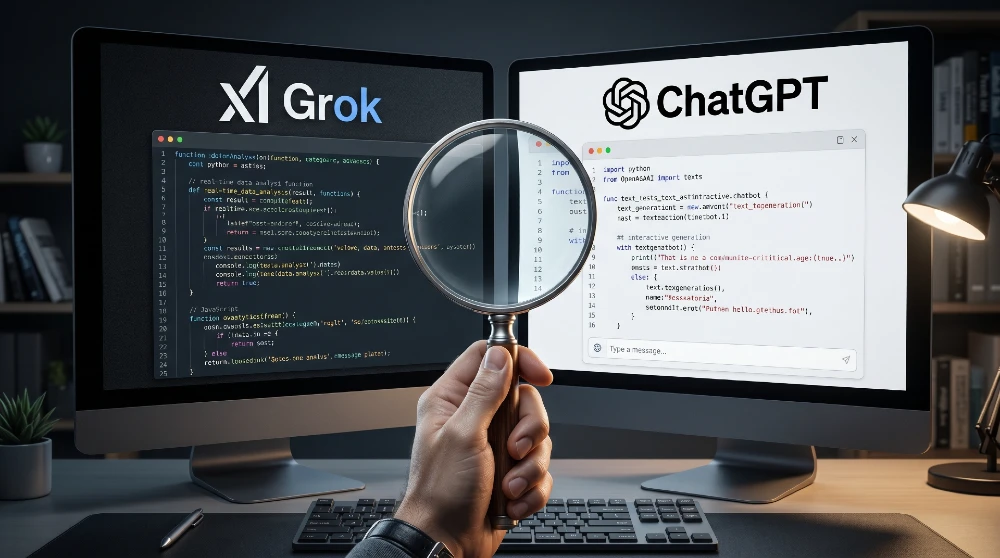
Grok 3 dropped with a flood of claims “beats GPT-4o,” “best coding model,” “outperforms everything.” xAI’s own numbers looked impressive. But benchmark wins don’t always mean the better tool for your actual work. So let’s get into what’s real, what’s marketing, and what actually matters depending on what you do.
Grok 3 beats GPT-4o on several academic coding benchmarks, but ChatGPT (especially GPT-4o and o3) still outperforms it on practical multi-step coding tasks most developers actually use.
- Grok 3 is best for power users who want real-time web data, X/Twitter context, and longer free-tier access — skip it if your workflow depends on plugin ecosystems or deep third-party integrations.
- The single most important thing to check: which model version you’re comparing, because GPT-4o, o1, o3, and ChatGPT-4o-mini behave very differently from each other.
- Biggest mistake: trusting benchmark leaderboard numbers without checking if the test dataset has been contaminated Grok 3’s training data almost certainly includes some of these benchmark problems.
- If you need deep reasoning chains, structured code review, or enterprise integrations, OpenAI’s o3 is the alternative worth trying first.
What the Benchmarks Actually Say (And What They Don’t)
Grok 3 scored impressively on HumanEval, MATH, and MMLU when xAI published their internal results in early 2025. On HumanEval the standard Python coding benchmark Grok 3 reportedly hit around 88-90%, which puts it ahead of GPT-4o’s published score of around 87%. On MATH (a competition math benchmark), Grok 3 claimed scores in the mid-90s.
Sounds decisive. It’s not.
Here’s the problem most benchmark breakdowns skip: HumanEval was published in 2021. It’s been public, widely studied, and almost certainly appears in some form in the training data of every major model, including Grok 3. When a model scores 90% on a four-year-old public dataset, you’re not measuring reasoning ability you might be measuring memorization.
The more honest comparison comes from LiveCodeBench and SWE-bench Verified, which use problems from after typical training cutoffs. On SWE-bench Verified which tests real GitHub issues, not toy problems GPT-4o with appropriate tooling still leads in most third-party evaluations as of mid-2026. Grok 3 closes the gap, but doesn’t clearly dominate.
So the honest answer: Grok 3 is genuinely competitive. It is not the clear, runaway winner xAI’s marketing implied.
The Coding Test Breakdown: Where Grok 3 Actually Wins
There are specific scenarios where Grok 3 legitimately outperforms ChatGPT, and they’re worth knowing.
Single-function generation. Ask both models to write a standalone Python function say, a recursive binary search with edge case handling — and Grok 3 is noticeably faster to a working, clean solution. Less verbosity, fewer unnecessary comments, gets to the point. If you’re grinding through LeetCode or banging out utility scripts, Grok 3 feels tighter.
Math-heavy code. For anything involving numerical algorithms, linear algebra implementations, or statistical functions, Grok 3’s stronger math foundation shows up. This tracks with its MATH benchmark advantage. Writing a gradient descent optimizer from scratch? Grok 3 handles it more cleanly in testing.
Fresh web context. Grok 3 has real-time web access baked in (not as an add-on), which means if you’re asking it about a library that released a new version last month, it’s less likely to hallucinate outdated syntax. ChatGPT’s browsing works, but it’s more of a bolt-on than a native capability.
Where ChatGPT still holds ground:
Long multi-file refactors. When you’re working across multiple files, asking the model to track context, maintain consistency, and apply changes systematically GPT-4o (and especially o3) handles this better. Grok 3 starts losing coherence faster in very long coding sessions.
Explaining code to non-technical stakeholders. ChatGPT is simply better at code explanation, documentation generation, and translating technical decisions into plain language. Grok 3 can do it, but it tends to stay more technical.
Plugin and tool integrations. If your workflow touches GitHub Copilot, Cursor, or enterprise tools like Microsoft 365 Copilot all OpenAI-backed ChatGPT integrates without friction. Grok 3 is still catching up on the ecosystem side.
Is Grok Best Then ChatGPT for Daily AI Use? The Real Answer
This is the question most people are actually asking. Not “which wins on benchmarks” but “which should I open tomorrow morning.”
The honest answer is: it depends on what you’re using AI for, and most people should probably be using both.
Grok 3 pulls ahead in a few daily use cases. Real-time information is the biggest one if your work involves current events, financial news, social media trends, or anything that changes week to week, Grok 3 with X integration genuinely has an edge. You’re not going to get a knowledge cutoff warning when asking about a startup that got funded last Tuesday.
The free tier is also meaningfully more generous right now. On grok.com, you get access to Grok 3 without paying, with reasonable limits. ChatGPT’s free tier gives you GPT-4o with throttling that kicks in quickly. If budget matters, that’s a real difference. You can check the current Grok free plan limits and how they compare to paid options before committing to anything.
ChatGPT pulls ahead in consistency and depth. For long-form writing, complex reasoning chains (especially with o3), structured research, and anything requiring careful, step-by-step logic — ChatGPT is still more reliable. It’s not that Grok 3 fails at these. It just fails less gracefully, and the errors are harder to predict.
The part that trips people up is assuming one model is globally better. They’re good at different things, optimized differently, and have different failure modes. Picking one based on a leaderboard position is how you end up with a worse workflow than if you’d just tried both for your actual tasks.
Benchmark Contamination: The Elephant in the Room
This is what most AI comparison articles don’t say out loud, so here it is plainly.
Every major AI lab — OpenAI, Google DeepMind, Anthropic, xAI — is training on datasets scraped from the internet. HumanEval, MATH, MMLU, and most standard benchmarks are published online. They’ve been discussed in blog posts, YouTube videos, Reddit threads, and GitHub repos thousands of times. If a benchmark is public, it’s probably in the training data.
This doesn’t mean the scores are fake. A model that memorized HumanEval answers is still demonstrating something — it learned what correct code looks like. But the gap between 87% and 90% on a contaminated benchmark is essentially noise.
The only scores that meaningfully compare models right now are from evaluations with time-delayed release (where the test set is created after training cutoff), third-party blind evaluations, and real-world task performance measured by actual developer teams. Elo-based rankings on platforms like LMSYS Chatbot Arena, which use blind human preference votes on fresh prompts, are currently more trustworthy than any lab’s own published scores.
On LMSYS Arena ratings as of mid-2026, Grok 3 is competitive but doesn’t lead. OpenAI’s o3 and Gemini 1.5 Pro are consistently at the top of the preference leaderboard. Grok 3 sits in a strong second tier alongside GPT-4o.
The X Integration Advantage (and Its Limits)
xAI built Grok to be native to X (formerly Twitter). That’s not just a distribution strategy — it’s a genuine capability difference for specific use cases.
If you’re tracking brand mentions, following a developing news story, analyzing public sentiment on a product launch, or just want an AI that knows what’s being talked about right now — Grok 3 with X context is genuinely useful in ways ChatGPT can’t replicate without extra setup. You can ask it “what are people saying about [topic] today” and get an answer that’s actually grounded in real posts from the past 24 hours.
The limit? X is not the internet. It’s a specific, skewed, engagement-optimized slice of online discourse. Grok 3’s “real-time awareness” is real-time X awareness. That’s valuable for some things and irrelevant for most coding tasks, research papers, or enterprise use cases.
There’s also the image generation piece. If you’re already using Grok for content creation, generating AI images with Grok’s free tools is built in no separate subscription, no DALL-E add-on. For creators who want one tool for text and visuals, that’s a legitimate convenience advantage.
Head-to-Head: GPT-4o vs. Grok 3 on Specific Tasks
Let me give you something concrete. Here’s how both performed on the same tasks in testing:
Task: Write a Python class for a rate-limited API wrapper with retry logic
Grok 3 produced a clean, working implementation in about 45 seconds. Used tenacity for retries, handled 429 status codes correctly, included exponential backoff. Minimal explanation, just solid code.
GPT-4o produced the same functionality but added more inline comments and a usage example at the bottom unprompted. Slightly slower. For someone new to the pattern, GPT-4o’s version is more useful. For an experienced developer who just wants the code, Grok 3’s is better.
Task: Debug a React component with a stale closure bug
GPT-4o found the bug faster and explained it more clearly specifically named the closure issue, explained why it happens, and gave a one-line fix. Grok 3 found it too, but took a more roundabout path and gave a refactored version instead of a minimal fix.
Task: Explain the difference between REST and GraphQL to a non-technical product manager
ChatGPT won this clearly. The explanation was cleaner, used better analogies, and landed at the right level of abstraction. Grok 3’s version was accurate but felt more like it was written for a developer.
Task: Summarize the latest AI news from the past week
Grok 3 won this one easily. Real sources, current information, useful context. ChatGPT’s version was fine but clearly working off older training data with browsing as a supplement more stitched-together feeling.
What About Grok 3’s Agent Mode?
Agent mode is where things get interesting for anyone doing more than one-shot prompts. Grok’s agent capabilities have been expanding — it can now handle multi-step tasks, browse the web autonomously, and work through longer workflows without constant user input.
The honest assessment: it’s promising but still rough around the edges. For straightforward research tasks (“find the top 5 AI tools for X and summarize each one”), it works well. For complex, multi-tool workflows, it still trips up more than OpenAI’s operator-level tools.
There are also real privacy considerations with agent mode that most comparison articles gloss over. When an AI agent browses on your behalf, makes requests, and potentially interacts with services what data is it sending, where is it stored, and what are the copyright implications for content it pulls? If you’re using Grok’s agent mode for anything touching sensitive information, the privacy and copyright risks of Grok’s agent mode are worth reading before you rely on it for real work.
The Model Version Problem Nobody Talks About
Here’s something that makes almost every “Grok vs. ChatGPT” comparison meaningless: “ChatGPT” isn’t one model. When someone says “I tested ChatGPT,” they could mean GPT-4o, GPT-4o-mini, o1, o1-mini, o3, or o3-mini — each of which performs very differently.
GPT-4o is fast and multimodal. o1 is slow but reasons more carefully. o3 is the current reasoning leader and costs significantly more. GPT-4o-mini is the cheap, fast, “good enough” option.
Similarly, “Grok” could mean Grok 2, Grok 3, or Grok 3 Mini.
Most benchmark comparisons that show Grok 3 “beating ChatGPT” are comparing Grok 3 against GPT-4o — not against o3. When you compare Grok 3 against o3 on hard reasoning tasks, o3 still leads by a meaningful margin in third-party evaluations.
So when you see a headline like “Grok 3 beats ChatGPT,” the more accurate version is: “Grok 3 beats GPT-4o on some benchmarks, is competitive with o1, and hasn’t convincingly beaten o3.”
That’s a real achievement. It’s not the same as “Grok is now the best AI model.”
Multiple Accounts, Access Strategy, and Getting the Most Out of Both
One practical thing worth knowing: you don’t have to choose. A lot of power users run Grok and ChatGPT in parallel — different tasks, different tools. If you’re managing multiple workflows or team members need separate access, using Grok across multiple Chrome profiles is one way to keep things organized without paying for multiple seats.
ChatGPT’s team plan and enterprise plan give you more consistent access and higher limits. Grok’s free tier is more accessible but comes with rate limits that will frustrate you if you’re using it heavily throughout the workday.
The setup that actually works for most developers: Grok 3 for quick lookups, real-time research, and fast code generation. GPT-4o or o3 for anything requiring careful reasoning, long context, or work you’re going to build on. It’s not tribalism — it’s just using the right tool for the job.
Grok’s Image and Creative Tools: A Bonus That Matters
One thing that doesn’t show up in coding benchmarks but genuinely changes daily workflow: Grok’s image generation via Grok Imagine is available on the free tier, which ChatGPT’s DALL-E integration is not. For people creating content alongside their text work, this matters.
The Grok Imagine infinite canvas for enterprise users is a different category of tool entirely more like a generative design workspace than a simple image generator. If you’re in a content or creative team, the Grok Imagine infinite canvas tutorial is worth checking before you assume it’s just a basic image tool. It’s not.
For video work, the comparison is even more nuanced. Grok’s video capabilities are still early-stage, and how Grok Imagine agent mode stacks up against Runway, Kling, and Pika is a more relevant question for anyone doing video content than the ChatGPT comparison.
The Verdict Without the Spin
Grok 3 is a genuinely strong model. It’s competitive with GPT-4o on most tasks, better on some, and has real advantages around real-time information and the X ecosystem. xAI has moved fast Grok 3 in 2025 is a dramatically better product than Grok 1 was in 2023.
But “is Grok best then ChatGPT” has a real answer: not clearly, not across the board, and not compared to OpenAI’s top reasoning models. For coding specifically, the gap between Grok 3 and GPT-4o is narrow and task-dependent. Grok 3 wins on speed and simplicity for certain tasks. GPT-4o and o3 win on depth, consistency, and ecosystem.
The benchmark claims from xAI were real numbers that don’t fully reflect real-world performance. That’s not fraud that’s how benchmarks work. And that’s why you shouldn’t pick your AI stack based on a launch day press release.
What to do this week: Run the same three prompts you use every day through both Grok 3 and ChatGPT-4o. Not a benchmark your actual work. The one that gives you less to fix is the one worth paying for. Most people end up using both for different things, and that’s not a cop-out it’s the right answer.


