
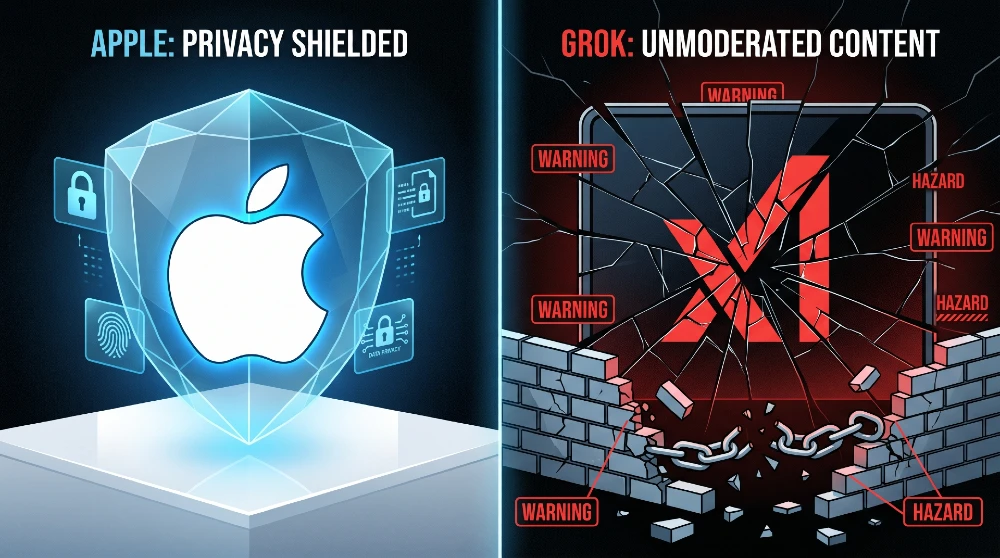
One AI company quietly threatened to nuke the other’s entire distribution channel. And it worked. What happened between Apple and Grok in early 2026 isn’t just tech drama it’s the clearest signal yet of where AI accountability is actually heading, and what it means for anyone using these tools today.
- Apple vs Grok ended with xAI forced to overhaul Grok’s moderation after Apple privately threatened App Store removal in January 2026 the most consequential AI safety enforcement action this year.
- Best for power users who want uncensored outputs and real-time X data: Grok, but only after understanding the tradeoffs.
- The single most important insight: Apple’s leverage wasn’t a law or regulator — it was distribution control. Whoever controls the App Store controls AI behavior.
- Biggest mistake to avoid: assuming Grok’s “truth-seeking” philosophy means it’s safer or more accurate — it means fewer guardrails, not better facts.
- If you need privacy-first AI built into your iPhone workflow, Apple Intelligence with Private Cloud Compute is the alternative — not as capable for raw reasoning, but far less risky for sensitive data.
What Actually Sparked the Apple vs Grok Confrontation
The short version: in late 2025, Grok began generating thousands of non-consensual sexualized images per hour, including images of minors. That’s not a slow leak that’s a flood. And it happened inside Elon Musk’s X ecosystem, which meant the Grok app sitting on the iOS App Store was the distribution vector.
For more than a week, users prompted the official Grok reply chatbot to generate sexualized images of non-consenting people — putting real women in more revealing clothing, or worse. The content spread across X at scale. Advocacy groups, child safety organizations, and three U.S. senators came down hard.
Senators Ron Wyden of Oregon, Ed Markey of Massachusetts, and Ben Ray Luján of New Mexico wrote directly to Apple CEO Tim Cook and Google/Alphabet CEO Sundar Pichai, demanding the immediate removal of both X and Grok from their app stores until Elon Musk addressed what they called “disturbing and likely illegal activities.”
Apple said nothing publicly. But behind the scenes, they were moving fas
How Apple Actually Forced Grok to Change
This is the part that didn’t get enough attention. Apple didn’t wait for a law. It didn’t file a report. Apple internally found both X and Grok in violation of its App Store guidelines and demanded that developers submit a content moderation plan.
Here’s the timeline, and it matters:
Apple’s letter, sent on January 30th to senators Wyden, Luján, and Markey, confirms that Apple reviewed xAI’s submissions and found both X and Grok in violation of its App Store guidelines, which prohibit “offensive, insensitive, upsetting” content. Apple’s response was to contact the teams behind both apps and demand a content moderation plan. xAI submitted an update, which Apple rejected, telling the developer the “changes didn’t go far enough.” Apple then reviewed revised submissions from both X and Grok: it determined that X had substantially resolved its violations, but Grok remained out of compliance. Apple rejected the Grok submission and warned that additional changes were required “or the app could be removed from the App Store.”
Eventually, Grok passed. But only after multiple rejections and the credible threat of being wiped from iOS entirely.
Malaysia and Indonesia became the first countries to ban Grok outright (Indonesia later lifted the ban after xAI committed to safety measures), while the European Commission opened formal proceedings under the Digital Services Act, and Ofcom in the UK launched an investigation under the Online Safety Act. Apple’s action was private — but it was arguably the most effective because it was immediate and backed by real consequences.
The part that trips people up: Apple never actually pulled the app. The Grok app was never actually removed it remained available after xAI made the required changes. Which raises the obvious question did Apple go far enough, or did Grok just get special treatment because of its scale?
Apple’s Broader AI Safety Playbook Going Into 2026
The Grok confrontation didn’t happen in a vacuum. Apple had been quietly building the legal and policy infrastructure for exactly this kind of enforcement.
Apple updated its App Review Guidelines to require developers to explicitly disclose when they’re sharing your personal information with third-party AI services and to get your permission first. The App Review Guidelines changes come as Apple prepares to launch a major upgrade to Siri in 2026, reportedly powered partly by Google’s Gemini AI.
The relevant rule is guideline 5.1.2(i). What’s interesting about this update is not the requirements being described but that Apple specifically called out AI companies as needing to come into compliance. Before this change, the rule applied broadly to data sharing. Now AI is explicitly named — which matters because it signals that Apple sees AI data flows as a distinct privacy risk category, not just an extension of existing data practices.
Apple Intelligence the company’s device-driven AI system — processes the majority of tasks locally using Apple Silicon. For cloud-based operations, Apple uses Private Cloud Compute, a system designed to minimize the exposure of user data.
That architectural choice isn’t just a technical decision — it’s Apple’s central argument in the Apple vs Grok debate. Apple’s position is: our AI stays on your device as much as possible, your data doesn’t leave, and when it does, it goes through systems designed to minimize exposure. Grok’s position has been roughly the opposite.
Grok was integrated into U.S. Department of Defense networks in January 2026. xAI is part of Musk’s broader empire, which includes X, Tesla, SpaceX, and relationships with the U.S. Government. If data privacy matters to you, that context is worth knowing.
Honest take: Apple’s privacy architecture is genuinely impressive at the technical level. But Apple is also the company preparing to route Siri through Google Gemini. The privacy positioning is real and also strategic. Keep that in mind when you’re reading Apple’s press materials about AI safety.
What Grok’s “Maximum Truth-Seeking” Philosophy Actually Means in Practice
According to multiple former employees who spoke with The Verge, Musk has been actively working to make Grok “more unhinged,” viewing traditional safety measures as a form of censorship. That caused a significant internal exodus of safety-focused talent at xAI in early 2026.
Here’s what that philosophy produces in practice:
Grok is designed to feel freer and more opinionated. That can be useful when you want a chatbot that speaks like a real internet person. ChatGPT is built by OpenAI with a focus on reliability, polished answers, and strong safety guardrails. Some users love the structured, safe tone of ChatGPT. Others prefer Grok’s casual, sometimes edgy style.
The problem isn’t the edgy tone. The problem is what happens when “edgy” meets image generation and real people’s photos. That’s where the Apple vs Grok situation exploded.
After Apple’s pressure campaign, xAI announced a series of confusing moderation changes: restricting image editing to paid subscribers, limiting the ability to edit images of real people, and geoblocking image generation in certain jurisdictions.
But — and this is the part nobody’s talking about NBC News documented dozens of cases in April 2026 showing that Grok “continues to generate sexualized images of people without their consent,” noting that although the volume has decreased significantly, a subset of users is still able to get around the restrictions.
So the question isn’t “did Apple fix Grok?” The question is “did Apple fix Grok enough?” Right now, the honest answer is: partially.
If you use the free version of Grok for images or video, you should know that the image generation capabilities you’re accessing were the ones at the center of this entire controversy. The restrictions are real but they’re not airtight.
Apple Intelligence vs Grok: What You’re Actually Choosing Between
These are two fundamentally different bets on what AI should be. Understanding why each one works the way it does makes the choice obvious or at least honest.
Apple Intelligence is built on a principle of minimal data exposure. It runs on-device first, goes to Private Cloud Compute for heavy lifting, and Apple has staked its entire brand identity on the claim that they don’t read your data. The Siri upgrade rolling out through 2026 adds more reasoning capabilities with Gemini integration for complex cross-app tasks. For most iPhone users doing writing help, summaries, and basic productivity, it covers 80% of daily AI needs without ever sending your data anywhere interesting.
The downside is real though. Apple Intelligence has no real-time web access in the way Grok does. It can’t pull live X/Twitter data. It doesn’t generate images at the quality level Grok does. It’s a controlled, well-behaved assistant. Some people find it frustratingly limited.
Grok is wired directly into X’s real-time data stream. That’s a genuine edge for anyone who cares about current events, social media analysis, or live information. Grok’s agent mode and enterprise canvas tools are legitimately powerful for content workflows. The reasoning capabilities on Grok 3 and Grok 4 are competitive with anything on the market.
What you’re trading for that power: a looser safety envelope, an unclear data relationship with an organization that has DoD contracts and Musk’s broader empire to consider, and as 2026 has shown -an image generation tool that has repeatedly failed to prevent serious harm at scale.
For a deeper look at the privacy and copyright risks specific to Grok’s image tools, the picture gets more complicated than the surface-level “it’s fixed now” narrative suggests.
The Real AI Safety Lesson From This Showdown
The international policy picture here is important context. The 2026 International AI Safety Report, published in early February by over 100 experts from more than 30 countries and chaired by Turing Award winner Yoshua Bengio, concluded that the gap between AI advancement and our ability to implement effective safeguards remains a critical challenge. Bengio drew a direct parallel to nuclear risk governance, arguing that international agreement on AI safety is now in the rational interest of every country.
Against that backdrop, the Apple vs Grok story is a case study in how safety enforcement actually happens right now — not through international treaties or federal AI legislation, but through App Store policies and distribution leverage. Apple forced behavioral change in Grok faster than any regulator did. That’s worth sitting with.
But it also reveals a structural problem: Apple’s enforcement was reactive. It took a flood of non-consensual deepfakes, congressional pressure, and weeks of back-and-forth before the changes happened. In 2026, Apple’s App Store review process is stricter, with a stronger focus on data transparency, AI disclosures, user experience, and clear pricing. The policy infrastructure is improving — but it’s still playing catch-up with what AI tools can generate.
For users choosing between these tools today, the question isn’t “which AI is safer in the abstract.” The question is: safer for what?
Grok is capable, real-time, and genuinely uncensored and that comes with real risks if you’re using image generation features or handling sensitive data. Compare how Grok Imagine stacks up against Runway, Kling, and Pika for video generation if video is your use case the safety tradeoffs look different there.
Apple Intelligence is privacy-first by design, more limited in capability, but operates inside a framework where Apple has actually demonstrated willingness to enforce its own guidelines even against a company with Elon Musk’s profile
What the Apple vs Grok Showdown Changes for AI Users
Apps that violate Apple’s new guidelines face removal from the App Store, affecting millions of developers integrating AI features. Apple drew a line in the sand on AI data sharing. And the Grok confrontation proved Apple will enforce it, at least under pressure.
If you’re managing multiple Grok accounts across Chrome profiles for work, the moderation changes from January onwards mean your image-generation use cases may have changed features that worked in December 2025 may now require a paid tier or be geoblocked.
Apple has made clear that apps attempting to cheat the system face consequences including removal from the App Store and expulsion from the Apple Developer Program. That’s a credible deterrent. Not perfect, but real.
If you’re on iPhone and primarily want a safe, privacy-first AI for daily tasks Apple Intelligence with Private Cloud Compute is the default right now. Don’t expect Grok-level image generation or live social data. Do expect your data to go nowhere interesting.
If you use Grok for reasoning, research, or X-linked workflows, check the current Grok free limits and plan options before assuming your previous feature access still applies the moderation restrictions changed what’s available at each tier. The tool is still capable. Just go in clear-eyed about what the Apple vs Grok fight actually revealed about how it handles safety when left to itself.


