

The majority of users use AI similar to how they did with the search engine in 2005: entering a few keywords and hope for the best results. In 2026, this approach can leave a huge amount of value to be gained. Advanced Prompt Engineering is the expertise that distinguishes the experts who achieve remarkable results using AI in comparison to those who only get average results. This guide will provide you with the entire framework, methods as well as real-world examples to help you master it.
What Is Advanced Prompt Engineering and Why Does It Matter in 2026?
If you’ve had the experience of typing a question in ChatGPT, Claude, or Gemini and were a bit unimpressed by the answer You already know the gap Advanced Prompt Engineering closes. Prompting isn’t only the act of asking questions. It’s about interacting using the AI machine in a manner that will produce the precise output you want — and with the appropriate quality, the appropriate format, the correct tone, and with the correct level of logic built in right from the beginning.
Advanced Prompt Engineering involves the disciplined practice of developing tests, refining, and evaluating the inputs that you feed to AI models of language in order to create superior, reliable and precisely targeted outputs. It is situated at the interplay between psychology, communication and system thinking. In 2026, it’s been deemed to be among the top lucrative abilities that professionals can acquire regardless of whether they are working in the fields of content creation or software development marketing, legal services research, executive decision-making.
| 92% | of AI powerful users in 2026 of AI power users in 2026 report that prompt qualitynot model selectionis the most important element that determines output quality. Source: State of AI Tools Report, Q1 2026 |
Why Advanced Prompt Engineering matters so in the present is because AI models by 2026 will be extremely capable, however, they are limited by the limits of what they’re required to accomplish. A vague prompt produces a vague result. A carefully engineered prompt yields an outcome that could substitute hours of manual labor or produce content that can be published or tackle complex analytical problems without further adjustments. The design hasn’t changed between the two scenarios. The prompt has changed.
This guide is geared towards people who have gone beyond the basics and wish to apply Advanced Prompt Engineering to unlock the true potential of the capabilities that modern AI can create. Each technique described in this guide can be applied today, and is practical and supported by real examples across different AI platforms.
The Foundation: Why Basic Prompts Fail and Advanced Ones Succeed
Before you get into specific techniques it is important to understand the principles behind the reasons prompt quality is important so fundamentally. AI language models don’t possess opinions, plans or objectives. They are essentially pattern-completion systemshighly sophisticated ones however, they are still pattern-completion. When you type a prompt you set the context that the model will complete the pattern. The more precise, detailed and precise the context is and the more precisely the model will be aligned to the end result you need.
A simple prompt provides the model little or no information to work from. It is unclear about the intended audience, the preferred format, the proper depth, the appropriate constraints as well as the criteria of success to be used for output. The model fills in those gaps using its defaults for training that produce standard, averaged outputs which are technically correct, but inadequate.
Advanced Prompt Engineering eliminates ambiguity through the design. It provides the model with an explicit function and a clear mission and constraints that are clearly defined and a specific output format and — when appropriate, examples to help anchor the design. It views the model as a highly skilled collaborator who requires proper direction, not an oracle that can generate wisdom out of thin air.
| The principle behind this is that the level of quality in the AI output is directly correlated with what the model’s input quality is. Advanced Prompt Engineering is not about hacks or tricks -it’s about providing the model all the information it requires to be able to perform its best that is specified prior to the time, rather than correcting in the aftermath. |
Core Techniques of Advanced Prompt Engineering
Advanced Prompt Engineering draws on a collection of repeatable and multi-purpose techniques that expert prompt designers employ in every scenario. The sections below cover each of them in detail with examples that show how each method affects output quality when used in the real world.
The CRISPE Framework: The Most Complete Prompt Structure for 2026
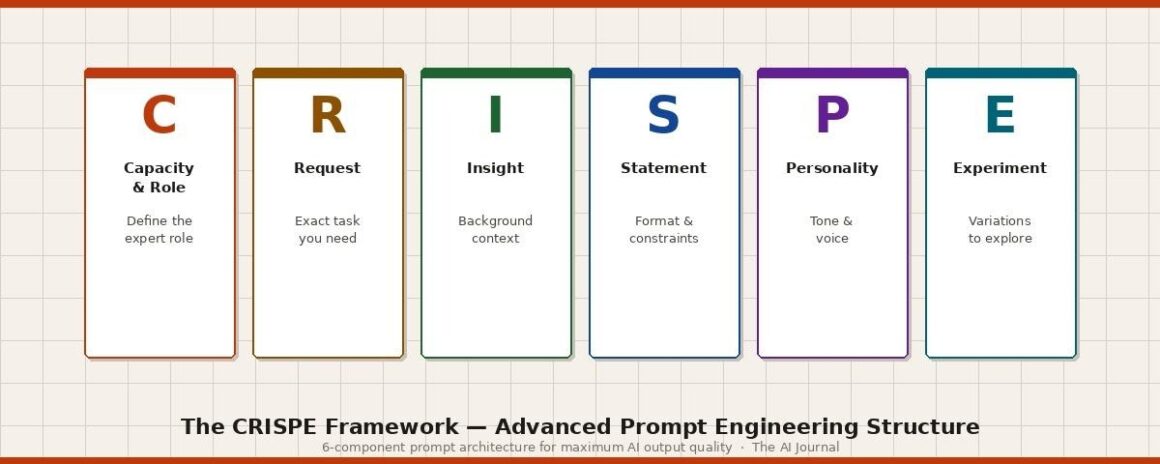
The most efficient structural frameworks used in Advanced Prompt Engineering is CRISPE — a mnemonic which encompasses the six elements of a prompt that is highly effective:
- C -Capacity and Role What expertise or role should the model be able to play?
- R -Request: What do you wish to be?
- I – Analysis: What kind of background information or context is it requiring?
- S – Statement What are the specific limitations, requirements for format or boundaries?
- P – Personality Which tone, style or tone should output be using?
- E -Experiment: What other angles or variations should we be able to
Most basic prompts focus on just the Request component. Advanced Prompt Engineering fills in all six components – and the quality of output is considerable. A prompt with an explicit role, a specific circumstances, clearly defined constraints and a specified output format can produce results that need only minimal modification and, in most cases, no revision of them.
| BASIC PROMPT (weak): |
| Create a blog post on engineering prompts. |
| Advanced Prompt ENGINEERING (CRISPE used): |
| You are a senior AI researcher and technical writer with 8 years ofexperience making complex AI concepts accessible to business professionals.Write a 600-word introductory section for a guide on Advanced PromptEngineering targeted at marketing directors who use AI tools daily buthave no technical background.Background context: The audience understands ChatGPT and Claude butdoes not know the difference between zero-shot and few-shot prompting.Constraints:- Use concrete examples, not abstract definitions- Avoid jargon without immediate plain-English explanation- Structure with a brief hook, three core ideas, and a transition- Tone: confident and direct, like a trusted advisor, not academicDo not use the phrase ‘delve into’ or ‘it is important to note.’ |
The second prompt creates output that can be used immediately. The first prompt generates output that requires to be completely changed. This could be Advanced Prompt Engineering in action.
Chain-of-Thought and Multi-Step Prompting
The most effective methods in Advanced Prompt Engineering is chain-of-thought prompting, in which the model to consider an issue step by step before coming to the conclusion. Studies consistently show the fact that whenever AI models are specifically required to consider their reasoning, they can provide more precise answers to complicated problems, including those that involve logic, math analysis, multi-variable decision-making.
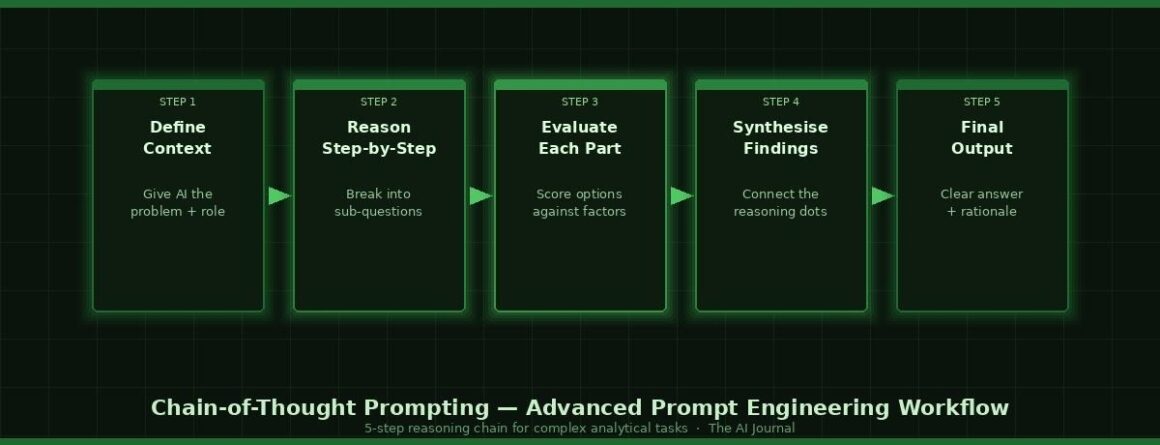
The process is simple. If a model is able to jump directly to an end the model is actually matching patterns to the most likely answer. When it is told to solve the problem in a step-by-step manner every step is a framework that restricts the next step and helps to identify mistakes that could otherwise result to create incorrect final results.
| CHAIN-OF-THOUGHT PROMPT EXAMPLE: |
| I’m looking to analyze three SaaS pricing strategies for a product that is B2B and will launch in the 3rd quarter of 2026. The choices are per-seat, usage-based, and flat-rate.Before providing me with your recommendations I would like you to: 1. Define the main factors that make these pricing strategies different in B2B SaaS2. Analyze each pricing model against the factors relevant to our situation (mid-market customer, 10-200 seats businesses, ACV target $25K-$80K)3. Find the strongest two arguments against and in support of each model4. Then, make your recommendation based on solid reasoning. Don’t jump to the conclusion until you’ve completed the steps three through. |
Don’t jump into the suggestion’ rule is a crucial element that is a crucial part of Advanced Prompt Engineering in chain-of-thought prompts. In absence of it, the models typically bypass the reasoning process and offer a clear answer that is well-thought out but isn’t fully thought through. A clear and precise sequence of thinking will produce more substantively superior analytical outputs.
| Tips for advanced students: For especially complicated problems, you should use multi-step prompting – break the task down into separate prompts, and each expands on the results of the previous. This helps avoid context overload and lets you check and correct your intermediate reasoning prior to combining to form a final solution. |
Role-Based Prompting: Unlocking Expertise On Demand
Role-based prompting is a fundamental method in Advanced Prompt Engineering. It continuously improves output quality in almost every usage scenario. The concept is straightforward When it is assigned to the AI an skilled role with a specific experience in context and experience, the AI generates outputs that are calibrated to the specific expert level instead of using generic averaged responses.
The reason for this is due to the fact that expert reasoning frameworks, language patterns and other knowledge models are incorporated into the data used to train huge language models. When you play a certain job, you are activating a specific portion of these patterns, resulting in outputs that correspond to what the person performing the role actually produces.
| Use Case | Basic Prompt Role | Advanced Prompt Engineering Role | Output Quality Difference |
| Legal contract review | None / ‘You’ | Senior Commercial Attorney who has 15 years SaaS contract experience | Generic cautions – specifically clause-level risk analysis |
| Analysis of the financials | None | The CFO for a Series B SaaS company that is evaluating a strategic acquisition | A surface-level summary of financial model with key assumptions marked |
| Marketing copy | Copywriter | Direct response copywriter, specializing on B2B enterprise software. 10plus years of experience | Conversion-optimized copy that is readable and readable with psychological triggers |
| Technical documentation | Technical writer | Senior developer relations engineer writing for API-first developers | Basic explanation of the developer-native documentation with code examples |
| Business strategy | Consultant | McKinsey engagement manager specializing in digital transformation for mid-market retail | Generic advice, structured analysis that uses specific frameworks |
The particularity of the job is crucially important. Inconsistent roles such as ‘expert writers or’smart analysis provide little improvements. Particular roles — with specified experience levels specificity, specialization, and a relevant context — result in outputs that differ in quality.
Few-Shot and Zero-Shot Prompting Compared
When it comes to Advanced Prompt Engineering the ability to recognize the difference between zero-shot and prompting using a few shots is a crucial capability that directly influences output quality for various tasks.
Zero-Shot Prompting
Zero-shot prompting refers to providing the model with an assignment with no examples, but only instructions. This method is suitable for tasks that are simple, and when the model’s previous training data already has solid examples of the output desired. Writing tasks that are simple, factual inquiries and standard formatting requirements and a majority of reasoning tasks can be completed well with zero-shot prompts. The problem is that prompts using zero shots provide the model no anchors for your particular design, style or quality bar.
Few-Shot Prompting
The prompting of a few shots provides the model with a minimum of five instances of the input-output pattern you want to use prior to presenting the actual job. It is among the most effective tools available in Advanced Prompt Engineering precisely because it conveys more of what you are looking for than any description. If you’d like to use to create LinkedIn posts with your own voice, then showing three examples of the posts you’ve written conveys your voice better than any description.
| FEW-SHOT PROMPT STRUCTURE (Advanced Prompt Engineering): |
| I’m asking that you write LinkedIn posts that are written in my particular style.Here some examples posts that I have composed: EXAMPLE 1:’Most AI tools are amazing. A few are useful.The distinction is that one of them solves the actual issue, while one solves an issue you can live with without solving.Know what is which prior to you purchase. “Example 2:’ The prompt is not an actual question. It’s an specification.The greater the precision of specification more precise, the better output.Vague in In, vague out. Each time. Three things that help to make AI efficient at work:1. Understanding what questions to make. Understanding the right way to approach it3. Being aware of when to not ask. Now write three LinkedIn posts on Advanced Prompt Engineering for a business professional audience. Write them exactly in the same way: short, concise and no hashtags. One concept per article. |
The short examples that are included in the prompt accomplish more than any style descriptions could. They define sentences’ length, rhythm and tone, as well as capitalization conventions, as well as the level of understanding that posts provide. That’s Advanced Prompt Engineering working at its finest.
Prompt Chaining: Building Workflows That Think for Themselves
Prompt chaining is a Advanced Prompt Engineering technique that makes multi-step thinking into its highest level by creating interconnected sets of prompts, where the results for each one feeds following. Instead of trying to complete a complicated task with a single, overwhelmed prompt the prompt chaining technique breaks it down into specific, targeted processes that do only one thing effectively.
Imagine it as making something like an AI assembly line. Each station performs its task, and then passes the results over to the station next and the final product will be better than what a single command could ever produce.
Practical Prompt Chain Example: SEO Article Production
- Prompt 1: Research Brief”Identify the top 10 questions that people ask regarding Advanced Prompt Engineering in 2026 in accordance with typical search intent patterns. The format should be an ordered list, with the primary purpose of every question.’
- Prompt 2 – Outline: ‘Using the question list, you can create an elaborate outline of the article to create a 3,000 word guide to Advanced Prompt Engineering. Include H2s, the H3s and the most important points that each section needs to be able to cover.’
- Prompt 3 -Section writing: Write the section three of this outline completely. Audience: Business professionals with intermediate AI knowledge. Tone: authoritative, but casual. Provide a concrete example.’
- Prompt 4 SEO optimization: “Review this page to determine the density of keywords and natural search engine optimization for your language. Make suggestions for specific changes for improving AEO (Answer Engine Optimization) alignment without making the text appear overloaded with keywords.’
- Prompt 5: Finish polishing: Review your complete article to ensure consistency flow, flow, and quality of the editorial. Look for any sections you think are weak and suggest changes.’
This prompt chain generates the highest quality final product than any prompt alone could as each step is geared to a specific sub-task. This particularization is the main reason to use prompt chaining in an advanced Prompt Engineering procedure.
Advanced Prompt Engineering for SEO, AEO, and AIO Strategies
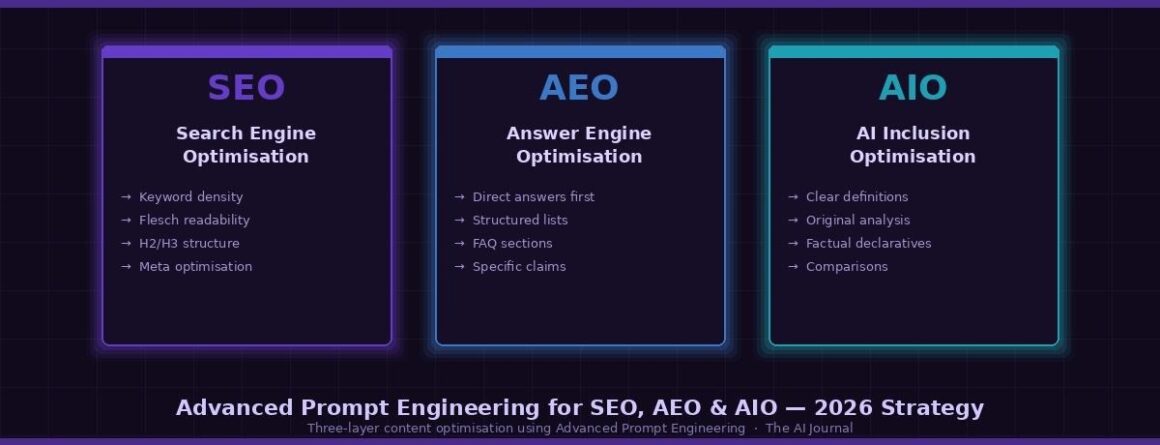
Advanced Prompt Engineering in 2026 has been incorporated into strategies for content that are who is serious about organic exposure. The growth of the Answer Engine Optimization (AEO) as well as AI inclusion Optimization (AIO) (AIO)making your content more likely to be cited by AI systems such as Perplexity, Gemini, and ChatGPT has resulted in an entirely new level of prompting strategies specifically designed for SEO professionals and creators of content.
Using Advanced Prompt Engineering for Traditional SEO
When making use of AI to create content that is SEO-focused, Advanced Prompt Engineering must explicitly instruct the model about the strategy for keywords and alignment of search intent and the best structural practices. A prompt that demands “an SEO article’ creates generic content. A well-designed prompt incorporates SEO into the structure of content beginning with the first word.
| SEO-Optimized Prompt (Advanced Prompt Engineering for content): |
| You are an experienced expert SEO expert with 10 years’ experience in creating content that ranks for informational competitive keywords.Write 400 words of an article that targets the keyword ‘Advanced Prompt Engineering techniques’. The intent of the search is informative — the user seeks out practical techniques that you can implement immediately.SEO guidelines: Include the main keyword naturally within the opening 100 characters. Utilize H3 subheadings with the terms “prompt engineering techniques “AI prompting techniques 2026″Write in simple and concise sentences that are suitable for featured snippets capture. Create one section as an ordered list of five items. Avoid passive voice. Flesch-Kincaid reading level: Grade 9-11 Do not include meta titles or descriptions -body content is the only thing to include. |
Advanced Prompt Engineering for AEO: Getting AI Systems to Cite Your Content
Answer Engine Optimization is the process of creating content in a way that AI systems can cite it when responding to queries from users. Advanced Prompt Engineering for AEO is focused on creating content with three characteristics AI answer engines generally prefer: straightforward, clear responses to specific questions with a structured, scannable format and highly specific, authoritative claims that are clearly attributed.
| AEO Ranking Factor | What AI Answer Engines Favour | Advanced Prompt Engineering Instruction |
| Direct responses | Content that addresses the question within just the 40 first words in a paragraph | The instructor will instruct you to answer the question directly within the first phrase of the section’ |
| Structured data | Tables, lists of numbers, and explanations in the style of definitions | Instruction: Format important information into either a table or a numbered list whenever it is it is |
| Specificity | Named frameworks, specific percentages and concrete examples | Provide examples, named frameworks and figures that are concrete throughout’ |
| Completeness | Content that tackles the question from many perspectives | Instruct students to address the questions of what, why and how misconceptions about every topic’ |
| Signals of freshness | Contextual references to 2026 as well as current tools and the most recent advancements | Instruction: Frame any advice within relation to the present AI landscape in 2026′. AI landscape’ |
Advanced Prompt Engineering for AIO: Optimising for AI Inclusion
AI Integration Optimization — making sure that AI systems that have been trained to crawl current web content can learn from and refer to your content requires a new method of prompting. In this case, Advanced Prompt Engineering is employed to create content that is organized in a way that is comprehendible for AI inference and training systems. These include clearly defined definitions, unambiguous attributions, well-structured comparisons and content that exhibits authentic expertise instead of synthetic depth.
- Make use of Advanced Prompt Engineering to create documents that define the terms accurately rather than presuming knowledge of the reader.
- Ask you to ask your child’s model for writing in factual declarative sentences instead of hedged, qualified words when feasible.
- It is important to instruct the model to include specific comparisons such as “X differs from Y three distinct ways’ instead of “X and Y are different.’
- Utilize Advanced Prompt Engineering to generate FAQ sections that provide direct answers to questions AI systems will likely to receive from users.
- Structure calls for documents that demonstrate an original analysis, not just summaries — because original content that is analytical in nature tends to get cited than summaries that have been aggregated.
Common Advanced Prompt Engineering Mistakes and How to Fix Them
Even professionals with years of knowledge of Advanced Prompt Engineering can make frequent mistakes that affect their effectiveness. Knowing the patterns that cause failure is as crucial as learning the procedures themselves.
| Mistake | Why It Limits Output | Advanced Prompt Engineering Fix |
| The model is over-constrained | Many rigid requirements lead to an unnatural, mechanical output | Prioritise the top 3-5 constraints. Leave the rest to model’s decision |
| Vague role definitions | “Act as an expert” provides the model with virtually no context | Indicate the position and the number of number of years experience, the level of expertise as well as the particular perspective you require |
| There is no output format specification | The Model is defaulted to it’s preferred format, which might not be suitable for your particular use. | Always indicate the your format: ‘Respond using an alphabetized list Use H2/H3 headings Write in paragraph form No lists’ |
| Thinking in single-turns for difficult tasks | One prompt can’t adequately deal with the multi-stage reasoning task | Utilize prompt chaining to break up complex tasks into specialized, sequential prompts |
| Accepting the first output without iteration | The first outputs are the starting point but not the end product. | Incorporate it inside the Advanced Prompt Engineering workflow: review, refine, or solicit specific enhancements |
| Neglecting negative instructions | Giving the model instructions on what to do isn’t effective if it is not also describing what to NOT do. | Include ‘Do Not’ …’ instructions for the most common behavior you wish to stay clear of |
| Copy-pasting prompts across models | Claude GPT-4o, Gemini are different in their strengths and default behavior | Make adjustments to the Advanced Prompt Engineering approach to the particular characteristics of each model |
Building a Personal Prompt Library for 2026
One of the best leverage investment that professionals can make in 2026 is the creation of your own personal prompt libraryan organized collection of highly-performing, tested prompts arranged by usage. Advanced Prompt Engineering is iterative in nature. A prompt that you spend 20 minutes reworking today could make you more productive in each and every subsequent use of that task.
A useful prompt library is arranged around three dimensions that are: the type of task (writing analysis, analysis research, coding, strategy) as well as a the quality of the bar (a prompt that creates output that is ready for publication versus a prompt which produces a useful first draft) and models (prompts that are optimized for Claude work differently in GPT-4o and need to be adapted).
Recommended Prompt Library Categories for Business Professionals
- Content creation blog posts, LinkedIn content, email newsletters cases studies and landing page copy
- Analysis Analyzing competitive Analysis, Financial Review market sizing, risk assessment and data interpretation
- Research Study of the literature, trends analysis, synthesis of sources, expert persona interviews
- Strategy Development of business cases go-to-market strategy pricing strategy, positioning for products
- Communication Executive briefings, meeting summaries, proposals from clients Updates to stakeholders
- SEO as well as AEO Content optimized for keywords such as FAQ sections and structured data content meta descriptions
- Technical and code Review of code document writing, architecture design as well as debugging assistance
The money you invest in creating this library increases over time. Every prompt you add and refinement represents an ongoing enhancement to the AI output quality for the kind of task. Professionals who approach Advanced Prompt Engineering as a regular practice, not a sporadic experimentalways outperform those who make up prompts as they go along.
“Advanced Prompt Engineering is not about using AI better. It is about thinking more precisely — and AI is the environment that makes that precision visible.”
Advanced Prompt Engineering Across Different AI Models in 2026
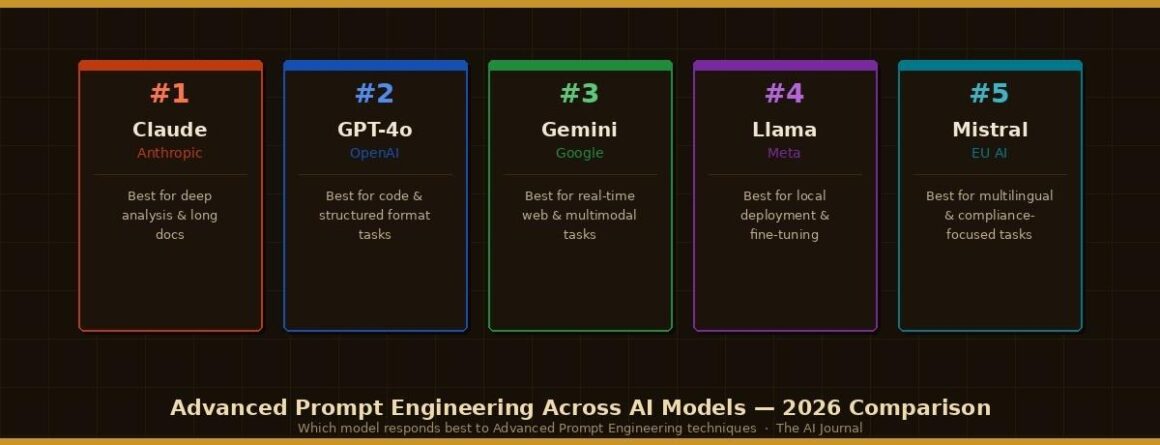
One crucial and often unnoticed aspect that is often overlooked in Advanced Prompt Engineering is that the different AI models react different to prompting strategies. Knowing the unique features of each major platform lets you optimize your approach to achieve the best output quality.
| AI Model | Prompting Strength | Where Advanced Prompt Engineering Shines | Key Adaptation Needed |
| Claude (Anthropic) | The Long Context Reasoning, Nuanced Analysis document processing | Multi-document complex analysis financial/legal review, lengthy-form writing with continuous quality | Provide clear reasoning guidelines -The Claude Claude excels in analyzing complex situations when given the opportunity |
| GPT-4o (OpenAI) | Instruction-following, code generation, structured outputs | Technical documentation and code review multi-step workflows, exact formatting compliance | The prompts that are format-specific work extremely well. They can be very specific about the format in great details |
| Gemini 1.5 Pro | Multimodal tasks, Google ecosystem integration, real-time web | Synthesis of research with recent sources Visual analysis Google Workspace workflows | Make use of the web search contextallow it to draw from the most recent information in a clear manner |
| Llama 3.1 (Meta/Open) | Customization, local deployment, fine-tuning flexibility | Domain-specific tasks that require fine-tuning are feasible, and privacy-sensitive applications | More explicit instruction-following prompts — fewer implicit assumptions than frontier models |
| Mistral Large | Effectiveness, European regulatory alignment, multilingual work | Multilingual and EU-compliant content high-volume, cost-sensitive tasks | Simple, clear promptswork well when combined with clear instructions without lengthy framing |
The consequence of these distinctions could be the fact that an application library designed only for one model may perform poorly on other models. Effective advanced Prompt Engineering in 2026 includes models-specific versions of your most valuable prompts, particularly when output quality variations between models are the most significant.
Frequently Asked Questions About Advanced Prompt Engineering
What exactly is Advanced Prompt Engineering and how does it differ from standard prompting?
Advanced Prompt Engineering refers to the systematic process of creating prompts that result in extremely precise and reliable, high-quality outputs generated by AI models. Basic prompting provides the model with an assignment with no background. Advanced Prompt Engineering provides explicit role definition, specific limitations, requirements for output format along with reasoning instructions and sometimes examples results in outputs that require very little or no changes.
Which AI model is most responsive the best Advanced Prompt Engineering techniques?
The majority of the major frontier models respond much better to highly-engineered prompts as in comparison to the simple ones. Claude from Anthropic is especially sensitive to complex reasoning instructions as well as complex analytical tasks. GPT-4o is extremely responsive to precisely-defined formatting requirements. The most suitable option that is suitable for Advanced Prompt Engineering is the one most suited to the specific type of task you have -A well-engineered prompt will always outperform an unengineered prompt regardless of the type of model.
How long will it take to master Advanced Prompt Engineering?
The fundamental concepts that underlie Advanced Prompt Engineering can be learnt and put into practice in a matter of days concentrated training. The development of true proficiency — in which you are able to reliably engineer prompts for complicated tasks using multiple modelsrequires four to eight weeks of continuous training. Making a comprehensive private prompt collection that addresses your most common scenarios is usually between six and twelve weeks of work.
Are there ways to use Advanced Prompt Engineering be used to create SEO or AEO content?
Yes, and it’s one of the top-performing uses that utilizes Advanced Prompt Engineering for business professionals by 2026. Properly designed prompts can generate content that is optimized for search engine rankings that are traditional Answer Engine Optimization (AEO) as well as Artificial Integration Optimization (AIO) which isto ensure that your content works across all channels of discovery.
What is the biggest error people make when using Advanced Prompt Engineering?
The most costly and common error is to accept the initial output without repeating it. Advanced Prompt Engineering is a dialog, not a single request. Most experienced engineers use initial outputs as a starting point and integrate critique-and-refine loops in their workflows, requiring the software to find the weaknesses in its output, suggest improvements or approach the issue by a different perspective.
Do Advanced Prompt Engineering work for the coding of tasks?
Absolutely. Advanced Prompt Engineering is particularly efficient for programming as the requirements for specificity are very high, and it is non-linear which means that the code is working or not. A well-engineered coding prompt will provide the framework, language requirements for performance edge cases that need to be handled documents, edge cases, and the problem that is being addressed. This results in code that is significantly more ready for production than code derived by a vague request.
What can I do to determine if the quality of my Advanced Prompt Engineering is improving?
Monitor three metrics including Revision frequency (how frequently do you have to modify models output? ) and iteration counts (how many prompts do need to be completed before you get an outcome that is usable? ) and time-to-final output (how is it long does it take from launching the prompt until having an usable, publishable result?). Enhancing Advanced Prompt Engineering skills consistently reduces all three indicators.
| Master Advanced Prompt Engineering in 2026Weekly expert guides for AI prompting tools, strategy, and more Published in the AI Journal The AI Journal * theaijournal.co |


