
| What It Is | Why It Matters | How to Fix It |
|---|---|---|
| AI behavioral drift = model behavior changes silently after deployment without code changes | Models can lose 8–33% accuracy within months of launch | Set up continuous monitoring with tools like Evidently AI or Arize AI |
| Caused by data shift, concept shift, or silent model updates | Businesses can lose revenue, trust, and compliance standing without knowing why | Define retraining triggers before you deploy, not after |
| LLMs (like GPT-4) also drift — verbosity, tone, instruction-following all change | You can’t patch it the way you patch a bug | Test against a fixed benchmark dataset monthly |
What Is AI Behavioral Drift (And Why Most Teams Miss It)
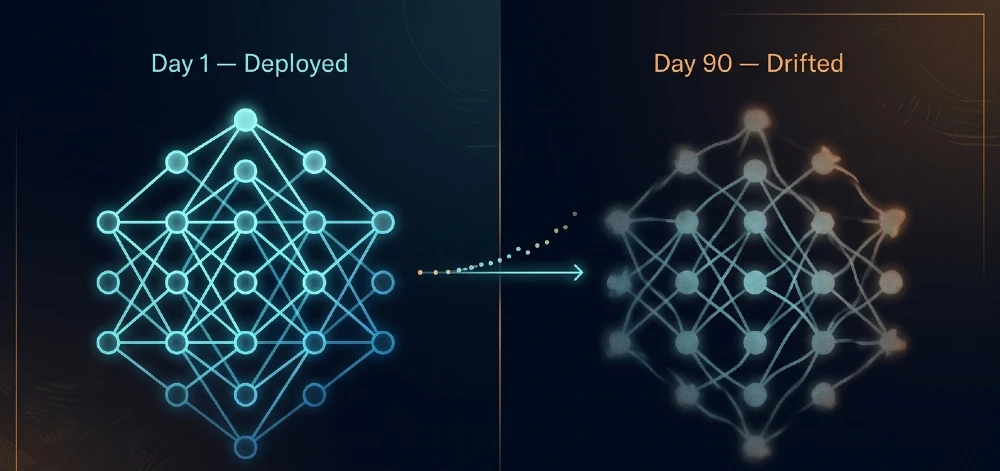
AI behavioral drift is when a model’s outputs change, quietly, gradually, without any code being touched — because the world around it has moved on but the model hasn’t.
Here’s the key thing: it’s not a crash. There’s no error log. The API still returns a 200. Your dashboard shows green. But the model is giving worse answers, making weaker predictions, or behaving differently than it did on launch day. That’s what makes this so dangerous.
Most teams catch bugs. Very few teams have a system to catch drift.
IBM defines model drift as the degradation of machine learning model performance due to changes in data or in the relationships between input and output variables. That definition is technically precise but practically incomplete — because it doesn’t capture how invisible the problem usually is.
Think of it like this: you hire a sharp analyst, they do excellent work for six months, and then slowly their recommendations start getting worse. Not dramatically — just a little off. By the time you notice, six months of bad decisions have already stacked up. That’s drift, except the analyst is your AI model and there’s no performance review built into your workflow.
The Real Cost: Numbers That Justify Taking This Seriously
Before getting into causes and fixes, the numbers matter here because “drift is bad” sounds abstract until you see what it costs.
According to a 2024 enterprise survey cited by MoldStud Research (October 2025), 67% of organizations using AI at scale reported at least one critical issue linked to statistical misalignment that went unnoticed for over a month. That’s not a corner case — it’s a majority.
Evidently AI’s 2024 survey found that up to 32% of production scoring pipelines experience distributional shifts within the first six months of deployment. Not years — months.
One concrete example: a credit default prediction model that achieved 95% accuracy at deployment had dropped to 87% by September 2024 — a full 8 percentage points — simply because economic conditions shifted and new credit risk patterns emerged that the training data had never seen. The code hadn’t changed. The model had just quietly stopped understanding the world it was predicting.
An 8-point accuracy drop in a credit risk model isn’t a small calibration problem. That’s approving loans that should be flagged, or flagging accounts that should sail through. Real money. Real decisions. Real people affected.
The financial damage compounds across industries: recommendation engines stop surfacing products users want (revenue loss), demand forecasting becomes unreliable (inventory waste), fraud detection misses new attack patterns (financial loss), and medical diagnosis models miss conditions that weren’t in their training data (patient safety risk).
Why Drift Happens: The 3 Types That Actually Matter
There are more taxonomy labels than necessary in most ML literature. In practice, there are three forms of drift worth understanding clearly.
Data Drift (also called Covariate Shift)
This is when the inputs to your model change their statistical shape, even though the underlying task hasn’t.
Example: a model was trained on customer behavior data where 60% of users were aged 25–40. Two years later, the product has attracted a different audience — now only 30% fall in that age range. The model’s internal logic about “what a typical customer does” no longer matches who’s actually showing up.
Data drift is the more detectable type. You can catch it by watching feature distributions over time using statistical tests like the Population Stability Index (PSI), the Kolmogorov-Smirnov test, or Jensen-Shannon divergence.
Concept Drift
This one is sneakier. Concept drift is when the relationship between inputs and outputs changes — not just what the data looks like, but what it means.
A fraud detection model is the clearest example. In 2022, certain transaction patterns strongly predicted fraud. By 2025, criminals had adapted. The patterns that used to signal fraud now show up in legitimate transactions, and new fraud tactics don’t match anything the model learned. The inputs look fine. The output labels have changed meaning entirely.
Concept drift is harder to detect because your input distributions can look perfectly stable while the model’s predictions are silently wrong.
LLM Behavioral Drift (The Newer Problem)
This is where things get more interesting, especially for teams building on top of language models like GPT-4, Claude, or Mixtral.
A research paper published by Stanford’s Lingjiao Chen, UC Berkeley’s Matei Zaharia, and Stanford’s James Zou — “How is ChatGPT’s Behavior Changing Over Time?” (arXiv:2307.09009) — found something that got a lot of attention: GPT-4’s accuracy on prime number identification dropped from 84% in March 2023 to 51% in June 2023. Three months. Same model name. Wildly different performance on the same task.
That paper also documented that GPT-4’s ability to generate directly executable code dropped from over 50% of outputs in March 2023 to about 10% in June 2023. Both GPT-3.5 and GPT-4 had more formatting mistakes in code generation in June than in March.
The researchers noted that changes in the model’s ability to follow user instructions appeared to be a common thread behind many of these drifts. And the problem is structural: when LLM providers fine-tune or update their models to improve performance on Task A, it often has unintended side effects on Task B. Better at multi-hop reasoning, worse at code formatting. Safer on sensitive questions, less willing to explain its refusals.
A separate analysis of 2,250 model responses across 15 prompt categories found that GPT-4 showed 23% variance in response length across snapshots, Claude 3 showed 15% improvement in factuality over the same period, and Mixtral displayed 31% inconsistency in instruction adherence.
Behavioral drift in LLMs isn’t just about accuracy — it shows up as tone shifts, verbosity changes, formatting inconsistencies, and instruction-following reliability. For a customer-facing product built on an LLM API, any of these can silently degrade the user experience.
Why Silent Drift Is Specifically a Post-Deployment Problem
Drift doesn’t usually happen on day one. It accumulates. That’s the whole problem.
Most AI teams spend significant time on pre-deployment testing: train-test splits, validation sets, benchmarks, A/B tests, red-teaming. All of that is valuable. But it assumes the world at deployment time looks like the world at training time — and that assumption starts breaking the moment you push to production.
Traditional software behaves deterministically. The same input gives the same output. A bug is reproducible. You can write a unit test that catches it. Machine learning models don’t work that way. They’re probabilistic. They exist in a state of continuous silent degradation as production data diverges from training data.
What makes this worse in enterprise contexts: the people monitoring application performance are often not the same people who trained the model. DevOps teams watch uptime and latency. Data scientists watch training metrics. Nobody owns the space in between — which is exactly where drift lives.
And for LLMs specifically, the opacity problem is real. As the Stanford/UC Berkeley researchers pointed out, model providers don’t announce when they quietly update model weights or adjust RLHF fine-tuning. If you’re building a product on a third-party LLM API, you’re essentially depending on infrastructure that can change behavior without notice.
How to Detect Drift: The Monitoring Framework That Actually Works
Step 1: Define your baseline before you deploy
This sounds obvious but most teams skip it. A baseline is a fixed, representative sample of inputs and expected outputs that reflects your model’s performance at launch. Think of it as a snapshot you’ll compare against forever.
The baseline should cover:
- Distribution of input features (means, variances, categorical frequencies)
- Model output distributions (prediction confidence, label frequencies)
- Business KPIs tied to model output (click rate, approval rate, conversion rate)
- Task-specific benchmarks for LLMs (instruction following rate, format compliance, factual accuracy on a fixed test set)
Step 2: Choose the right statistical tests
For structured/tabular data: the Population Stability Index (PSI) is widely used and practically effective. A PSI below 0.1 generally indicates stable features. Between 0.1 and 0.25 suggests moderate change worth investigating. Above 0.25 signals significant shift.
The Kolmogorov-Smirnov test is useful for continuous features. Jensen-Shannon divergence works well for comparing probability distributions. Wasserstein distance is more sensitive to subtle shifts in multimodal data.
For LLMs: statistical tests on distributions don’t capture behavioral drift well. Better signals include: response length variance, format compliance rate against a fixed template prompt, factual accuracy on a locked benchmark, and refusal rate on edge-case prompts.
Step 3: Set up monitoring infrastructure
This is where tooling matters. The major options in 2025-2026:
Evidently AI — Open-source, 25+ million downloads, widely used. Strong for data drift analysis with interactive reports. Works with structured data and text embeddings. Good option for teams with strong MLOps skills who want control without high licensing costs. The open-source version integrates with Prometheus and Grafana for dashboard monitoring.
Arize AI — Strong for LLM observability specifically. Offers Phoenix, a free open-source edition for span tracing and drift detection. The paid AX Pro tier starts at $50/month and provides deeper analytics including heatmap-based performance breakdowns and explainability overlays. Well-suited for teams running production LLM pipelines who need long-term visibility into behavior over time.
WhyLabs — Privacy-first architecture, recently open-sourced under Apache 2.0 in January 2025. Strong for regulated industries (SOC 2 Type 2, HIPAA compliant). Includes guardrails for LLM applications like prompt injection and jailbreak detection. Low-latency detection under 100ms. Less suitable for small teams without dedicated infrastructure.
Fiddler AI — Best for teams where bias, fairness, and regulatory compliance are the primary concern. Combines model monitoring with interpretability analysis. Strong in healthcare and finance contexts.
The general guidance: if you’re a startup, Evidently AI open-source plus Arize Phoenix covers most needs for free. If you’re enterprise-scale in a regulated industry, WhyLabs or Fiddler AI warrant the investment.
Step 4: Define retraining triggers
An alert without a response plan is just noise. Before deploying, define what action follows which alert:
- PSI above 0.25 on a key feature → flag for investigation, schedule retraining within 2 weeks
- Output distribution shifts by more than X% → trigger immediate evaluation against held-out test set
- Business KPI decline of Y% over Z days → human review + potential rollback
- LLM format compliance drops below threshold → pin to a specific model version if possible
The hybrid approach — scheduled retraining (weekly or monthly) combined with event-driven triggers on significant drift signals — is generally more reliable than either alone.
One important caution from practice: if a freshly retrained model performs worse than the drifted deployed model, don’t push it. The goal is improvement, not just freshness. Always evaluate the retrained model against the baseline before deploying.
The LLM-Specific Problem: Monitoring Third-Party APIs
If you’re building a product on top of a third-party LLM (OpenAI, Anthropic, Google, Mistral), drift monitoring gets harder because you don’t control the underlying weights. The model can change without you knowing.
The practical monitoring approach for third-party LLMs:
Maintain a fixed evaluation harness. Create a test suite of 50–100 prompts that cover your core use cases. Run this suite at a fixed schedule (weekly is reasonable) and log outputs. Track: average response length, format compliance rate, factual accuracy on factual questions, instruction-following score on structured prompts.
Version-pin when stability is critical. Most major providers offer dated version endpoints (e.g., gpt-4-0613, claude-3-opus-20240229). For production systems where consistency matters more than having the latest improvements, use version-pinned endpoints. This trades off cutting-edge capability for behavioral stability.
Log everything in production. This sounds obvious but many teams are selective about what they log to manage costs. For LLMs, logging complete inputs and outputs (with appropriate privacy handling) is essential for retroactively diagnosing drift. Without logs, you’re blind to what changed and when.
Track user behavior as a proxy signal. If users are suddenly copy-pasting outputs and re-editing them more, submitting the same query twice, or abandoning mid-conversation at higher rates — those are early signals of degraded output quality that may show up before you catch it in technical metrics. <br>
Real-World Patterns: When Drift Shows Up Differently By Industry
Drift doesn’t look the same across domains. Here’s how the failure mode typically presents:
Finance (credit, fraud): Concept drift is the dominant risk. New fraud patterns, shifted economic conditions, and changed borrower demographics all erode model relevance. Performance often appears stable for months before a single dramatic miss event reveals the problem. The 8-point credit default accuracy drop example cited earlier is representative.
Healthcare: Drift can be seasonal (fall semesters vs spring semesters showed measurable performance differences in educational prediction models, per MDPI’s August 2025 research). Patient population shifts, new treatment protocols, and updated diagnostic criteria all introduce concept drift. Safety stakes make this the domain where monitoring investment is most justified.
E-commerce / Recommendation: Data drift is the typical culprit. User demographics shift as platforms scale. Seasonal behavior is predictable but still causes temporary degradation if not handled. Recommendation models trained on pre-pandemic buying behavior famously failed to capture the behavioral shifts of 2020–2021.
Customer-Facing LLM Products: Behavioral drift shows up as user experience degradation — more verbose responses, inconsistent formatting, changed tone, or decreased instruction adherence. Users notice before metrics do. Complaint patterns and session abandonment rates often catch it first.
Education: Even a “relatively stable” domain shows measurable drift. The academic success prediction study cited from MDPI (2025) found that models trained on student behavior data showed meaningful performance drops over two academic years, with fall semester performance consistently weaker than spring, suggesting seasonal patterns that standard monitoring might miss. <br>
The Governance Layer: What Regulation Is Starting to Require
This isn’t just a technical problem anymore. It’s becoming a compliance requirement.
The EU AI Act, which is progressively coming into effect, requires that high-risk AI systems maintain ongoing monitoring and logging of model performance. ISO 42001, the AI management system standard, includes requirements for model governance and continuous evaluation. Organizations operating in regulated industries increasingly need to demonstrate not just that their models worked at launch, but that they’re actively monitored.
Recent research from Efficiently Connected found that drift was detected in 90% of tested models in enterprise environments — a finding that underscores both how pervasive the problem is and how few organizations have adequate systems in place to catch it.
The practical implication: if you’re deploying AI in healthcare, finance, legal, or any heavily regulated context, monitoring infrastructure isn’t optional engineering hygiene — it’s a compliance requirement with audit implications.
A Practical 3-Step Monitoring Setup (For Teams Starting From Zero)
If there’s currently no drift monitoring in place, here’s where to start without over-engineering it:
Step 1: Build a baseline dataset (Day 1)
Before or immediately after deployment, capture 500–1000 representative production examples. For structured models: log feature distributions. For LLMs: log prompt categories, response lengths, and format compliance rates. Store this as a static reference file.
Step 2: Set up Evidently AI for basic drift reporting
Evidently AI’s open-source library is the most accessible starting point. Install it, connect it to your prediction pipeline, and set it to generate a weekly drift report comparing current production data against your baseline. This alone catches the majority of data drift issues. The Evidently Cloud version adds team collaboration and scheduled runs without requiring MLOps expertise.
For LLMs, Arize Phoenix is the parallel recommendation — free, open-source, and specifically built for LLM tracing and behavioral monitoring.
Step 3: Define one action per alert
Write down: “If metric X crosses threshold Y, the action is Z.” Start with two or three of the most business-critical signals. Make sure someone owns each alert. The most common failure mode after setting up monitoring is having no clear owner — alerts get acknowledged and ignored.
From there, the system can mature: add more signals, automate retraining pipelines, incorporate business KPIs. But the three-step version is functional and better than nothing, which is where most teams currently are.
Here you can check technical tooling and organizational structures for oversight. Check our latest accountability mechanisms for responsibility assignment.
The Broader Point Most Teams Are Still Missing
Most organizations treat deployment as the finish line. Resources get poured into building and validating models, and then the project closes out. The model lives in production indefinitely, checked only when something visibly breaks.
That mental model is wrong — and it’s getting more wrong as AI systems take on more consequential tasks.
Production AI maintenance is an ongoing operational requirement, not a one-time engineering task. The data the model encounters keeps changing. User behavior evolves. Market conditions shift. Adversarial patterns adapt. Each of those forces creates pressure on a model that was trained on a static snapshot of the past.
The organizations that have consistently maintained model performance over time aren’t the ones who built better models at the start. They’re the ones who built better monitoring systems and took drift seriously as an operational concern from day one.
The tools exist to do this well. The statistical methods are mature. The hard part is cultural — getting teams to own the space between model training and model behavior in production, and treating drift detection as a routine engineering responsibility rather than an incident-response reaction.
Here you can check asset discovery methods for shadow AI and vendor classification. Check our latest governance infrastructure for operational frameworks.
Summary: What to Take Away
AI behavioral drift is the gradual, silent degradation of a model’s behavior after deployment — no code changes, no alarms, just quietly worsening outputs. It happens because the world changes and static models don’t.
It affects both traditional ML models and LLMs. The Stanford/UC Berkeley study documented GPT-4’s prime number accuracy dropping from 84% to 51% in three months. Evidently AI’s 2024 data shows 32% of production pipelines experience distributional shift within six months. IBM’s definition confirms this is a recognized, studied problem — not a theoretical edge case.
The practical response: baseline your model at deployment, choose monitoring tooling matched to your model type (Evidently AI for structured data, Arize Phoenix for LLMs), define retraining triggers linked to specific metrics, and treat production monitoring as ongoing operational infrastructure rather than a post-incident investigation tool.
Deployment isn’t the finish line. It’s when the real maintenance work starts.
Here you can check harmonizing compliance requirements across jurisdictions efficiently. Check our latest AI inventory guide for implementation foundation.


