

| Challenge | Root Cause | Fix |
| Projects stalling at pilot stage | No clear ROI definition before deployment | Pick one use case, measure before scaling |
| Data silos blocking agent performance | Legacy systems with incompatible formats | Data readiness audit before any agent build |
| Trust breakdown with stakeholders | Lack of explainability and human oversight | Assign a human owner to every AI agent |
| Governance lagging behind tech | Controls added after deployment | Embed governance from day one, not after |
| Workforce resistance | Fear of replacement, not understanding | Role redefinition, not workforce elimination |
What Is Agentic AI, and Why Is It Different from What You Already Use?
Agentic AI is not ChatGPT. It is not a chatbot. It is not a smarter autocomplete.
An agentic AI system is a software agent that receives a goal, breaks it down into steps, decides what tools to use, executes actions across systems, checks its own results, and adjusts all without a human typing the next prompt.
The difference is autonomy. A standard AI model responds. An agentic AI acts.
For example, a regular generative AI tool like Claude or GPT will write a draft email if you ask. An agentic AI like Salesforce Agentforce or Microsoft Copilot Agents will look up the CRM record, draft the email, check your calendar for availability, send the follow-up, and log the response without you pressing a button between steps.
That is the shift. And that is why adoption is genuinely complex.
When the AI is just responding to prompts, mistakes are easy to catch. When the AI is taking multi-step actions across real systems sending emails, approving workflows, touching financial data the stakes of a wrong move are completely different.
Why Over 40% of Agentic AI Projects Are Heading Toward Cancellation
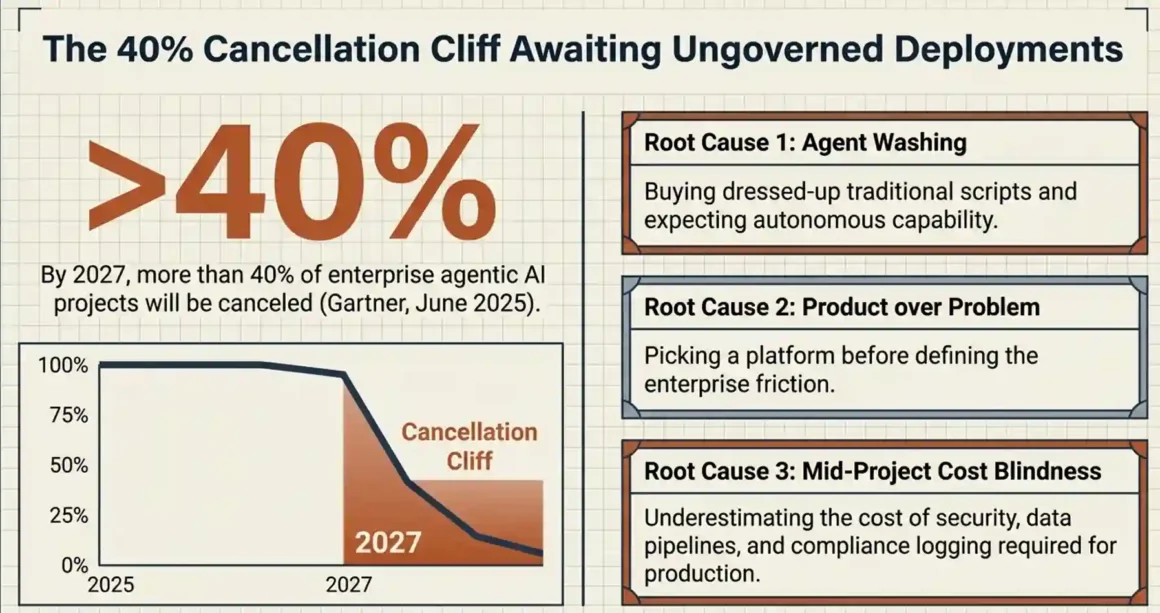
Gartner released a stark finding in June 2025: more than 40% of agentic AI projects will be canceled by the end of 2027. The reason is not bad technology. The reason is misapplication.
Most organizations start with the product, not the problem. They hear about agentic AI, pick a platform, build a proof of concept, and then ask, “Okay, where does this fit?” That sequence is backwards, and it is expensive.
The second issue is what Gartner calls “agent washing.” Vendors are rebranding existing tools — simple chatbots, rule-based RPA bots, even basic workflow automation as “agentic AI.” Organizations buy them expecting autonomous multi-step capability and get dressed-up scripting instead. The result is a project that never reaches production because it could not do what was promised.
The third issue is cost blindness. Running a proof of concept with agentic AI is relatively cheap. Scaling it to production with proper security, data pipelines, monitoring, compliance logging, and human oversight systems is not. Organizations get surprised mid-project and pull funding.
So. What actually works?
Explore multi-agent AI systems explained 2026. Specialized agents collaborate via A2A protocols for complex workflows. Agent Zero orchestration delivers 46% efficiency gains—scale intelligent teams now!
The Two-Speed Reality: Why Some Companies Are Running and Others Are Stuck
Not every organization is starting from the same place.
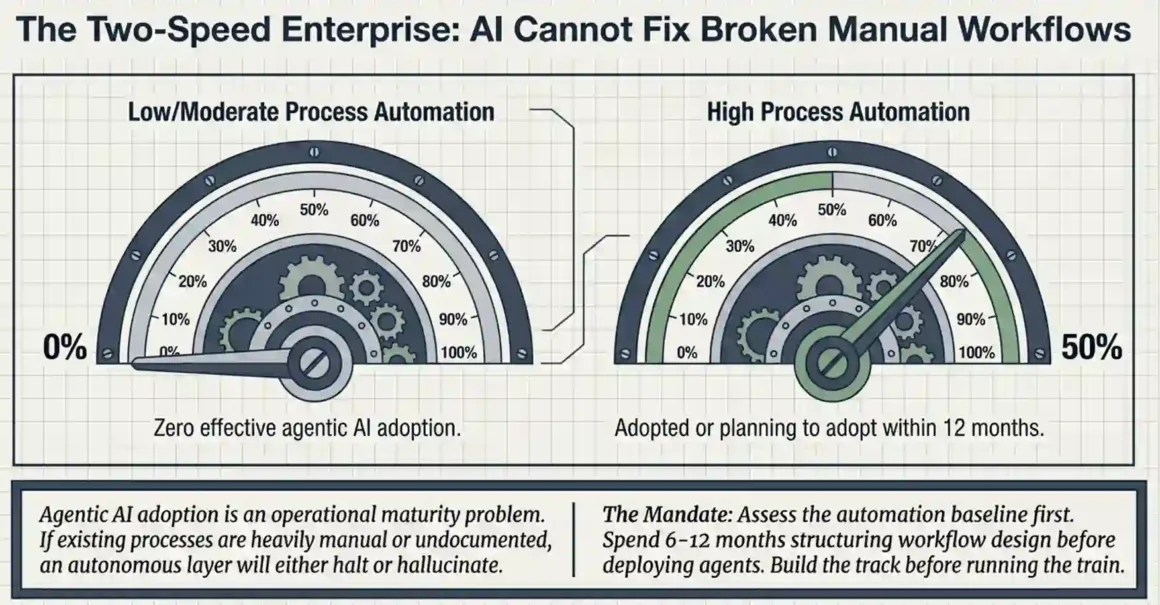
Research from PYMNTS Intelligence in late 2025 identified what it calls the “two-speed enterprise landscape.” Companies that already have strong automation foundations meaning they have been running structured workflows, CRM automation, or supply chain triggers for years — are adopting agentic AI fast. Among the most automated enterprises, 50% had either adopted agentic AI or planned to within twelve months.
Companies with low or moderate automation? Adoption was effectively zero.
This matters because it means agentic AI adoption is not just a technology problem. It is an operational maturity problem. If your current processes are still heavily manual, adding an autonomous AI layer on top of them will not work. The AI needs structured, clean data and clear process boundaries to function. Without those, it either halts or makes unpredictable decisions.
The practical takeaway: assess your automation baseline before deciding on agentic AI deployment timelines. If your organization scores low on process automation, spend six to twelve months on structured workflow design first. That is not slowing down that is building the foundation the AI needs to actually run.
The Three Real Blockers to Agentic AI Adoption
Blocker One: Infrastructure That Was Never Built for This
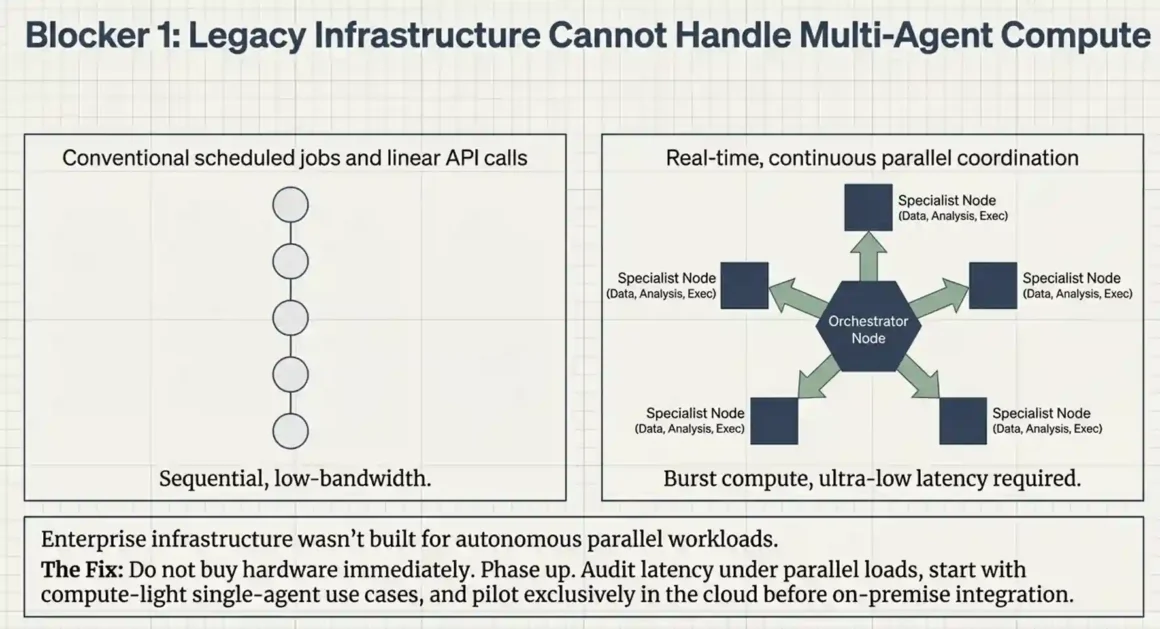
Current enterprise infrastructure was designed for conventional applications scheduled jobs, API calls, human-triggered workflows. Agentic AI systems, especially multi-agent designs where multiple AI agents communicate and coordinate in real time, place a completely different kind of demand on that infrastructure.
Consider what happens in a multi-agent system. You have an orchestrator agent that receives a goal. It delegates sub-tasks to specialist agents one for data retrieval, one for analysis, one for action execution. Those agents run in parallel, pass outputs to each other, and report back. All of this happens continuously, not on a schedule.
That requires ultra-low latency networking, scalable compute that can burst on demand, and data center architectures designed for real-time coordination not batch processing. Most enterprise infrastructure is not there yet.
The fix is not buying everything at once. It is a phased infrastructure upgrade plan:
Step 1: Audit your current compute and network capacity. Specifically test latency under parallel workloads — not just single-task throughput.
Step 2: Identify which agentic use cases are compute-light (single-agent, limited API calls) vs. compute-heavy (multi-agent, real-time data access). Start with compute-light.
Step 3: Pilot on cloud infrastructure — AWS, Azure, or Google Cloud before committing to on-premise upgrades. Cloud gives you the flexibility to test real agent workloads without permanent hardware investment.
What NOT to do: Do not build your agentic AI production system on infrastructure you have not load-tested. Agents that work perfectly in staging can fail catastrophically in production when actual data volumes and concurrent users hit the system.
Blocker Two: The Data Gap That Everyone Underestimates
Data is what agentic AI runs on. And most enterprise data is a mess.
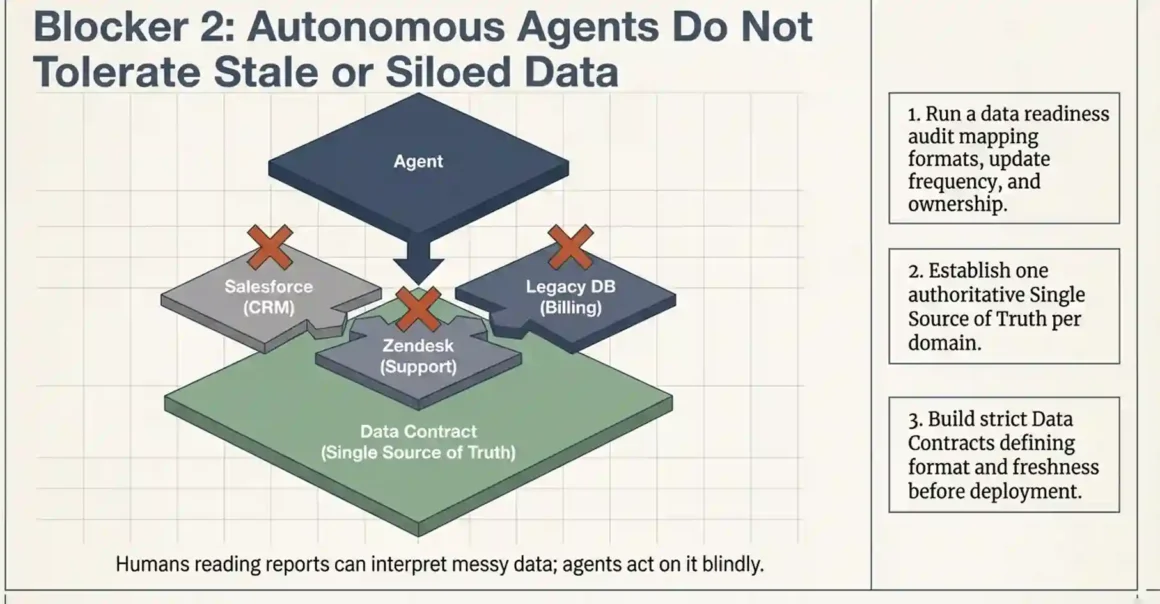
Here is what that actually looks like in practice. An agent is tasked with identifying which customer accounts are at risk of churning. To do that properly, it needs CRM records from Salesforce, billing history from a separate finance system, support ticket data from Zendesk, and product usage logs from your internal database. Those four systems have different data formats, different field names for the same concept, different update frequencies, and almost certainly some conflicting records.
The agent either halts, works with partial data and gives unreliable output, or worst case makes a confident wrong decision based on data that looks complete but is not.
This is not a theoretical problem. Research from the California Management Review confirms that data complexity and data silos are among the top barriers cited by IT professionals. Legacy systems storing data in incompatible formats make integration expensive and slow. For agentic systems specifically, the stakes are higher because they need consistent, real-time information to make autonomous decisions.
Here is how to address the data gap concretely:
Step 1 — Data Readiness Audit: Before building any agent, map which data sources it will need to access. List every system, the format of that data, how often it updates, and who owns access. Be honest about gaps.
Step 2 — Establish a Single Source of Truth per domain: For each data domain the agent touches (customer data, financial data, product data), decide which system is the authoritative source. All other systems feed from it, not around it. Tools like Collibra or Alation can help manage this data governance layer.
Step 3 — Build a data contract: A data contract is a formal agreement between teams about what data an agent can access, in what format, and with what freshness requirement. If the finance system updates billing data every 24 hours but your agent needs real-time billing status, that is a contract violation and you need to solve it before deployment, not after.
What NOT to do: Do not assume your data is clean enough because it works for your current reporting. Reporting tools tolerate stale and inconsistent data because humans interpret the results. Agents do not — they act on it.
Blocker Three: The Trust Deficit That Kills Deployment
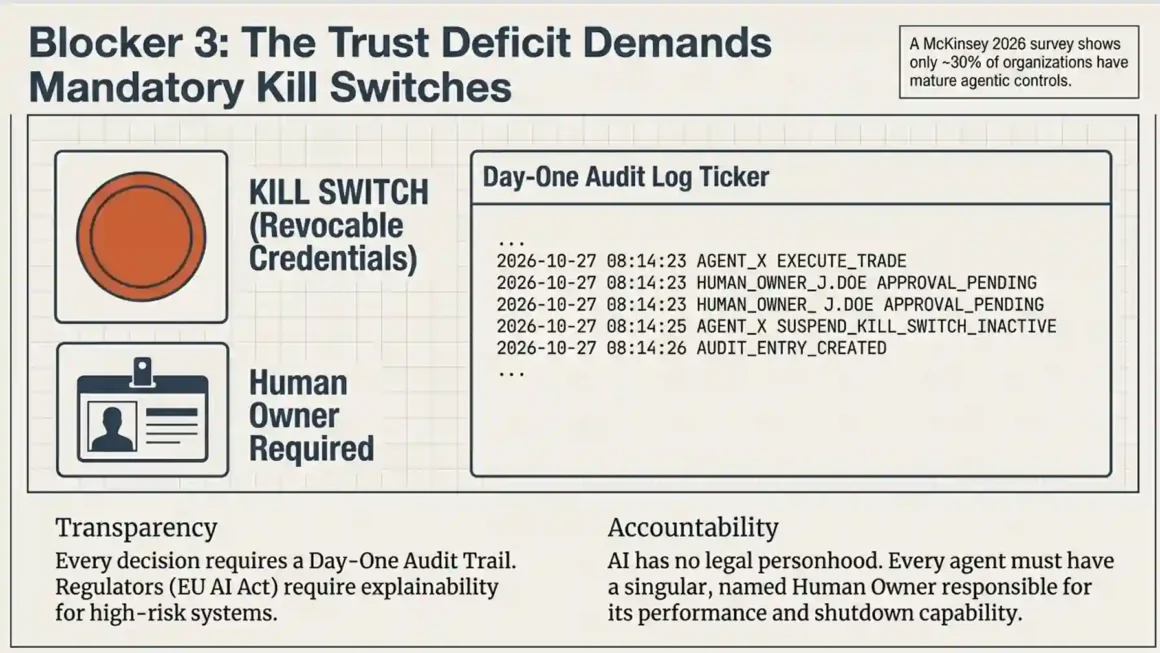
This is the one most technical teams underestimate.
You can build a technically solid agentic AI system. Clean data, good infrastructure, and a well-trained model. And then leadership kills the project because nobody in the business trusts it.
The trust problem in agentic AI has two layers.
The first is transparency. When an agent makes a decision approves a discount, escalates a support ticket, flags a transaction can anyone explain why? Large language models are often described as “black boxes.” When the AI is just generating text, black boxes are tolerable. When the AI is taking actions with real consequences, they are not. Regulators under frameworks like the EU AI Act now require explainable AI for high-risk systems. You must be able to show an audit trail of how an agent reached a decision.
The second is accountability. Who is responsible when an agent makes a mistake? This sounds philosophical but it has immediate legal and operational meaning. AI systems do not have legal personhood. They cannot be held accountable. So responsibility falls on the humans who designed, deployed, and oversee them.
McKinsey’s 2026 AI Trust Maturity Survey conducted across approximately 500 organizations between December 2025 and January 2026 found that only about 30% of organizations had reached meaningful maturity in agentic AI governance and controls. Governance is consistently lagging behind technical capability.
The practical solution:
Step 1 — Assign a human owner to every agent. Not a team. A person. That person is responsible for the agent’s performance, for reviewing its decisions, and for shutting it down if something goes wrong.
Step 2 — Build an audit log from day one. Every action the agent takes should be logged: what it did, what data it used, what decision it made, and when. Tools like IBM watsonx.governance or Microsoft Fabric IQ support this kind of decision trail tracking.
Step 3 — Build a kill switch. Technically called “revocable credentials,” this means the human owner can revoke the agent’s access to systems immediately if behavior becomes unpredictable. This is not optional it is a governance requirement.
What NOT to do: Do not deploy an agent into a sensitive workflow without explainability mechanisms in place. If you cannot answer “why did the agent do that?” in thirty seconds, you are not ready for production.
Master agentic AI marketing automation guide. Autonomous campaigns optimize 5x opens, 300% conversions. Agent Zero revenue funnels run 24/7—transform marketing ROI instantly!
Why the “Pilot Forever” Trap Happens and How to Break Out of It
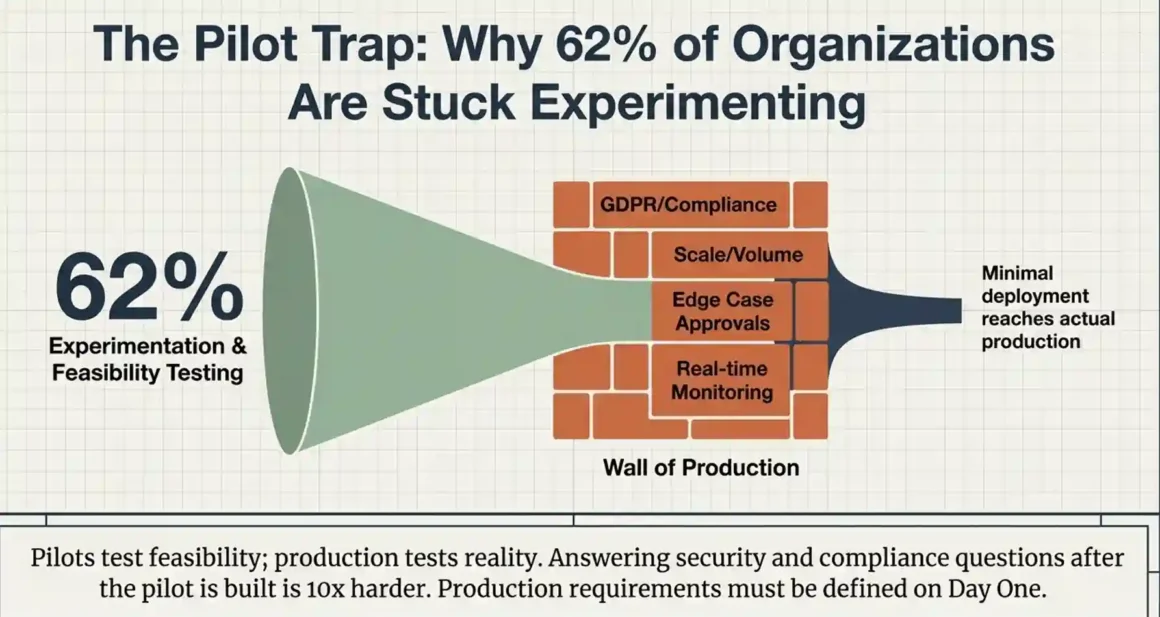
Look at the data. McKinsey found that 62% of organizations are experimenting with AI agents. Two-thirds of those have not begun rolling them out in any meaningful way.
That gap — between experimenting and deploying is the pilot trap.
It happens for a specific reason. Pilots are designed to test feasibility. They usually succeed at that. The agent does the task. The demo looks good. But then the conversation turns to production: real users, real data, real regulatory requirements, real volume. And suddenly the questions pile up: How do we monitor this at scale? Who approves the agent’s decisions in edge cases? What happens when it touches a GDPR-sensitive record? How do we handle the support agent when it escalates to a human incorrectly?
None of those questions were answered in the pilot. And answering them after is ten times harder than answering them before.
The way to break out of the pilot trap is to define production requirements before you build the pilot.
That means:
- Writing down the success metric before the pilot starts. Not “the agent works” but “the agent resolves 40% of Tier 1 support tickets without human escalation, with an error rate below 2%, measured over 30 days.”
- Identifying the compliance requirements up front. If your data touches EU residents, document how the agent handles GDPR article 22 the right not to be subject to automated decisions — before you build, not after.
- Assigning the human oversight role before the agent goes live. That person needs to know their responsibilities, have access to the audit log, and understand when to intervene.
How to Pick the Right Agentic AI Use Case (The Scoring Method)
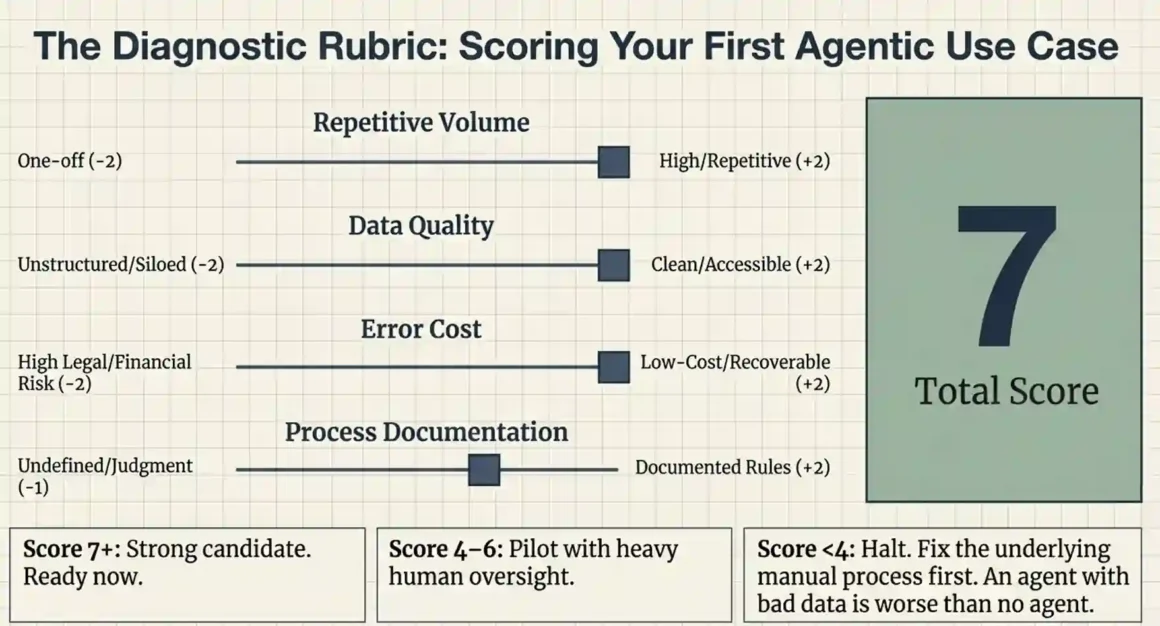
Not every business process should be handed to an autonomous agent. Choosing the wrong starting point is one of the fastest ways to waste the budget and lose internal credibility for the project.
Here is a four-question scoring method to evaluate whether a use case is right for agentic AI right now:
Question 1: Is the process currently high-volume and repetitive? If yes, score +2. Agentic AI earns its keep on tasks that happen hundreds or thousands of times. If it is a one-off complex decision, a human does it better.
Question 2: Is the data the agent needs clean, structured, and accessible? If yes, score +2. If partially, score +1. If no, score -2. Do not skip this. An agent with bad data is worse than no agent.
Question 3: What is the cost of an agent error on this task? If errors are recoverable and low-cost (wrong email draft, incorrect report section), score +2. If errors are hard to reverse or legally sensitive (wrong financial approval, incorrect medical recommendation), score -2.
Question 4: Does a human currently handle this with a defined, documented process? If yes, score +2. Agentic AI works best when it can learn from a clear existing process. If the process is undefined or highly judgment-based, score -1.
Scoring: 7 or above strong candidate for agentic AI now. 4-6 pilot with heavy human oversight. Below 4 not ready yet; fix the underlying process first.
Use this scoring on three to five candidate processes. Pick the highest scorer. Start there. Do not try to do five at once.
Pre-Built Platforms vs. Custom Build: The Decision That Determines Your Timeline
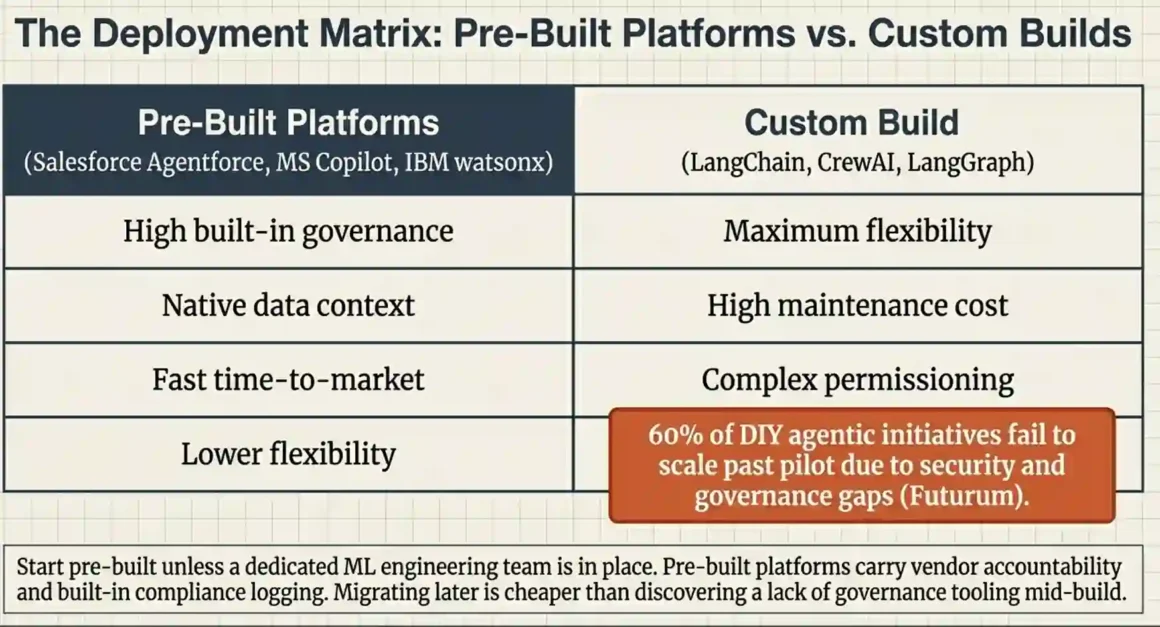
Once you have picked a use case, you face a choice that will define your next twelve months: do you use a pre-built enterprise agentic AI platform, or do you build your own using open-source frameworks?
Here is the honest breakdown.
Pre-built platforms like Salesforce Agentforce, Microsoft Copilot Agents, and IBM watsonx Orchestrate give you a governed, integrated environment out of the box. They come with built-in security controls, compliance logging, and integrations to common enterprise systems. They cost more. They are less flexible. But they reach production faster — often in weeks rather than months — and they carry vendor accountability. If something breaks, you have support.
Agentforce specifically is designed to embed agents directly into Salesforce CRM workflows. If your business already runs on Salesforce, it is the logical starting point for customer service or sales automation agents because the data context is already there.
Microsoft Copilot Agents work natively within Microsoft 365. If your team lives in Teams, Outlook, and SharePoint, Copilot Agents can access that data environment without complex integration work.
IBM watsonx Orchestrate is stronger for enterprises with complex compliance requirements. It has deeper governance tooling and is used in regulated industries like financial services and healthcare.
Custom-built approaches using LangChain, CrewAI, or LangGraph give you far more flexibility but at a serious cost. Research from Futurum shows that 60% of DIY agentic AI initiatives fail to scale past the pilot stage. The reasons: unclear governance, lack of security tooling, extended development cycles, and difficulty maintaining the system as the underlying models update.
LangChain is a Python-based framework that helps developers chain together LLM calls, tool integrations, and memory systems. It is powerful. It is also complex to maintain in production, especially when you are running multiple agents simultaneously with different permission levels.
The honest recommendation: Unless you have a dedicated ML engineering team and a use case that pre-built platforms genuinely cannot handle, start with a pre-built platform. You can always migrate later once you understand the operational demands better. Starting with a custom build and discovering you need governance tooling after the fact is the most expensive path.
Learn building agentic AI applications problem-first approach. Solve business pain before tech selection. Agent Zero maximizes ROI via precise problem mapping—production success guaranteed!
The Workforce Problem Nobody Is Solving Correctly
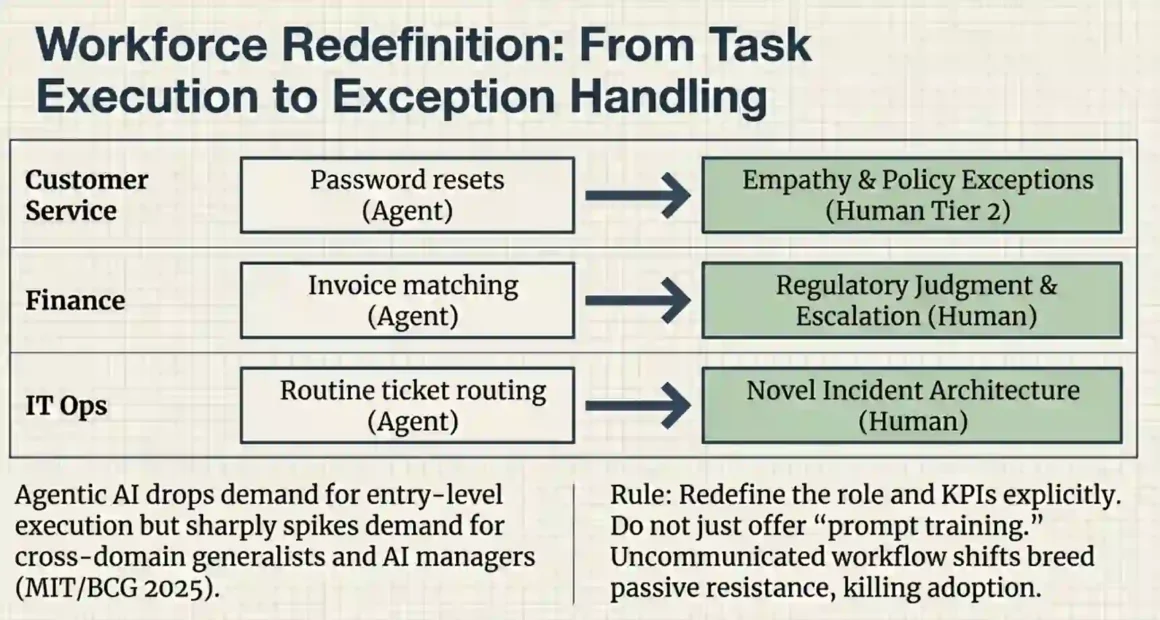
The MIT Sloan and Boston Consulting Group 2025 report on agentic enterprise found something striking: agentic AI adoption is reshaping workforce composition in ways that organizations are not managing well.
When agents handle routine tasks at scale, demand drops for entry-level roles that consisted mostly of executing those tasks. At the same time, demand rises sharply for generalists people who can work across multiple domains, interpret agent outputs, manage agent behavior, and make judgment calls in edge cases that agents cannot handle.
Most organizations are responding to this by either ignoring the workforce shift (hoping employees figure it out) or announcing generic “AI training programs” that teach people how to write prompts but not how to actually work alongside autonomous systems.
Neither approach works.
What actually works is role redefinition. Concretely, that means:
For customer service teams: The agent handles Tier 1 inquiries password resets, order status, basic troubleshooting. Humans handle Tier 2 emotional situations, policy exceptions, complaints requiring empathy. The human role does not disappear; it upgrades. But you need to explicitly define what Tier 2 means, train people on it, and measure their performance against those new criteria not the old ones.
For finance teams: The agent handles invoice matching, anomaly flagging, and report generation. Humans handle interpretation, escalation, and decisions involving regulatory judgment. Again, the role shifts but it needs to be defined explicitly, not assumed.
For IT operations: The agent handles incident detection, ticket routing, and standard remediation scripts. Humans handle novel incidents, vendor escalations, and architecture decisions. The 2025 Autonomous IT Report found that IT operations is actually one of the most mature areas for agentic AI adoption because the workflows are already heavily documented and the data is structured.
What NOT to do: Do not announce an agentic AI deployment without a parallel workforce communication plan. Employees who find out through the rumor mill or who discover their workflow has changed without explanation will resist, actively or passively. That resistance is one of the top reasons pilots fail to reach production.
How Governance Works in Practice: The KPMG TACO Framework
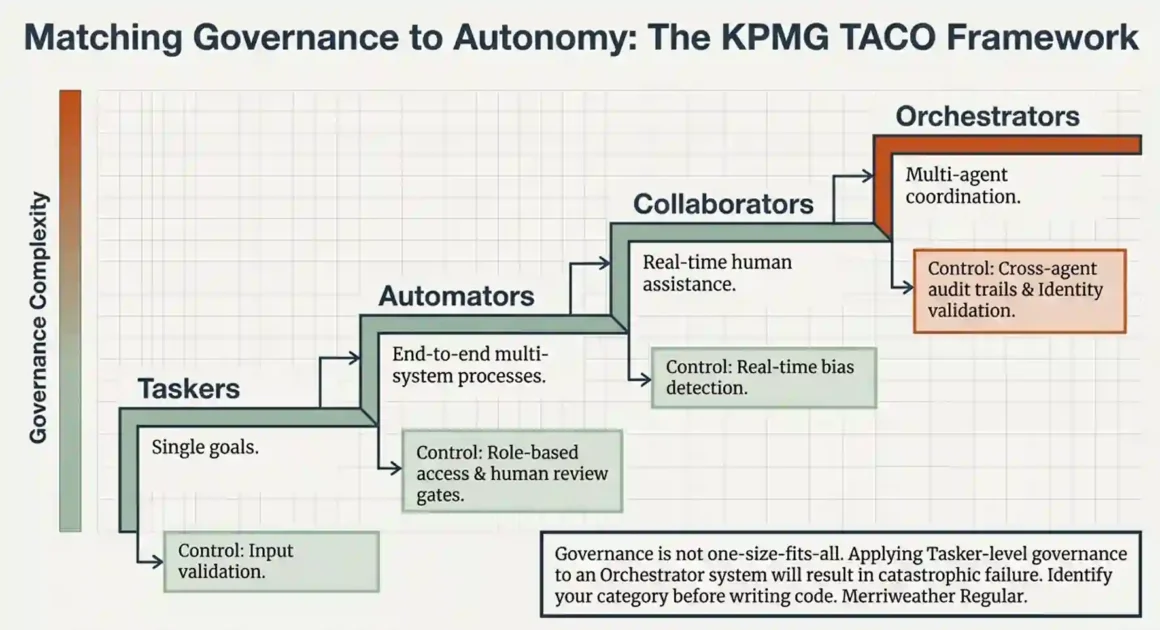
Governance sounds like a compliance box to check. It is not. Governance is what makes the difference between an agent that runs safely in production and one that causes a security incident or a regulatory fine.
KPMG’s published TACO Framework classifies agentic AI into four types based on their scope and autonomy level. Understanding which type you are deploying determines what governance structure you need.
Taskers are the simplest. A Tasker agent does one thing breaks a single goal into structured, repeatable sub-tasks. Example: an agent that takes a customer name, queries the CRM, retrieves their order history, and formats it into a standard report. Governance for Taskers is relatively light: input validation, output auditing, data access controls.
Automators handle end-to-end business processes that span multiple enterprise systems. Example: an agent that receives a new employee onboarding request, creates accounts in HR systems, grants system access, triggers the equipment request, and sends welcome communications. Governance for Automators requires strict role-based access control, action logging for every system touched, and human review gates at key decision points.
Collaborators are agents that work alongside humans in real time for example, a sales agent that listens to a customer call and surfaces suggested responses or pricing options to the human sales rep. Governance here focuses on real-time bias detection and ensuring the agent is assisting rather than overriding human judgment.
Orchestrators sit at the top. These are multi-agent systems where a master agent manages other agents to complete complex enterprise-wide tasks. Think of a supply chain optimization system where one agent monitors inventory, another negotiates with suppliers, and another adjusts logistics routing all coordinating in real time. Governance for orchestrators is the most complex: you need agent identity validation (how do you know one agent is not impersonating another?), cross-agent audit trails, and human escalation points that trigger automatically when agent coordination breaks down.
The practical step: identify which TACO category your planned deployment falls into, then match your governance controls to that category before you build. Do not apply Tasker-level governance to an Orchestrator system. It will not hold.
Master agentic AI testing guide reduce false positives costs. 98% false positive elimination, 50% cost savings. Agent Zero CI/CD pipelines ensure bulletproof deployments!
The ISO/IEC 42001 Standard: What It Is and Why It Matters Now
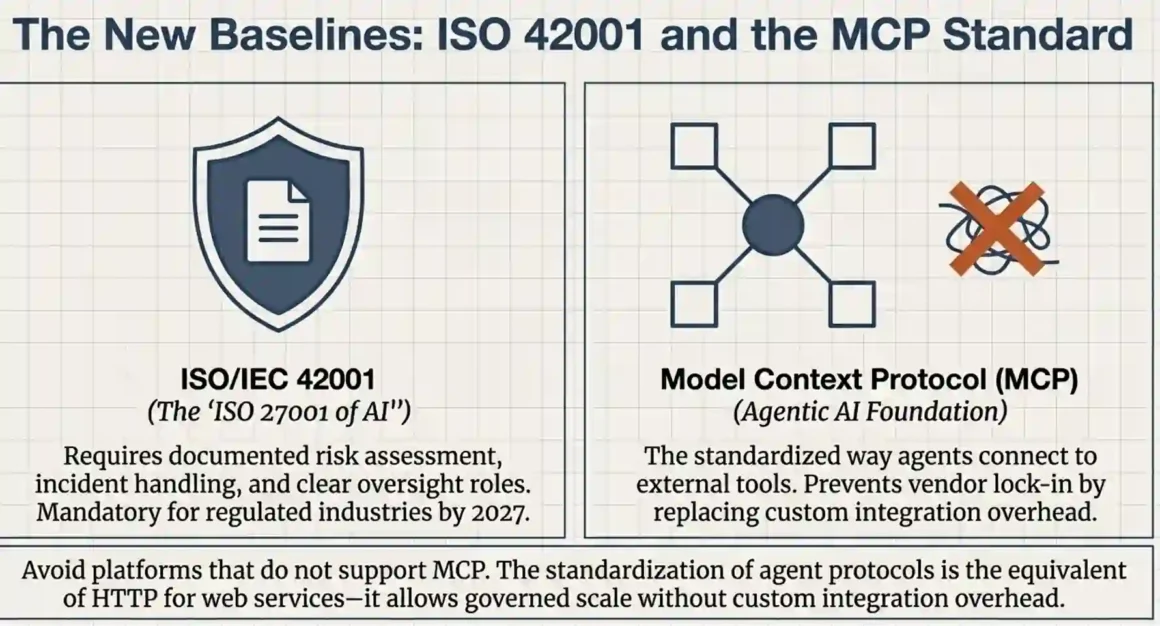
Most enterprise leaders have not heard of ISO/IEC 42001. By 2027, most will have to implement it.
ISO/IEC 42001 is an international standard specifically for AI management systems. It was published in 2023 and sets out requirements for organizations that develop, deploy, or use AI systems. Think of it as the ISO 27001 of AI a structured framework for demonstrating that your AI systems are managed responsibly.
What it requires, in plain terms:
- A documented AI policy that defines the organization’s approach to AI risk, ethics, and governance
- A process for identifying and assessing AI-specific risks before deployment (not just generic cybersecurity risks)
- Clear roles and responsibilities for AI oversight
- A system for monitoring AI performance and detecting problems in production
- A process for handling AI incidents what to do when an agent behaves unexpectedly
Enterprises in regulated industries finance, healthcare, insurance, public sector will increasingly face customer and regulator demands for ISO/IEC 42001 certification. Getting ahead of it now, rather than scrambling to comply later, is both cheaper and strategically smarter.
The easiest starting point: use the ISO/IEC 42001 risk assessment template as your pre-deployment checklist for every agentic AI system you build. It forces the right questions before the agent goes live.
The MCP Protocol: Why Agent Interoperability Just Became a Real Standard
In early 2026, Anthropic transferred ownership of MCP the Model Context Protocol, to the newly formed Agentic AI Foundation (AAIF), a body operating under the Linux Foundation with members including OpenAI, Google, AWS, Microsoft, Cloudflare, and Bloomberg.
This is significant and worth understanding.
MCP is a protocol a standardized way for AI agents to communicate with external tools and data sources. Before MCP, every agent-to-tool connection was a custom integration. One agent might connect to Salesforce one way, another agent connected to it differently, and they could not share that connection cleanly.
MCP creates a standard interface. If a tool supports MCP, any compliant agent can connect to it without custom integration work. This massively reduces the technical overhead of building multi-tool agentic systems.
What this means practically: when evaluating agentic AI platforms, check whether they support MCP. Platforms that do — like those built on Anthropic’s Claude models or that integrate with the growing MCP ecosystem — will be easier to extend as your use cases grow. Platforms with proprietary-only integrations create long-term lock-in.
This is not hype. The standardization of agent communication protocols is the same kind of shift that HTTP created for web services. Organizations that build on standard protocols scale faster and switch vendors more easily.
Discover affordable AI agent frameworks transparent pricing startups. Agent Zero $0 core + infra vs enterprise bloat. Startup production scaling without budget limits!
What a Realistic 12-Month Agentic AI Roadmap Looks Like
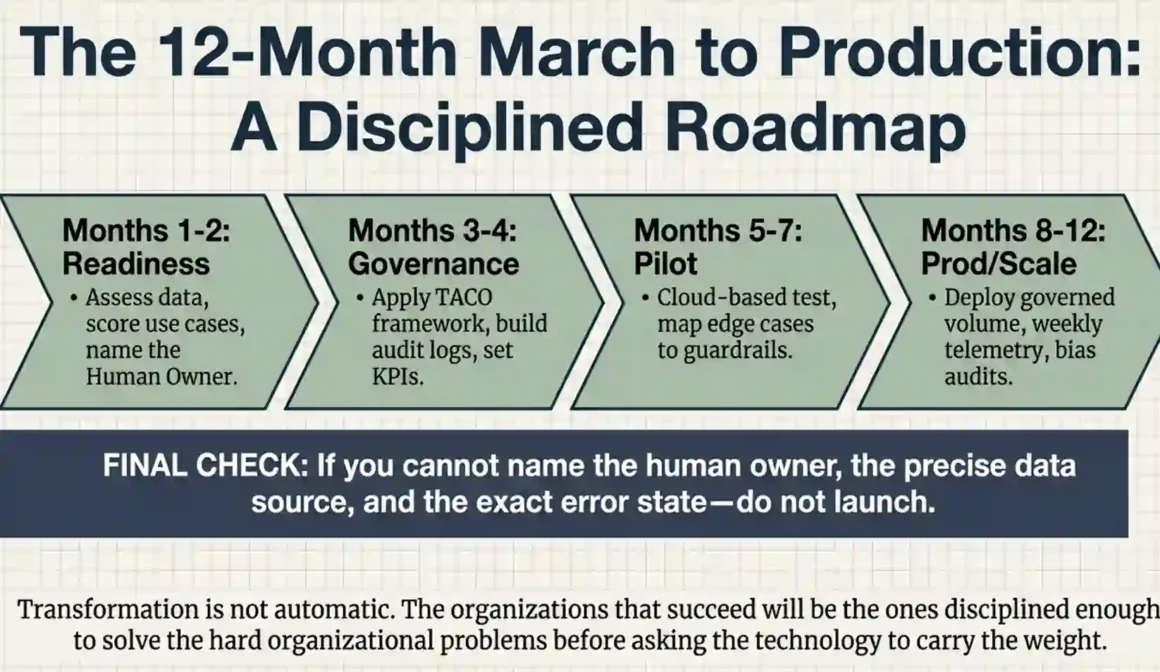
Month 1-2: Readiness Assessment
- Complete the four-question use case scoring exercise across five candidate processes
- Run a data-readiness audit on the top-scoring use case
- Map infrastructure capacity against the compute requirements of a single-agent deployment
- Identify the human owner for the planned agent
Month 3-4: Governance Foundation
- Define the governance framework using KPMG TACO classification and ISO/IEC 42001 as the reference standard
- Build the audit log architecture before writing a single line of agent code
- Define success metrics, error thresholds, and escalation triggers
- Communicate the deployment plan to affected teams explain what the agent will do and what it will not do
Month 5-7: Pilot Build and Test
- Choose between a pre-built platform and a custom build using the criteria above
- Build the pilot against the predefined success metrics
- Run the pilot on a limited dataset with full human monitoring
- Document every edge case the agent encounters; these become your production guardrails
Month 8-10: Controlled Production Deployment
- Expand to full production volume with human oversight still active
- Monitor the defined metrics weekly, not monthly
- Run bias audits on agent decisions especially if the agent is making decisions that affect customers or employees
- Adjust guardrails based on real production behavior, not pilot behavior
Month 11-12: Review and Scale Decision
- Assess whether the deployment met its defined success metrics
- Decide whether to scale, adjust scope, or revisit the use case
- Use the lessons from this deployment to accelerate the next one
The Real Cost of Getting This Wrong
Gartner’s prediction of 40%+ project cancellations is not just a warning about wasted money. It is a warning about organizational credibility.
When an agentic AI project fails publicly either because it produced wrong decisions, caused a compliance issue, or simply never reached production it makes the next project harder. Stakeholders who already have concerns about AI autonomy use the failure as evidence. IT teams who pushed back on the timeline say “we told you so.” And executives who approved the budget grow skeptical of the next request.
This is the compounding cost of poorly managed adoption. And it is preventable.
The organizations that are succeeding right now share a specific pattern. They started with one well-defined use case. They built governance before building the agent. They defined success in measurable terms before deploying. They kept humans in the loop at every meaningful decision point. And they expanded from there methodically, not reactively.
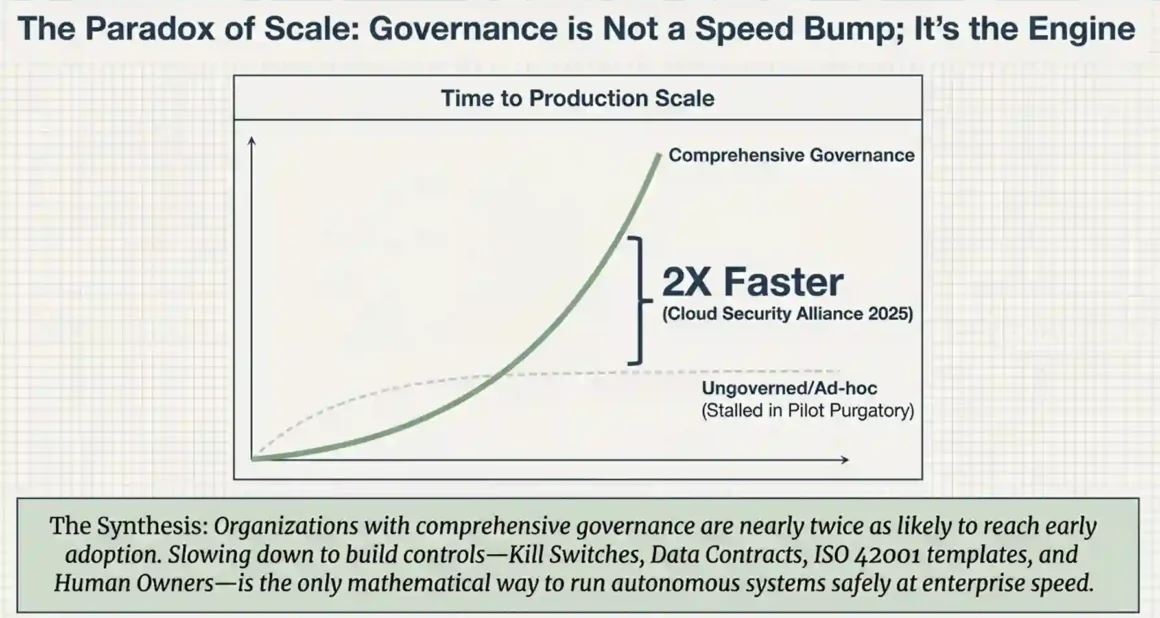
According to the 2025 Cloud Security Alliance data, organizations with comprehensive AI governance policies are nearly twice as likely to reach early agentic AI adoption compared to those with partial guidelines. Governance is not a constraint on adoption speed. It is an accelerator.
Explore best AI agent frameworks 2026. Agent Zero speed/memory leader vs CrewAI/AutoGen. Complete production matrix reveals true winners!
The Questions Worth Asking Before You Start
Before your organization commits to an agentic AI deployment, these questions deserve honest answers — not optimistic ones.
Can we explain, in one sentence, what specific problem this agent solves?
If the answer is vague — “improve efficiency” or “leverage AI capabilities” the project is not ready.
Do we know exactly what data the agent needs, where it lives, how current it is, and who owns it?
If not, data work comes first.
Have we defined what “wrong” looks like for this agent, and what happens when it occurs?
If there is no error definition and no escalation plan, the governance is not ready.
Is there a human who is willing to put their name on this agent’s performance?
If every team is willing to sponsor it but nobody wants to own it, that is a signal worth taking seriously.
Have we told the people whose work will change exactly what is changing and why?
If the answer is “we will communicate closer to launch,” the change management is not ready.
These questions are not blockers. They are the map. Answering them early is what separates the 40% whose projects get canceled from the organizations that actually deploy, scale, and get the returns they projected.
Discover AI agents vs agentic AI. Reactive tools vs autonomous decision-makers. Agent Zero powers true agentic workflows—future of AI unlocked!
Final Thought
Agentic AI is genuinely transformative. The PwC estimate that these systems could contribute between $2.6 and $4.4 trillion annually to global GDP by 2030 is not fantasy it reflects what happens when autonomous systems handle genuinely complex, multi-step work at machine speed across entire industries.
But transformation is not automatic.
The complexity of agentic AI adoption is real, and it is mostly organizational not technical. The technology works. The data pipelines, the governance structures, the workforce redefinition, the change management those are the hard parts. And those are the parts that most articles, most vendor demos, and most conference keynotes skip past.
The organizations that navigate this well will not be the ones that moved fastest. They will be the ones that moved most deliberately clear about what they were building, honest about what they were not ready for, and disciplined enough to solve the hard organizational problems before asking the technology to carry the weight.
That is what navigating this complexity actually looks like.


