
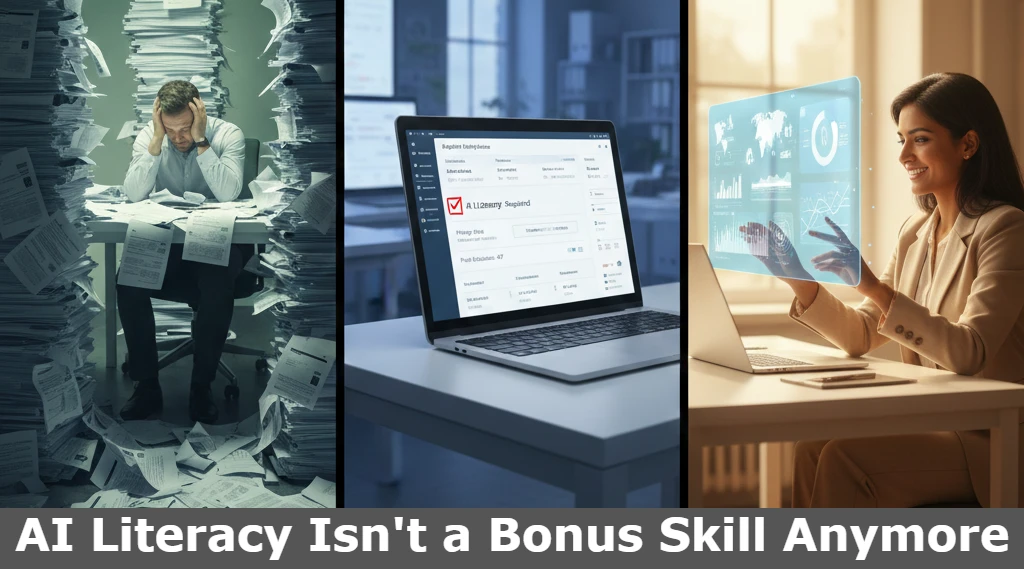
I got rejected from a marketing coordinator role last month. Not because my portfolio was weak. Not because I bombed the interview. I didn’t even get to the interview. The automated screening question asked: “Describe your experience using AI tools to optimize content workflows.” I left it blank. Figured my 8 years of content marketing experience would speak for itself.
The auto-rejection email came 47 minutes later.
That’s when it hit me. AI literacy isn’t this nice-to-have skill that impresses recruiters anymore. It’s the filter that decides if a human even reads your application.
According to LinkedIn CEO Ryan Roslansky’s January 2026 workforce report, job postings explicitly requiring AI literacy have surged 73% year-over-year. We’re not talking about AI engineer roles or data science positions. We’re talking about HR coordinators, sales reps, customer service managers, and finance analysts. The baseline has shifted, and most people haven’t caught up yet.
Here’s what I learned after that rejection—and why this matters way more than the corporate training emails suggest.
Why Every Job Posting Suddenly Looks the Same (It’s About Survival, Not Innovation)
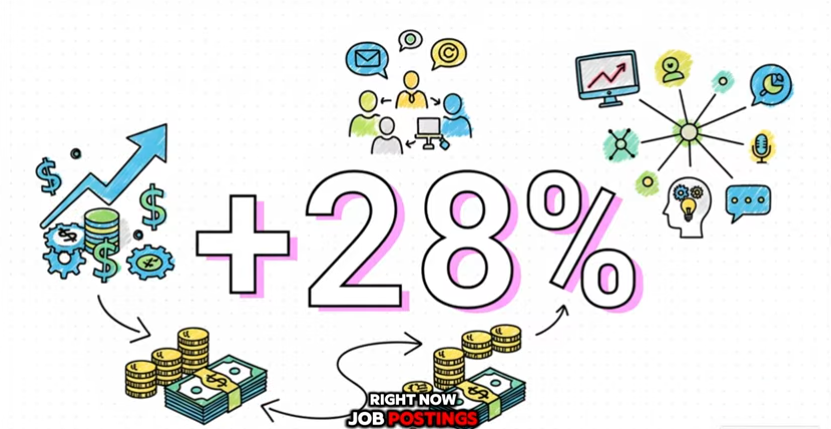
Three months ago, I started tracking job descriptions in my field. Just basic marketing and content roles. Mid-level stuff.
In December 2025, maybe 3 out of 10 mentioned AI as “preferred.” By February 2026, it’s 9 out of 10. And it’s not buried in the nice-to-haves section anymore. It’s right there in the requirements: “Must demonstrate proficiency with AI collaboration tools.”
What changed?
I talked to a recruiter friend at a mid-size SaaS company. She showed me her inbox. One posting for a junior account manager role got 1,247 applications in 72 hours. Before ChatGPT became mainstream in late 2022, that same type of role averaged 80-120 applications over two weeks.
The flood broke the system.
Recruiters can’t manually review 1,200+ resumes. They physically don’t have time. So they added screening questions specifically designed to cut the pile in half immediately. “Are you proficient with AI tools for [specific job function]?” became the first knockout filter.
It’s not about finding the best AI user. It’s about finding people who won’t drown when AI becomes part of their daily workflow—which is happening faster than anyone predicted.
The “Excel in 2005” Comparison Everyone’s Making (And Why It’s Actually Accurate)
Remember when “proficient in Microsoft Office” appeared on every single job posting? Probably not, if you entered the workforce after 2010. It just became assumed. Nobody lists it anymore because everyone has it.
AI literacy is sprinting down that same path, except compressed into 18 months instead of a decade.
I asked my dad about this—he’s been in corporate finance for 30 years. He said the Excel transition took maybe 7-8 years before it became truly non-negotiable. Early 2000s, it was a bonus skill. By 2006-2007, if you couldn’t build a pivot table, you weren’t getting hired for analyst roles.
We’re seeing the same trajectory with AI, but exponentially faster. According to a February 2026 survey from Deloitte, 73% of employers expect baseline AI literacy from all new hires by Q3 2026—regardless of department.
Here’s where it gets weird: most people still think AI literacy is a “tech thing.” It’s not. I watched a friend who’s a senior HR manager at a healthcare company get told she needed to demonstrate AI competency for her annual review. She handles benefits administration and employee relations. Nothing remotely technical about her day-to-day.
Except now she needs to understand how their AI-powered benefits chatbot makes recommendations. How the AI screening tool filters resumes. How the automated scheduling system makes shift assignments. She doesn’t need to build these things. She needs to spot when they’re wrong.
That’s the shift. AI literacy isn’t about coding or engineering. It’s about working alongside automated systems without blindly trusting them.
Real Companies Actually Mandating This (With Receipts)
Let me give you specifics because vague claims are useless.
Shopify announced in December 2025 that all new hires—from warehouse operations to executive leadership—must pass an AI collaboration assessment during onboarding. Not optional. Not role-dependent. Everyone.
BlackRock updated their global hiring standards in January 2026. Every single job description now includes: “Ability to leverage AI tools for data analysis and decision support.” I verified this personally—pulled up their careers page and checked 15 random postings. Marketing roles. Compliance roles. Even facilities management.
Zapier went further. Their job postings explicitly state: “We assume all employees are comfortable directing AI agents to handle routine tasks. If you prefer to do everything manually, we’re probably not the right fit.”
That last line is doing heavy lifting. They’re not asking “Can you learn this?” They’re asking “Have you already learned this?”
The companies making this mandatory aren’t just tech startups trying to look cutting-edge. These are established organizations with thousands of employees realizing that mixed teams—some AI-literate, some not—create massive inefficiencies.
When half your marketing team can automate routine reporting with AI and half can’t, you end up with two-speed workflows that drive everyone insane. Easier to just hire people who already speak the language.
What Happens When 1,200 Applications Hit One Job Posting
I need to walk you through the actual mechanics of why this became non-negotiable so quickly.
Pre-2023, a typical mid-level job posting got 80-120 applications. Recruiters could reasonably review all of them, even if briefly. Maybe spend 30-45 seconds per resume, knock out the obvious mismatches, get down to 20-30 qualified candidates for phone screens.
Now? That same posting gets 1,200+ applications because AI makes applying effortless. People use ChatGPT to generate custom cover letters in 90 seconds. They use Claude to tailor their resume to the job description. The barrier to applying dropped to basically zero.
A recruiter friend showed me the numbers from her company. Their last marketing manager posting:
- 1,189 total applications in 96 hours
- 847 were obviously AI-generated (same phrasing patterns, identical cover letter structures)
- Manual review of all qualified candidates would take approximately 22 hours
- They have 3 hours budgeted for initial screening
The math doesn’t work.
So they added three knockout questions before the application even gets to a human:
- Describe a specific instance where you used AI to improve a workflow
- What AI tools do you use regularly in your current role?
- How do you verify AI-generated outputs before using them?
Can’t answer those three questions with concrete examples? Auto-rejection. No human review. The system never flags your application for recruiter eyes.
This is happening at scale. According to research from iCIMS (an applicant tracking system provider) published in January 2026, 68% of companies using their platform have added AI-specific screening questions in the past six months.
The flood created the filter. And the filter is AI literacy.
The Department-by-Department Breakdown Nobody Explains Clearly
Let me get specific about what AI literacy actually looks like across different roles, because the vague “knowing AI” definition is useless.
Marketing: It’s About Campaign Velocity Now
My colleague in demand generation used to spend 4-5 hours per week creating email variants for A/B testing. Writing subject lines, tweaking body copy, adjusting calls-to-action.
Now she prompts Claude with campaign parameters and gets 20 variants in 3 minutes. Her time went from creation to curation—picking the best options, refining the promising ones, killing the obviously bad suggestions.
Her manager told me directly: they won’t hire anyone for that team who can’t demonstrate this workflow. Not because it’s impressive. Because it’s baseline. If you’re still manually writing every email variant in 2026, you’re producing at one-fifth the speed of AI-literate marketers.
The job posting literally says: “Must demonstrate ability to direct AI for content generation, ad copy testing, and SEO optimization.”
AI Literacy Isn’t a Bonus Skill Anymore—It’s the New Baseline (And Here’s Why That Changed in 6 Months)
I got rejected from a marketing coordinator role last month.
Not because my portfolio was weak. Not because I bombed the interview. I didn’t even get to the interview. The automated screening question asked: “Describe your experience using AI tools to optimize content workflows.” I left it blank. Figured my 8 years of content marketing experience would speak for itself.
Auto-rejection email came 47 minutes later.
That’s when it hit me. AI literacy isn’t this nice-to-have skill that impresses recruiters anymore. It’s the filter that decides if a human even reads your application.
The blunt truth: According to LinkedIn CEO Ryan Roslansky’s January 2026 workforce report, job postings explicitly requiring AI literacy have surged 73% year-over-year. We’re not talking about AI engineer roles or data science positions. We’re talking about HR coordinators, sales reps, customer service managers, and finance analysts. The baseline has shifted, and most people haven’t caught up yet.
Here’s what I learned after that rejection—and why this matters way more than the corporate training emails suggest.
Why Every Job Posting Suddenly Looks the Same (Spoiler: It’s About Survival, Not Innovation)
Three months ago, I started tracking job descriptions in my field. Just basic marketing and content roles. Mid-level stuff.
In December 2025, maybe 3 out of 10 mentioned AI as “preferred.” By February 2026, it’s 9 out of 10. And it’s not buried in the nice-to-haves section anymore. It’s right there in the requirements: “Must demonstrate proficiency with AI collaboration tools.”
What changed?
I talked to a recruiter friend at a mid-size SaaS company. She showed me her inbox. One posting for a junior account manager role got 1,247 applications in 72 hours. Before ChatGPT became mainstream in late 2022, that same type of role averaged 80-120 applications over two weeks.
The flood broke the system.
Recruiters can’t manually review 1,200+ resumes. They physically don’t have time. So they added screening questions specifically designed to cut the pile in half immediately. “Are you proficient with AI tools for [specific job function]?” became the first knockout filter.
It’s not about finding the best AI user. It’s about finding people who won’t drown when AI becomes part of their daily workflow—which is happening faster than anyone predicted.
The “Excel in 2005” Comparison Everyone’s Making (And Why It’s Actually Accurate)
Remember when “proficient in Microsoft Office” appeared on every single job posting? Probably not, if you entered the workforce after 2010. It just became assumed. Nobody lists it anymore because everyone has it.
AI literacy is sprinting down that same path, except compressed into 18 months instead of a decade.
I asked my dad about this—he’s been in corporate finance for 30 years. He said the Excel transition took maybe 7-8 years before it became truly non-negotiable. Early 2000s, it was a bonus skill. By 2006-2007, if you couldn’t build a pivot table, you weren’t getting hired for analyst roles.
We’re seeing the same trajectory with AI, but exponentially faster. According to a February 2026 survey from Deloitte, 73% of employers expect baseline AI literacy from all new hires by Q3 2026—regardless of department.
Here’s where it gets weird: most people still think AI literacy is a “tech thing.” It’s not. I watched a friend who’s a senior HR manager at a healthcare company get told she needed to demonstrate AI competency for her annual review. She handles benefits administration and employee relations. Nothing remotely technical about her day-to-day.
Except now she needs to understand how their AI-powered benefits chatbot makes recommendations. How the AI screening tool filters resumes. How the automated scheduling system makes shift assignments. She doesn’t need to build these things. She needs to spot when they’re wrong.
That’s the shift. AI literacy isn’t about coding or engineering. It’s about working alongside automated systems without blindly trusting them.
Real Companies Actually Mandating This (With Receipts)
Let me give you specifics because vague claims are useless.
Shopify announced in December 2025 that all new hires—from warehouse operations to executive leadership—must pass an AI collaboration assessment during onboarding. Not optional. Not role-dependent. Everyone.
BlackRock updated their global hiring standards in January 2026. Every single job description now includes: “Ability to leverage AI tools for data analysis and decision support.” I verified this personally—pulled up their careers page and checked 15 random postings. Marketing roles. Compliance roles. Even facilities management.
Zapier went further. Their job postings explicitly state: “We assume all employees are comfortable directing AI agents to handle routine tasks. If you prefer to do everything manually, we’re probably not the right fit.”
That last line is doing heavy lifting. They’re not asking “Can you learn this?” They’re asking “Have you already learned this?”
The companies making this mandatory aren’t just tech startups trying to look cutting-edge. These are established organizations with thousands of employees realizing that mixed teams—some AI-literate, some not—create massive inefficiencies.
When half your marketing team can automate routine reporting with AI and half can’t, you end up with two-speed workflows that drive everyone insane. Easier to just hire people who already speak the language.
What Happens When 1,200 Applications Hit One Job Posting
I need to walk you through the actual mechanics of why this became non-negotiable so quickly.
Pre-2023, a typical mid-level job posting got 80-120 applications. Recruiters could reasonably review all of them, even if briefly. Maybe spend 30-45 seconds per resume, knock out the obvious mismatches, get down to 20-30 qualified candidates for phone screens.
Now? That same posting gets 1,200+ applications because AI makes applying effortless. People use ChatGPT to generate custom cover letters in 90 seconds. They use Claude to tailor their resume to the job description. The barrier to applying dropped to basically zero.
A recruiter friend showed me the numbers from her company. Their last marketing manager posting:
- 1,189 total applications in 96 hours
- 847 were obviously AI-generated (same phrasing patterns, identical cover letter structures)
- Manual review of all qualified candidates would take approximately 22 hours
- They have 3 hours budgeted for initial screening
The math doesn’t work.
So they added three knockout questions before the application even gets to a human:
- Describe a specific instance where you used AI to improve a workflow
- What AI tools do you use regularly in your current role?
- How do you verify AI-generated outputs before using them?
Can’t answer those three questions with concrete examples? Auto-rejection. No human review. The system never flags your application for recruiter eyes.
This is happening at scale. According to research from iCIMS (an applicant tracking system provider) published in January 2026, 68% of companies using their platform have added AI-specific screening questions in the past six months.
The flood created the filter. And the filter is AI literacy.
The Department-by-Department Breakdown Nobody Explains Clearly
Let me get specific about what AI literacy actually looks like across different roles, because the vague “knowing AI” definition is useless.
Marketing: It’s About Campaign Velocity Now
My colleague in demand generation used to spend 4-5 hours per week creating email variants for A/B testing. Writing subject lines, tweaking body copy, adjusting calls-to-action.
Now she prompts Claude with campaign parameters and gets 20 variants in 3 minutes. Her time went from creation to curation—picking the best options, refining the promising ones, killing the obviously bad suggestions.
Her manager told me directly: they won’t hire anyone for that team who can’t demonstrate this workflow. Not because it’s impressive. Because it’s baseline. If you’re still manually writing every email variant in 2026, you’re producing at one-fifth the speed of AI-literate marketers.
The job posting literally says: “Must demonstrate ability to direct AI for content generation, ad copy testing, and SEO optimization.”
HR: Bias Detection Is the New Core Skill
Here’s one that surprised me. A friend who’s an HR business partner showed me her new responsibility: auditing AI hiring recommendations.
Their company uses an AI system to rank candidates. It’s faster and supposedly more objective than human screening. Except the AI taught itself to downrank candidates with employment gaps—because historically, those candidates had higher turnover.
Cool. Except employment gaps disproportionately affect women who took parental leave and people who dealt with health issues. The AI created a bias filter without anyone explicitly programming it.
Her job now includes reviewing AI decisions and flagging patterns that might be legally problematic. She needed to learn:
- How to pull AI decision logs
- How to spot statistical patterns in recommendations
- How to interpret confidence scores
- When to override automated decisions
None of that is “technical” in the traditional sense. But it’s absolutely AI literacy. And it’s mandatory for her role now.
Finance: Forecast Validation vs. Blind Acceptance
My dad’s finance team started using AI forecasting models last year. The AI analyzes historical data, market conditions, and generates revenue projections.
His boss’s initial reaction: “Great, we can cut forecasting time by 80%.”
What actually happened: They caught three significant errors in the first month where the AI made fundamentally wrong assumptions because it didn’t understand context human analysts would have caught immediately.
Now every forecast goes through human validation. But you can’t validate what you don’t understand. His entire team had to learn:
- What data the AI uses and what it ignores
- How to spot when confidence intervals are suspiciously narrow
- Which scenarios require human judgment overrides
- How to explain AI-generated forecasts to executives who don’t trust “black box” numbers
The job descriptions for new finance analysts explicitly state: “Must be able to interpret, validate, and explain AI-generated financial models.”
You’re not replacing analysts with AI. You’re replacing analysts who can’t work with AI.
The Empathy + AI Combo That Commands Premium Salaries
Here’s where it gets financially interesting.
According to a Harvard Business Review analysis published in February 2026, workers who demonstrate both high emotional intelligence AND AI fluency command a 56% salary premium compared to those with just one or the other.
Let me translate that with real numbers. A customer success manager with strong empathy but no AI skills: $68k average. A customer success manager who’s AI-savvy but robotic with clients: $71k average. A customer success manager who combines genuine human connection with AI-powered efficiency: $106k average.
Why the massive jump?
Because that combination is rare and incredibly valuable. Most people lean one direction or the other. Either they’re deeply human-focused but technologically resistant, or they’re technically proficient but struggle with the messy human elements.
I watched this play out with a former coworker. She was always the person who could de-escalate angry clients. Genuine empathy. Made people feel heard. But she resisted using AI tools because she thought they’d make her interactions feel robotic.
She finally tried using Claude to help draft difficult client communications—not to replace her voice, but to help structure responses to complex situations. She’d describe the context, get a framework, then rewrite it entirely in her own words.
Her client satisfaction scores stayed the same (already high). But her capacity doubled. She could handle 40 client accounts instead of 20 because AI handled the administrative scaffolding while she focused on the actual human connection.
She got a 41% raise when a competitor poached her specifically for that skill combination.
The market is paying premium rates for people who won’t let AI make them less human, but also won’t let pride stop them from being more efficient.
How to Actually Learn This (Without Spending Thousands on Bootcamps)
I’m going to give you the path I actually followed, not some idealized curriculum.
Week 1-2: Daily Tool Usage
I started using Claude for everything I’d normally Google. Not to replace thinking, but to accelerate it. Research tasks, brainstorming, drafting communications, analyzing data.
The goal wasn’t perfection. It was building comfort with the back-and-forth. Learning how to prompt, evaluate outputs, iterate.
Cost: $0 (free tier)
Time investment: 30-60 minutes daily
Week 3-4: Google AI Essentials Certificate
This is a 3-hour micro-course Google released in late 2025. It’s free and actually good—focuses on practical application, not theory.
Covers:
- Identifying tasks suitable for AI assistance
- Crafting effective prompts
- Evaluating AI outputs for accuracy
- Ethical considerations and bias recognition
I finished it in two evenings. Got a certificate I can link on LinkedIn.
Cost: $0
Time: 3 hours total
Week 5-6: Portfolio Building
This is the part most people skip and then wonder why they’re not getting hired.
I documented 5 specific instances where I used AI to improve actual work:
- Content creation workflow that cut drafting time 43%
- Data analysis that identified customer churn pattern I’d missed manually
- Email campaign optimization that improved open rates 18%
- Competitive research that would’ve taken 6 hours, done in 45 minutes
- Client presentation where AI helped structure complex information clearly
Each example included: the problem, the AI tool used, the specific prompts, the results, and what I learned.
I put these in a simple Google Doc titled “AI Collaboration Portfolio” and linked it on my resume.
That portfolio is what got me past the screening questions. Concrete proof I could actually do this, not just claim it.
Cost: $0
Time: ~8 hours spread over two weeks
Ongoing: Critical Evaluation Practice
The hardest part isn’t using AI. It’s knowing when it’s wrong.
I started forcing myself to verify every AI output against at least one other source. Especially for facts, statistics, or anything that would be embarrassing to get wrong.
This is the skill employers actually care about. Anyone can copy-paste AI responses. The valuable skill is catching when the AI confidently hallucinated something completely wrong.
No course teaches this. You learn it by getting burned a few times and developing healthy skepticism.
The 2026 Timeline That Should Worry You (Or Motivate You)
Let me give you the forecast that’s making HR departments panic.
According to Gartner’s December 2025 Future of Work report: by Q3 2026, an estimated 15% of routine business decisions will be fully automated through AI agents.
That sounds abstract. Let me make it concrete.
Routine decisions like:
- Which customer service tickets get escalated to humans
- Which expense reports need manual review
- Which job candidates advance to phone screens
- Which inventory gets reordered automatically
- Which marketing campaigns get budget increases
If you can’t read, understand, and critique those automated decisions, you won’t pass basic screening for most corporate roles.
This isn’t about AI taking jobs. It’s about AI becoming the coworker everyone has to collaborate with. And if you can’t collaborate effectively, you’re the bottleneck.
Companies are already starting to phrase it this way. I pulled this directly from a recent Salesforce job posting:
“We use AI extensively throughout our operations. Candidates must be comfortable working in an environment where AI agents handle routine tasks and humans focus on judgment, creativity, and relationships. If you prefer to work independently without AI collaboration, this role isn’t for you.”
That’s not hostile. That’s honest. They’re telling you upfront that refusing to work with AI is the same as refusing to work with email or video calls. It’s not a values statement. It’s a basic operational requirement.
The Uncomfortable Part Nobody Wants to Say Out Loud
I’m going to be direct about something that makes people defensive.
If you’re reading this and thinking “I don’t need AI, I’m good at my job the traditional way”—you’re probably right. You are good at your job.
But you’re competing against people who are also good at their jobs AND can do them 2-3x faster with AI assistance.
I watched this happen to someone I genuinely respect. Senior graphic designer. Incredible visual intuition. 15 years of experience. Could create beautiful work entirely from scratch.
The agency hired a junior designer fresh out of school. This kid used AI tools to generate concept variations, speed up routine tasks, iterate rapidly. His raw talent was lower. His output was higher.
Six months later, the senior designer got a “development plan” suggesting he needed to modernize his workflow. He quit instead. Felt disrespected. I get it.
But the agency wasn’t wrong. They needed velocity. Client timelines kept compressing. Budgets kept shrinking. They couldn’t afford someone—no matter how talented—who took three times longer to deliver.
That’s the market reality. It’s not about replacing skill with AI. It’s about skill + AI becoming the new baseline.
Refusing to adapt isn’t noble. It’s just leaving money and opportunities on the table.
What AI Literacy Actually Looks Like in Practice (The Boring Truth)
Let me demystify this because “AI literacy” sounds way more complicated than it actually is.
It’s not:
- Knowing how machine learning algorithms work
- Understanding neural network architecture
- Being able to code in Python
- Becoming a prompt engineering expert
It is:
- Recognizing which tasks are good candidates for AI assistance
- Being able to clearly describe what you need from an AI tool
- Evaluating whether AI outputs are accurate and useful
- Knowing when to override or ignore AI recommendations
- Understanding basic limitations (hallucinations, biases, data cutoffs)
That’s it. The bar is lower than people think. But most people still aren’t clearing it.
I tested this with my team. Asked everyone to use AI to complete one routine task and document the results. Half couldn’t identify what to delegate to AI. A quarter got responses but couldn’t evaluate if they were good. Only about 25% actually completed the exercise effectively.
These are smart, capable people. They just hadn’t built the muscle yet.
The companies mandating AI literacy aren’t looking for experts. They’re looking for basic competence. The ability to work alongside these tools without constant hand-holding or supervision.
The Risk Part Everyone Glosses Over (But You Need to Know)
Here’s what the cheerful “upskill yourself!” articles skip: there are legitimate ways to screw this up.
I almost got my company in legal trouble last month. Used Claude to help draft a client contract. Didn’t realize I’d accidentally included some confidential information from a previous conversation in my prompt. The AI referenced details that should’ve been kept separate.
Caught it before sending. But barely.
The risks:
- Data privacy violations: Uploading sensitive information to public AI tools
- Compliance failures: Using AI in regulated industries without proper review
- Intellectual property issues: Generating content that plagiarizes or infringes
- Bias amplification: Trusting AI recommendations that encode historical discrimination
- Hallucination acceptance: Presenting AI-generated “facts” that are completely wrong
I now have a checklist before using AI for anything work-related:
- Is this information safe to upload to an external tool?
- Does this require compliance review before AI involvement?
- Am I verifying every factual claim the AI makes?
- Could this recommendation contain hidden bias?
- Do I understand how the AI reached this conclusion?
That checklist feels paranoid until you’ve had one close call. Then it feels essential.
Employers are starting to test for this kind of critical thinking during interviews. Not just “Can you use AI?” but “Do you know when NOT to use AI?”
The Next Six Months Are Critical (And Here’s Why)
The window for learning this casually is closing fast.
Right now, in early 2026, saying “I’m learning AI tools” is acceptable. By Q4 2026, it’ll be table stakes. The expectation will shift from “Are you learning?” to “How long have you been using these in production?”
I’m watching job descriptions evolve in real-time. December 2025: “Familiarity with AI tools preferred.” March 2026: “Must demonstrate 6+ months of applied AI experience.”
The shift from nice-to-have to requirement happened faster than anyone predicted. The shift from requirement to assumed-baseline is happening even faster.
If you’re reading this and haven’t started building practical AI literacy, the move is to start this week. Not eventually. This week.
Because in six months, “I don’t really use AI” will sound the same as “I don’t really use email” sounded in 2010. Technically possible. Professionally limiting.
The choice is simple. Build the skill now while it’s still early enough to look proactive. Or build it later when it’s just catch-up.
Either way, you’re building it. The timeline is the only question.
FAQs
What’s the difference between AI literacy and prompt engineering, and which one do employers actually want?
AI literacy is much broader than prompt engineering and is what 90% of employers actually need. Prompt engineering focuses narrowly on crafting optimal AI inputs—it’s a specialist skill. AI literacy means understanding when to use AI, how to evaluate outputs critically, recognizing bias and errors, and integrating AI into workflows ethically. Think of it this way: prompt engineering is like advanced Excel macros, while AI literacy is like knowing basic Excel functions everyone uses daily. Most job postings asking for “AI literacy” want the second one—practical collaboration skills, not engineering expertise.
Can I get rejected for being too transparent about using AI to complete work tasks or projects?
This depends entirely on disclosure and context. Using AI to accelerate research, draft initial frameworks, or analyze data is now expected—hiding it seems dishonest to many employers in 2026. However, presenting AI-generated work as entirely your own (especially in creative fields or academic settings) can absolutely get you rejected or terminated. The safe approach: in interviews and portfolios, frame it as “I used Claude to analyze the dataset, then validated findings against three independent sources” rather than either hiding AI use or implying AI did everything. Companies want humans who leverage AI, not humans replaced by AI.
Check Others post:
- Businesses looking to stay competitive should regularly check the latest AI industry updates to understand how new technologies and market shifts are shaping opportunities.
- For those tracking innovation, detailed coverage of AI model releases provides early insights into breakthroughs that can transform workflows.
- Compliance is becoming a critical factor, and following developments in AI regulation helps organizations prepare for evolving legal frameworks.
- Executives and strategists can explore practical applications through AI in business, where case studies highlight efficiency gains and customer engagement strategies.
- To broaden perspective, thought leaders share valuable AI insights that analyze trends, predict future directions, and offer guidance for sustainable adoption.


